
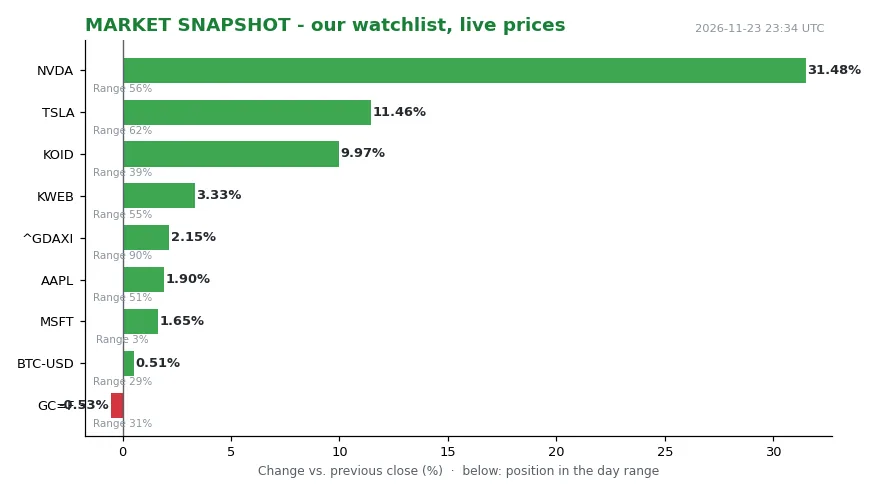
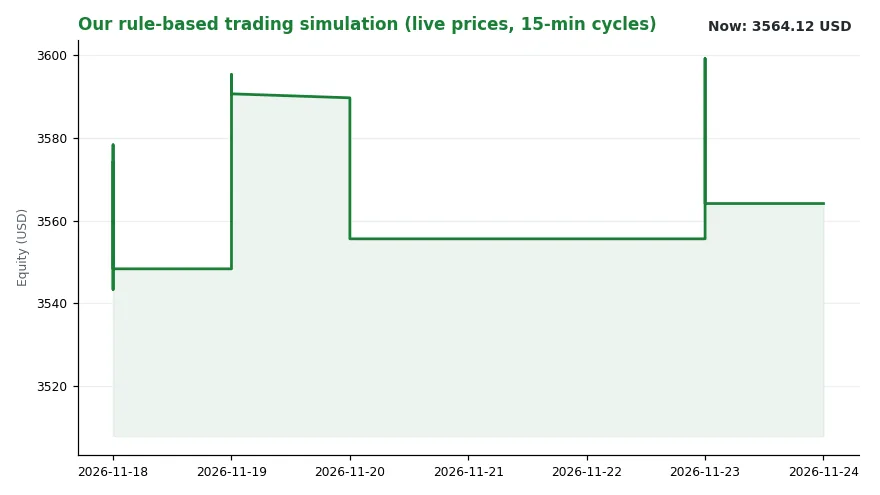
Our screens at 23:30 UTC on 23 November 2026 drew an unusually one-sided landscape. NVDA printed 165.05, up 31.48% against the previous close and sitting at 56% of its daily range; TSLA traded at 385.46, up 11.46% and mid-range at 62%; Germany’s ^GDAXI stood at 25,337.27, up 2.15% and close to its highs at 90% of range. The defensive corner of the board looked abandoned by comparison: gold futures (GC=F) at 3,629.30, down 0.61% and near the day’s lows at 8% of range, while MSFT managed only 1.65% and finished near its low at 3% of range. BTC-USD was almost inert at 61,490.76 (+0.54%, 29% of range) and KWEB gained 3.33% to 21.41, mid-range at 55%. That is a rotation pattern — money leaning into higher-beta growth (shares that swing more than the wider market, up and down), drifting away from the hedge (the defensive position, here gold, held against a fall in riskier assets). Our rule-based simulation book sat at 3,564.12 USD, unchanged versus the same time yesterday, with 1,800.97 in cash; the latest logged decision was WATCH KWEB. One thing our watchlist cannot show: Poundland has no ticker. The company at the centre of the news is not priced on any exchange we track, which is precisely why its fate is being decided in a creditor’s ledger rather than in a closing auction.
Six hundred shops across the UK and Ireland, 11,000 employees, and the Dealz brand on the Irish side of the estate — that is the physical footprint behind a story that has spent the autumn in Westminster committee rooms. The BBC reported on 23 November that Poundland faces a possible collapse into administration (the UK insolvency procedure in which a court-appointed practitioner takes over a company to try to rescue it or sell its parts) after its owner, the US investment firm Gordon Brothers, put the business up for sale in September and then rejected offers to keep it afloat. [1] The jobs of 11,000 employees sit directly in the frame, and the BBC notes that thousands more at supplier firms are exposed indirectly. That supply chain exposure is the part that rarely appears in headline counts: a value retailer’s stock is somebody else’s invoice.
The trading record argues the opposite of collapse
Here is the fact that complicates the obvious headline. Shoppers have not walked away. Over the year to September the business moved from a £68m loss to an £18.1m profit before interest, tax and certain accounting charges. In the first quarter, entering the Christmas trading period, like-for-like sales (revenue from stores open in both periods, so new or closed shops do not distort the comparison) were up 7% and operational profit of £1.9m was £1.2m better than a year earlier. Halloween sales came in 11.4% higher than last year — a figure retail analyst Catherine Shuttleworth of Savvy Marketing treats as a useful indicator of Christmas performance. Those are the two locked numbers worth carrying forward: 7% like-for-like growth, and 11.4% at Halloween.
The insolvency specialists read the same data the same way. Julie Palmer, managing partner at Begbies Traynor, puts the diagnosis bluntly: “This isn’t a story about shoppers abandoning Poundland. The tills are busier than they were a year ago.” She adds: “On the face of it, a turnaround seems well under way.” On that reading, the tills are doing their job.
So where is the constraint?
The answer sits in a different column of the accounts. Gordon Brothers has been restricting Poundland’s access to the cash needed to restock stores and cover day-to-day expenses. Roughly £50m was frozen, which raised the prospect of shelves emptying, before Gordon Brothers released around £21m over a two-week window — giving the chain a little more room to breathe. That is the mechanism in one sentence: this is a liquidity and ownership problem, not a demand problem. Palmer’s framing of it as “a funding and ownership problem rather than a trading collapse” is the cleanest summary available.
There is a structural reason the funding question is so charged. Gordon Brothers is not only the owner; it is also one of the lenders. It is owed a £22.5m shareholder loan (money the owner lent the company, which ranks as a claim in an insolvency) that it inherited when it bought the business for £1 from Pepco. The BBC reports that it has also made about £18m from a combination of debt interest payments and other fees and charges. As principal creditor (the lender owed the most, and therefore paid first out of the remains), it would stand first in line for repayment in an insolvency — suppliers would not. Palmer describes the resulting tension: “When the owner is also the main lender, its first priority is recovering [loans]. Sometimes the route that best protects the lender is different from the one that saves the most jobs, and that tension is why this has become such a political story.” That sentence explains why a shop closure has become a political event.
The tills, the ledger and the politics of a break-up
The first school holds that the trading numbers are a mirage and the chain was always heading for collapse. The evidence does not support it: the turnaround numbers, the Halloween uplift, the busier tills.
The second says the recovery is real but the capital structure is choking it. Management is on this side of the argument. Poundland boss Barry Williams describes a “strong recovery”, while Gordon Brothers has painted a different picture, calling the chain “challenged and vulnerable to any potential downturn in future trading”. [1] The firm says it has provided significant funding since acquisition to keep the company trading.
The third school, and the one Gordon Brothers is effectively arguing, holds that a break-up protects workers better. The US company has been weighing options to dismantle the retailer; its stated view is that a break-up offers more long-term security for employees, because any buyer of a store estate would also have to agree to keep the staff on. Critics quoted as insiders in the BBC’s reporting reject that logic and accuse the owner of driving the business into the ground to profit from the insolvency process — a claim Gordon Brothers denies.
Which reading wins on the evidence? Trading performance, which is measurable and positive, is not the binding constraint. Cash access, which is discretionary and contested, is. The bid table matters here. Irish firm Martin Property Group has offered to buy the business as a going concern (a sale of the whole business as a running operation rather than a break-up); London-based holding company Xyra Group has also made a rescue bid, though doubts remain about the credibility of that offer; and German investment firm Zachert Private Equity is understood to have submitted a late offer. Gordon Brothers rejected at least one offer that would have preserved jobs, which is what drew political pressure from Prime Minister Andy Burnham and Business Secretary Jonathan Reynolds, and questions from a committee of MPs last week. As a US firm, Shuttleworth suggests, Gordon Brothers appears unmoved by those arguments.
What to watch next, honestly
Two paths remain, in Palmer’s account: a solvent deal in which the company is bought and keeps trading, or a collapse followed by a break-up. The near-term constraint is seasonal, and Palmer states it without decoration: “The immediate make-or-break issue is Christmas: a value retailer that can’t get stock on its shelves in November and December is in serious trouble, whatever its full-year results say.
A deadline has already been extended by 10 days to allow a rescue deal to be found, so the clock is short and the outcome genuinely uncertain.
The mechanism is plain: a value retailer lives on Christmas-quarter cash flow, and a stock-out in November and December hits the one period that funds the rest of the year.
Quoted verbatim from the source
[1] Julie Palmer, Begbies Traynor: “This isn’t a story about shoppers abandoning Poundland. The tills are busier than they were a year ago.” Julie Palmer: “On the face of it, a turnaround seems well under way.” Julie Palmer: “a funding and ownership problem rather than a trading collapse”
Julie Palmer: “When the owner is also the main lender, its first priority is recovering [loans]."… “Sometimes the route that best protects the lender is different from the one that saves the most jobs, and that tension is why this has become such a political story.” Julie Palmer: “The immediate make-or-break issue is Christmas: a value retailer that can’t get stock on its shelves in November and December is in serious trouble, whatever its full-year results say.” Figures on stores, employees, sales, profits, frozen and released funds, loans and bidders are as reported by BBC News, 23 November 2026. Market data is our own reading at 23:30 UTC, 23 November 2026. This is educational analysis, not investment advice.