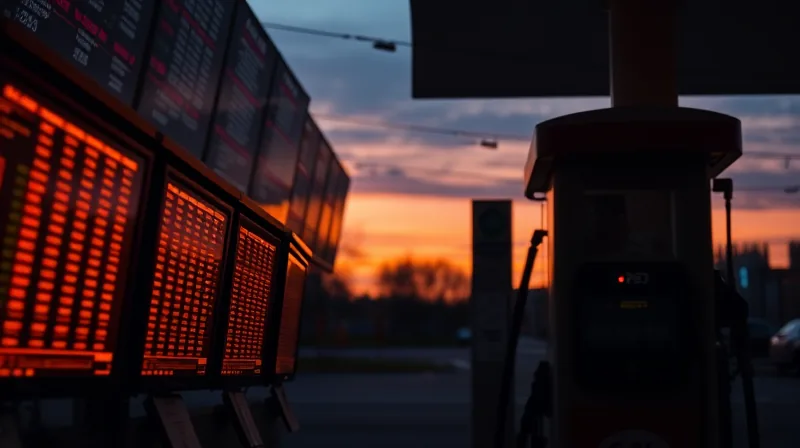
Kalshi odds show gasoline above four sixty in 2026
Slack water
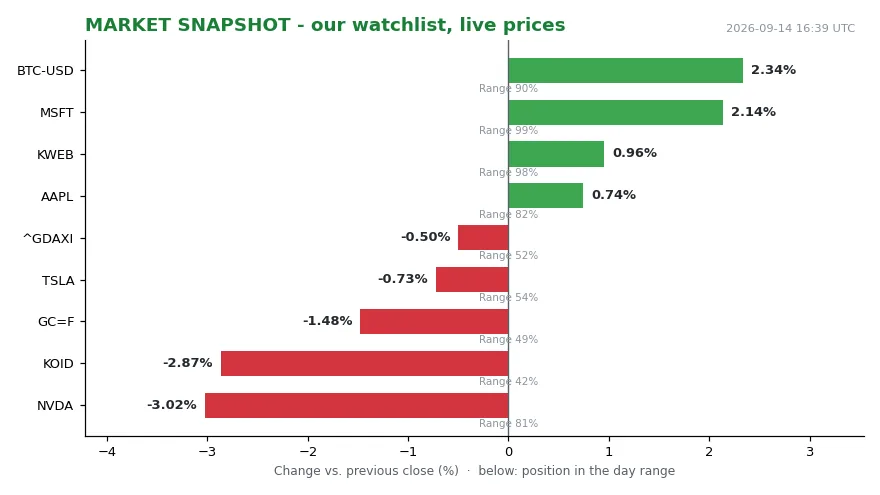
At 16:34 UTC, the tape reads 24.82 for KWEB — up 0.91%, pinned at 98% of the day’s range, the highest corner of the day. MSFT sits at 505.26, up 1.94%, at 94% of its range. BTC-USD trades at 78,655.00, up 2.41%, at 93% of its range. Three assets, three very different stories, one identical position: near the top of the day.
Now the other side of the ledger. NVDA prints 211.71, down 3.01% against the previous close, yet still near the day’s highs at 82% of its range — a gap down that was bought back. GC=F, the gold future, stands at 4340.80, down 1.54%, mid-range at 46%. ^GDAXI is 0.50% lower at 25,440.81, also mid-range at 52%, and TSLA at 363.10 is down 0.64%. The regime classifier attached to the data reads a falling trend at a level of 3.63.
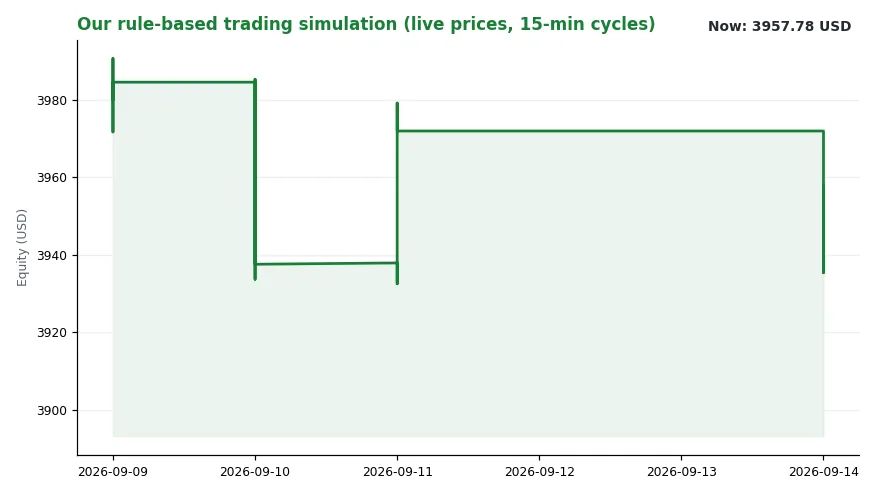
The simulated equity book — rule-based, documented in the open — stood at 3957.93 USD, down 0.35% from the same time the previous day, with 2010.97 USD in cash. The last recorded decision was a buy of GC=F at 4312.30 at 16:04:40 UTC, triggered by the day-rhythm rule: the 16:00 hour, price at 19% of the daily range, a purchase near the day’s low, capped at 25% of equity in a single position. That gold entry now sits slightly above its fill, while the book is still marginally down on the day — an honest reminder that a correct local entry is not the same thing as a correct direction. The sign layer, which tracks which channel carries the most activity, named the “other” channel as the busiest on 13 September, with 8 events. Attention is diffuse. Nothing in the numbers is shouting about crude oil.
The flood tide
On Kalshi, contracts ask traders whether the national average gasoline price will cross various price points, and they are resolved using AAA’s data. Against that settlement rule, the week’s headline numbers arrived. U.S. oil prices are again above $100 per barrel, and gasoline prices have climbed to multi-month highs.
Gas prices peaked at $4.56 per gallon on 21 May on AAA’s national average. Traders on Kalshi now assign a 71% probability that the average will surpass $4.60 this year. The same crowd puts 57% odds on a print above $4.80 a gallon, and just over a 40% chance that the average crosses $5.00. The record stands at just over $5 per gallon, set in June 2022
That escalation puts the Strait of Hormuz, the critical passageway for the global supply of oil, back in focus. On Monday, West Texas Intermediate crude futures rose 3.5% to more than $103 per barrel. And the market is not pricing a spike alone — Kalshi traders put 50-50 odds that gasoline will be above $4.25 per gallon on election day, 3 November. The flood tide, in other words, is being handed a long calendar rather than a short one.
The channel
Tides do not move boats directly. Channels do. The channel here is the settlement rule: Kalshi resolves its gasoline contracts against AAA’s national average, so the price that matters is not the futures screen but the pump average that AAA publishes each day. That is why the contract calendar stretches past election day — the mechanism is a published number, not a spot trade.
Where the water moves
Politically, the number that matters most may not be the annual peak. The 50-50 reading for $4.25 on 3 November turns a fuel statistic into an election-date variable.
The broader tape cannot resolve the question either. At 16:34 UTC, software, crypto and Chinese internet equities were bid near their highs while gold and European equities sat mid-range — a rotation, but not a verdict on crude. The simulated book is 0.35% below where it stood the previous day at this hour, with the gold fill slightly in profit and cash at 2010.97: small figures describing a rule being followed, not a forecast being confirmed.
The sign layer offers the least glamorous finding of all. On 13 September, the busiest channel was “other,” with 8 events. That diffuse attention is the honest backdrop to a market which has decided, at 71% and 57%, that the water is still coming in. The limitation is the interesting part: the gauge is settled by AAA, priced by strangers, and consulted by everyone at the same moment. That is not a hole in the reporting. It is what this particular market is.
Sources
1. Kalshi
2. AAA