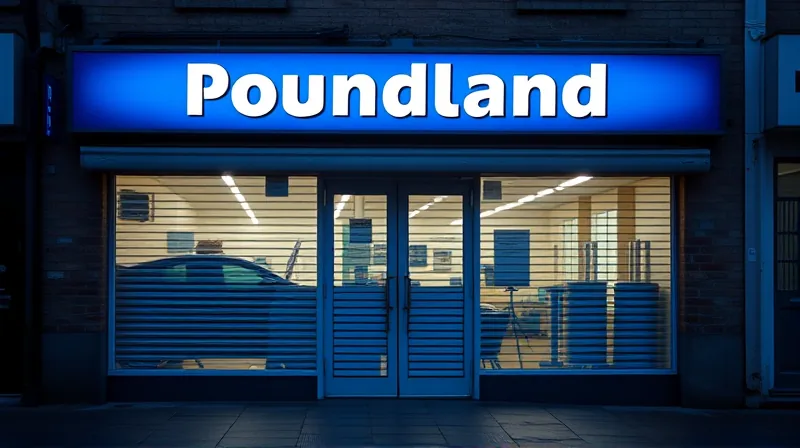
Poundland’s One-Way Door: The Lights Stay On, the Refund Desk Shuts
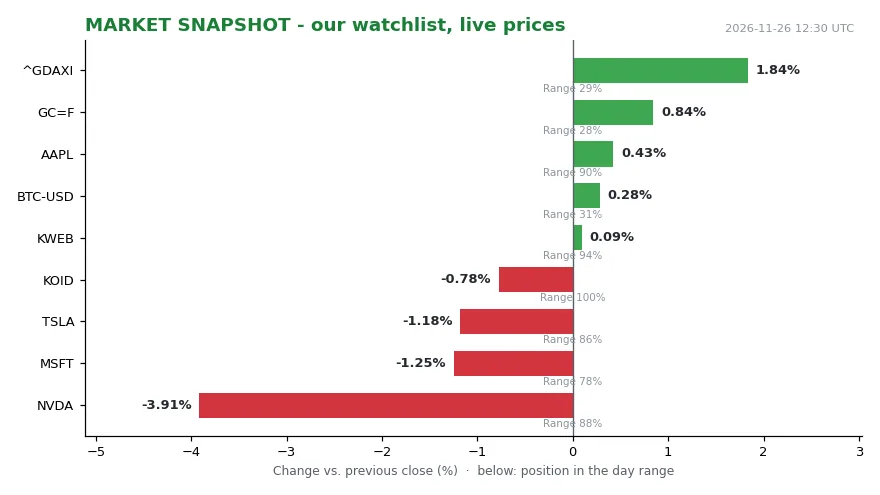
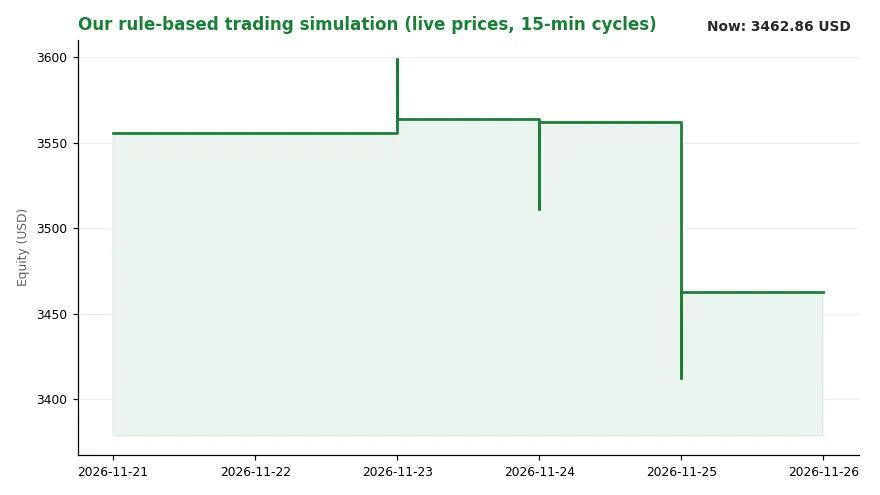
Our own tape at 12:26 UTC on 26 November opens split. NVDA prints 149.30, down 3.91% on the previous close, and still sits at 88% of its daily range [M]. AAPL trades 355.58, up 0.43%, at 90% of range [M]. MSFT is at 489.93, minus 1.25%, at 78% [M]. KOID shows 30.62, down 0.78%, pinned at exactly 100% of its range [M]. KWEB reads 21.17, plus 0.09%, at 94% [M]. Every one of those names sits nearer its high than its low. That is intraday rotation, not an exit from risk. The rest of the board is calmer: DAX 25,157.20, up 1.84%, mid-range at 30%; gold 3,595.00, up 0.85%, mid-range at 29%; bitcoin 60,564.62, up 0.31%, mid-range at 33% [M]. Our rule-based sim holds 3,462.86 USD entirely in cash, 0.00% versus the same time yesterday [M]. The last logged decision is WATCH KWEB [M]. The busiest signal channel today is “central banks”; the regime reading is trend falling, level 3.63 [M]. So: selective appetite, defensive tilt, no conviction trade. The fear that follows from that tape is a consumer in retreat — and the tape does not say that. It says participants want exposure without commitment.
What actually happened
The news itself is blunt. Poundland entered administration on Wednesday, announced by its American owner Gordon Brothers [1]. Around 11,000 jobs and roughly 600 stores are at risk [1]. The collapse follows a sales process that, in the words of the announcement, “did not identify a viable solvent solution for the business as a whole” [2]”. AlixPartners was appointed, with Clare Kennedy, Daniel Imison and Kevin Wall named joint administrators for Poundland Limited and Poundland Elgin Limited [2]. The applications followed a prolonged moratorium and a public sales process [2]. Trading continues: distribution centres and retail outlets keep functioning, and most shops are expected to stay open until further notice [2]. One detail carries the whole story. The returns policy changed on 26 November 2026, and customers can no longer receive in-store refunds or exchanges for unwanted purchases [2]. Claims for refunds on purchases made before that date will be treated as unsecured claims in the administration [2]. Here is the structure in a line: the lights stay on, the refund desk closes.
Gordon Brothers took control in June last year, providing £85 million (€97 million) in financing to help turn the business around, while shutting shops and axing staff [1]. The same owner statement records £100 million of cost savings achieved over twelve months, and more than 100 outlets shut during the overhaul [1]. Previous owner Pepco Group had said the already-struggling business faced added pressure from a business-tax rise in the UK [1]. It sold to Gordon Brothers for £1, with a portfolio of more than 800 stores [1]. Two numbers now sit side by side: more than 800 stores at the point of sale, around 600 trading today [1]. That gap is the visible record of a year of shrinkage.
The mechanism: costs, demand, and the legal pause
The cost channel first. Gordon Brothers’ statement names the mechanism plainly: “the business is still vulnerable to inflationary pressures or any downturn in sales and margin” [1]. [1] Its own account of the past year is a cost story — £100 million taken out, and still not enough [1]. Pepco’s earlier diagnosis added a tax line in the same direction [1]. In our reading, that sentence is about format: a fixed-price offer has very little room to absorb either variable, because the price point is the promise.
The demand channel second. The history is the argument: discounters came to the fore in Britain after the 2008 global financial crisis, providing consumers with everyday essentials at knockdown prices [1]. In recent years they have struggled to compete owing to high inflation and increased competition from supermarkets [1]. Both ends of that sentence matter at once. The crisis that made the format also taught the supermarkets to defend the value end. A summary of the wider sector frames the collapse as another setback for British retail, hit by weak consumer spending, rising costs and fierce competition [4].
The legal channel third, and this one decides the next twelve months. Administration is not liquidation. It is, in plain terms, a protected pause in which the administrators negotiate a sale of the whole business or substantial parts of it [2]. The moratorium that preceded the appointment belongs to the same machinery [2]. Inside that window, assets — stores, leases, stock, brand — can move in one parcel or in several [2]. The refund policy change is the first visible cost of the machinery, and it landed on customers rather than on the balance sheet [2]. The estate being administered also encompasses the Dealz operation in the Republic of Ireland [2].
The actors: risk, state, Parliament, buyers
Around 11,000 employees, and a union that says it was not consulted. Usdaw national officer Bally Auluk called the development “devastating news” for members and accused Gordon Brothers of failing to engage with the union [1]. The administrators’ stated priority is to work with all stakeholders, “including representatives from government and USDAW” [2]. That is a direct answer to the union’s charge, and it is the only answer on record [2].
Then the state. Prime Minister Andy Burnham said: “The news that it has gone into administration just weeks before Christmas will be deeply concerning for workers and their families” [1]. [1] A second reported statement calls Poundland “part of the fabric” of high streets and asks for jobs and shops to be protected [3]. On Monday, executives gave Business Secretary Jonathan Reynolds an update while a deal was still considered possible [3]. Government’s role in an administration is not ownership; per the administrators’ own statement, it is a seat among the stakeholders [2].
Then Parliament. The Business, Innovation, Science and Trade Committee has called Mark Newton-Jones, a director at parent firm Gordon Brothers, to an open hearing [2]. It requested guarantees that neither “Gordon Brothers or any related party will not act as administrator, liquidator or in any other insolvency capacity in relation to Poundland” [2]. It also wants assurance that stock will not be liquidated [3]. Newton-Jones has until 27 November to respond [2]. That is the tightest clock in this story [2].
Then the buyers. Tesco and B&M have expressed interest in acquiring parts of the business, including stores [3]. Earlier suitors — Martin Property Group, Xyra Holdings and Zachert Private Equity — went through talks without a completed transaction [3]. The administrators have invited anyone interested in the business “in part or as a whole” to come forward [1]. They have also invited UK retail operators with open employment opportunities to make contact [2]. That second invitation is quiet and important: it treats a workforce as an asset with a market [2].
Then the owners, past and present. Pepco exited at a pound and pointed at tax policy on the way out [1]. Gordon Brothers entered at a pound, financed £85 million, cut £100 million of costs, and now faces a parliamentary summons [1]. Both firms can describe their entry and their exit as rational. Neither can describe the outcome as a rescue [1].
Who wins? On the available record, nobody clearly does yet. The plausible gainers are rivals with estates to extend and supermarket groups shopping for locations [3]. The losers are employees, suppliers and holders of unsecured claims — including customers who bought in November and now hold a claim where a refund used to be [2].
What we watch next
Three items, in calendar order. First, 27 November: Newton-Jones’s response either closes the conflict-of-interest question or opens a hearing [2]. Second, the sale process itself. Administration buys time, not demand. The administrators will supervise merger and acquisition discussions while evaluating a sale of assets in whole or in parts [2]. Whether Tesco or B&M convert interest into bids is not knowable from here [3]. Third, the trading line: “most shops expected to remain open until further notice” is a statement about the near term only [2]. The stated aim is to preserve as many jobs and stores as possible [1]. “As possible” is the operative qualifier.
The shutters are up, the tills are running, and the refund counter has already gone quiet [2]. That is the air before the next thing lands — not an ending, a held breath with a deadline attached [2].
Sources: [1] Euronews original news; Retail Insight Network via Yahoo Finance; EconoTimes; MSN sector summary; [M] our own market measurement, 26 November 2026, 12:26 UTC. This is educational analysis, not investment advice.
Sources
Mentioned organisations (context, not sources)
- Poundland — Organisation (homepage)
- AlixPartners — Organisation (homepage)
- Usdaw — Organisation (homepage)
- Dealz — Organisation (homepage)
- Parliament — Organisation (homepage)
- Business, Innovation, Science and Trade Committee — Organisation (homepage)
- Tesco — Organisation (homepage)
- B&M — Organisation (homepage)
- Euronews — Organisation (homepage)
- Retail Insight Network — Organisation (homepage)