
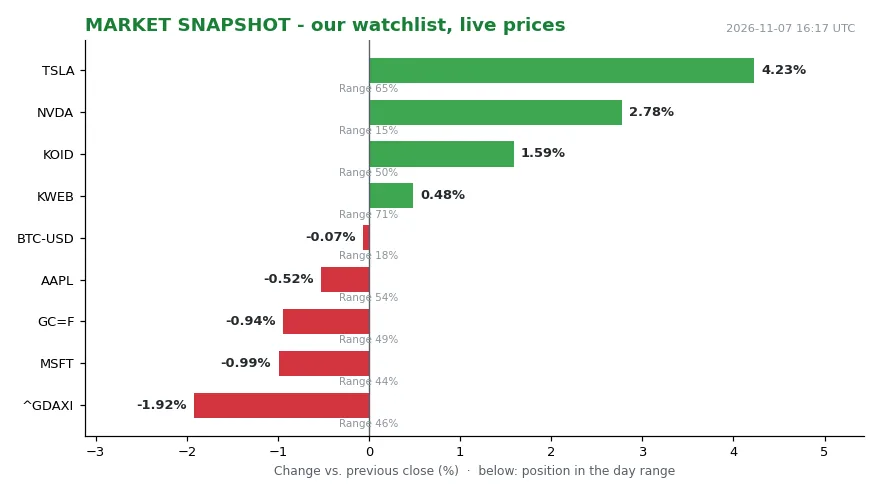
At 16:11 UTC on 7 November 2026 our watchlist showed Nvidia at 186.64, up 2.78 % on the previous close yet sitting near the day’s lows, with only 15 % of its range beneath the price. Apple traded at 342.37, down 0.52 %, mid-range at 54 %. The DAX stood at 25,820.36, down 1.92 %, mid-range at 46 %. Bitcoin was 75,659.54, off 0.11 % and near the bottom of its range at 12 %. Gold printed 4,074.90, down 0.94 %.
The pattern carries more information than any single print: direction and range position together describe conviction, not just momentum. A stock can rise 2.78 % and still finish near its low, which is what Nvidia did. Tesla did the opposite, adding 4.23 % while holding two-thirds of its range. Our regime reading is trend falling, level 3.63. Simulated equity stands at 3,723.97 USD, minus 0.02 % against the same time yesterday, with 1,863.17 in cash. The latest logged decision was a rule-based buy of Nvidia at 186.64 at 15:31, recorded as a record, not as advice. The busiest signal channel of the day was “other”, with seven events. Read together, the tape looks less like a rout than like a market that keeps handing back what it gains intraday - a sign of fading conviction rather than panic.
The border between public and private markets is where the story turns. The market data measures risk appetite in publicly traded markets. None of it measures Virgin Media O2. The UK broadband, TV, landline and mobile group has no ticker of its own, because it is jointly owned by Liberty Global and Telefónica. Its trouble arrives as private balance-sheet news, not as a share price.
Virgin Media O2 has announced £800m in cost savings, including potentially cutting up to a quarter of its 16,000 UK staff [1]. It carries a £22bn debt pile, with a potential refinancing looming next year [1]. It has lost 182,000 broadband and 644,000 mobile customers in two years, even though total customer numbers remain above where they stood at the merger, according to Enders Analysis [1]. Mike Fries, chief executive of co-owner Liberty Global, chose a steady register: “In our minds, anyway, this is not a crisis.” [1] Asked about refinancing, he said: “We made it clear, we have nothing to add to where we sit today.” [1]
The merger thesis and its broken links
Five years ago Liberty Global and Telefónica completed a £31bn combination, cleared by the competition watchdog in April 2021 and explicitly framed as a “national champion” built to challenge BT [1]. The implied arithmetic was tidy, and the source frames it as the post-merger mission. Scale would fund network investment, network investment would buy speed, speed would buy pricing power. In our reading, two of those three links have visibly failed: the technology leg and the pricing leg.
The technology leg is broken. Upgrading the cable network to full fibre has been abandoned as part of the savings package [1]. That is the operator equivalent of deciding not to repave the road it owns, and it cedes the speed argument by default. One senior industry executive described the consequence in plain terms: “They once used Usain Bolt in ads to trumpet that they had the fastest speed broadband, now the cables they have in the ground are slower than competitors.” [1]
Pricing mistakes and the customer backlash
The customer-facing record supplies its own corrections, and the regulator wrote two of them. In July, Virgin Media was fined a record £28m by Ofcom after an investigation found that millions of calls made between January 2022 and September 2024 were probably mishandled, with deliberate tactics used to prevent customers from cancelling and switching [1]. The company has repeatedly featured among Ofcom’s most complained-about providers [1].
Its O2 mobile arm then added a second correction. A surprise monthly bill increase, 40 % higher than customers had been told when they signed their contracts, produced a backlash [1]. Lutz Schüler later conceded the move “wasn’t the best decision”, estimating the loss of about 110,000 customers and a rebuke from the then-chancellor, Rachel Reeves [1]. Management has since pointed to Ofcom’s latest complaint data, which shows significant reductions and the lowest complaint level of any leading broadband provider, alongside measures such as a voice AI agent handling broadband fault calls [1].
How supply, technology, regulation and debt squeeze VMO2
The first channel is supply. Roughly 100 so-called alt-nets have been laying fibre, and BT decided to “build like fury” to replace its ageing copper lines [1]. More networks chasing the same households holds prices down and pushes profitability and revenue under pressure [1]. The second channel is technology: a cable estate that is not being upgraded cedes the speed argument by default. The third is regulation. VMO2 objected publicly to the fast-tracking of BT’s £400m rescue of TalkTalk, while the competition regulator signalled it might block the £2bn takeover of the alt-net Netomnia by Nexfibre, whose investors include Liberty Global and Telefónica [1]. The fourth is capital structure: £22bn of debt to refinance, against £800m of savings to find.
Actors: who gains, who pays, who decides
The paying side is the 16,000 UK staff facing cuts of up to a quarter [1]. The deciding side includes the Competition and Markets Authority, whose Netomnia ruling sits in the background, and Ofcom, whose complaint tables have become a public scoreboard. Karen Egan, managing director of telecoms at Enders Analysis, read the announcement as audience management: “A number of audiences may be in mind in constructing [VMO2’s] statement,” she said, naming Liberty Global shareholders, VMO2 bondholders and “those with potential influence over the Competition and Markets Authority’s decision on the Netomnia acquisition” [1]. On the receiving side sit the owners themselves: £5bn has been paid to shareholders in dividends since the merger, according to filings, money that some industry sources argue could have gone into fixing the estate [1]. Against that, VMO2 has invested £11bn in the UK since the merger, is expected to make about £200m in free cashflow this year, and has lifted profit margins from roughly 34 % to just over 40 % [1].
The cable-franchise legacy that still shapes VMO2
The deepest correction predates the merger by decades, and it is structural rather than managerial. “You could ask if anything has gone right since 1984,” said one TV industry executive. “The original sin was licensing 135 separate franchises with the ultimate endgame finally coming down to one in Virgin Media in 2007.” [1] The legacy, in that account, is fragmentation: “However, the end result was such a hotchpotch of systems and technologies it was easy to compete against, and they have never really fixed it, a problem the company is still dealing with today.” [1]
Outlook: what we watch next
Four observable items carry genuine uncertainty. First, the refinancing: Fries declined to add anything to the current position, so the terms are unknown [1]. Second, the CMA’s Netomnia decision, which Egan’s reading places inside the signalling game [1]. Third, a potential wholesale deal with BT to use Openreach and extend VMO2’s footprint from 19m to as many as 25m homes, which would trade network pride for reach [1]. Fourth, the complaint and churn data on the next reporting cycle, a scoreboard less easily managed by press release. Our own reading of falling trend at level 3.63 says nothing about any of these; it only tells us that the surrounding market is currently more interested in defending gains than extending them, which is the backdrop against which any VMO2 refinancing will be priced.
Sources and notes
[1] Guardian report: “Job cuts, lost customers and a £22bn debt pile: what has gone wrong at Virgin Media O2?” (quotes reproduced verbatim; figures as reported, including the £800m savings target, up to a quarter of 16,000 UK staff, £22bn debt, 182,000 broadband and 644,000 mobile customer losses, £28m Ofcom fine, 40 % undisclosed increase, about 110,000 customers lost, £5bn dividends, £11bn invested, £200m expected free cashflow, margins from about 34 % to just over 40 %, 19m to 25m homes, £400m TalkTalk rescue, £2bn Netomnia deal). Our own measurement, 7 November 2026, 16:11 UTC: watchlist quotes fetched two minutes prior (NVDA 186.64, +2.78 %, 15 % of range; AAPL 342.37, -0.52 %, 54 %; MSFT 530.61, -0.99 %, 44 %; TSLA 358.22, +4.23 %, 65 %; BTC-USD 75,659.54, -0.11 %, 12 %; GC=F 4,074.90, -0.94 %, 49 %; ^GDAXI 25,820.36, -1.92 %, 46 %; KOID 31.97, +1.59 %, 50 %; KWEB 24.88, +0.48 %, 71 %). Simulated equity 3,723.97 USD, cash 1,863.17, latest logged decision a rules-based buy of NVDA at 186.64 at 15:31. Regime: trend falling, level 3.63. Busiest signal channel: “other”, seven events. Educational documentation only; no investment recommendation.
—