Our measurement, before the story
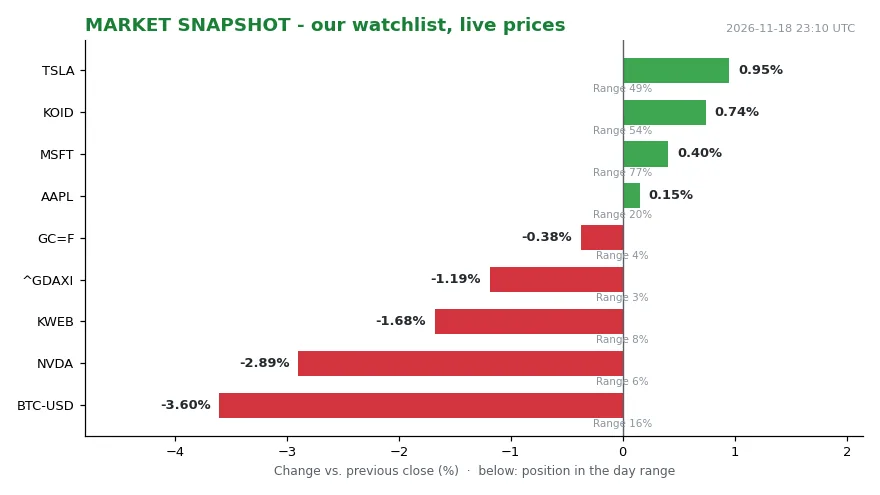
At 23:04 UTC on 18 November 2026 our watchlist showed Nvidia at 150.96, down 2.89% against the previous close and sitting at 6% of its daily range — near the lows. Microsoft printed 508.29, up 0.40% and at 77% of range, close to the highs. Bitcoin traded at 62,353.26, down 3.89%, at 9% of range. Gold stood at 3,727.80, down 0.38%, at 4% of range. The DAX was at 25,736.24, down 1.19%, at 3% of range. KWEB, the China internet proxy, sat at 21.71, down 1.68%, at 8% of range.
That is dispersion, not a uniform selloff. One mega-cap is bid near its highs. The AI hardware bellwether is offered near its lows. Crypto, gold, Germany and China internet all cluster at the bottom of their ranges. Our regime reading is trend=falling, level 3.63. The busiest signal channel on 17 November was “central banks”, with a single event logged.
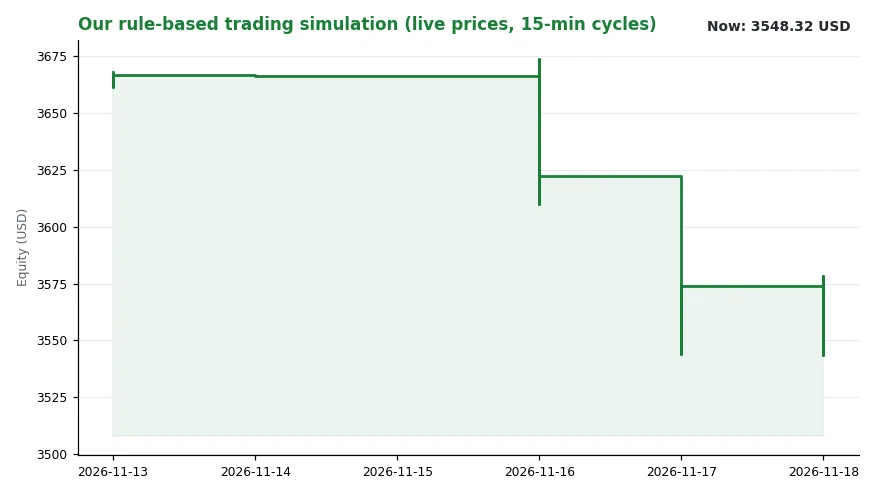
Our simulated book, run on documented rules, held 3,548.32 USD at the same timestamp, down 0.72% against the same time yesterday, with 1,788.13 in cash. The latest logged decision was WATCH KWEB at 0.00. None of that is advice. It is a description of how one rule-based account sits while a $3.8 trillion company answers a question about its own leadership.
The news, as a timeline
Nvidia co-founder Jensen Huang stepped down over revelations of extramarital affairs, one of which is alleged to have been with a Chinese spy. The confirmation arrived in stages, and each stage moved a number.
Stage one was valuation. Hundreds of billions of dollars were wiped off Nvidia’s stock market value. The company is now worth $3.8 trillion, or £2.9 trillion. It is not as familiar a name as Apple, Amazon or Microsoft, yet it has been just as integral to the booming US stock market of recent years.
Stage two was the business itself. On Tuesday the firm said its rapid growth is poised to continue. Quarterly sales had doubled from a year earlier. The interim boss, Colette Kress, described operations in three words: [Q1] “business as usual” — Colette Kress, Nvidia interim chief Stage three was lobbying. Elon Musk claimed that [Q2] “critical deals” involving Nvidia’s technology would be lost. Tim Sweeney, chief executive of Fortnite maker Epic Games, joined the call for reinstatement. Shareholders and supporters launched a campaign with a slogan: “Bring Jensen Back”.
Stage four was the return question. Huang indicated he is open to coming back, and used one word for how he would feel about it: [Q3] “honoured” — Jensen Huang, former chief executive [2] Nvidia’s board has said it is not considering bringing him back.
Stage five was the wider frame. Investors took fright at Democrat gains in the midterm elections, with many candidates having campaigned for tougher regulation of AI firms, and questions remain about whether the huge sums being invested in AI will actually pay off. Goldman Sachs expects AI investment to exceed $1 trillion in 2026 and calls the technology the [Q4] “dominant driver of business investment growth” — Goldman Sachs, on 2026
next year. That is the arc: a personal scandal became a strategic question, and the strategic question became a political one, inside roughly a week.
Where the shock travels
Channel one runs through supply, demand and financing, and it is unusual. Nvidia began by making chips that process graphics for computer games. It pivoted to the chips used in AI systems and now dominates that market. It sells microchips to customers including Meta, SpaceX and OpenAI. It has also funded those customers and other firms in the supply chain, through loans or direct investment. The practice is called “circular financing”, and it has built a spider’s web of deals.
The investor question here is mechanical, not moral. If Nvidia turned off the spending taps, would suppliers cut spending or jobs? Would that reach the wider US economy? AJ Bell’s Dan Coatsworth sets out the conditional case: [Q5] “If they decide to go with the much more cautious route… there could be a knock-on effect in that you have got various companies in the AI infrastructure space suddenly finding they don’t have a key source of finance,” — Dan Coatsworth, AJ Bell [2] He also offers the calmer reading, which is that [Q6] “it does change how people would look at the whole situation”. He adds that he has never seen circular financing used at this scale before. Bloomberg Intelligence’s Kunjan Sobhani expects the departure’s impact to be [Q7] “limited” for now, on the strength of firm commitments and a deep order book.
Channel two runs through expectations. Huang did not merely run a company; he was a key figure in “flying the flag” to drum up enthusiasm and investment for the wider AI industry. His exit therefore carries a “real risk” that Nvidia changes strategy and reins in spending. Concentration matters here. Up to 200 people reported directly to him; our reading is that a successor inherits an organisation shaped around one person’s span of control.
Channel three runs through regulation, and it is slower. Tougher rules raise the cost of the build-out that the chips feed. That channel is political, and no boardroom controls it.
Who wins, who loses, who decides
The clearest winners on the day of the plunge were competitors. When Nvidia’s share price fell, the stock of rival semiconductor makers including AMD, Broadcom and Marvell Technology jumped. Substitution is real, and it is one reason the wider AI industry may be partly insulated from a slowdown at a single firm.
The losers are concentrated. Nvidia’s shareholders absorbed the write-down. Firms in the AI infrastructure space that rely on Nvidia as a source of finance are exposed to a decision they do not make.
The deciders are few. The board rules on succession and has ruled out a return for now. Kress runs the company in the interim. Shareholders and supporters can campaign, and Musk and Sweeney can lobby, but neither group sets strategy.
A fourth group does the pricing. A Seeking Alpha analyst, Eric Sprague, argues Nvidia
[Q10] “remains a Buy for investors with at least a three-year horizon”.
His case leans on premium chip rental prices, accelerator scale and AI-assisted engineering. He projects revenue per employee of $8.6 million in 2026, and applies a 30% leadership discount to reach a $4.16 trillion to $5.54 trillion valuation range, against a $3.75 trillion market cap. He applies a 30% leadership discount and lands on a $4.16 trillion to $5.54 trillion range, against a $3.75 trillion market cap. He lists the risks without decoration: succession missteps, custom-silicon competition, receivables, customer financing and potential China-related legal consequences.
Our own tape offers a narrower observation: Microsoft near its highs, Nvidia near its lows. We cannot attribute that spread to this story from our data alone. We can say the market is discriminating rather than dumping.