The Whole Market in One Line of Fine Print
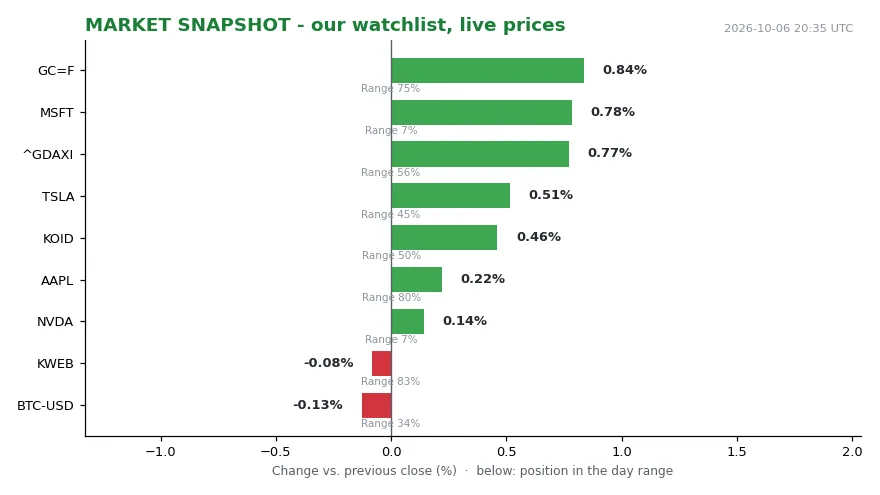
At 20:32 UTC on Oct. 6, our own tape looked calm on the surface and unsettled underneath. Nvidia printed 239.24, up 0.14% on the day but parked near its low — only 7% of its daily range. Microsoft traded 529.30, up 0.78%, and also sat at 7% of range. Apple was 333.63, up 0.22%, holding 80% of range, close to its high. Gold futures stood at 4,192.40, up 0.86%, at 76% of range. KWEB, the China internet basket, was 24.54, down 0.08%, at 83% of range. Bitcoin was 85,609.71, off 0.16%, mid-range at 32%. The DAX printed 25,449.19, up 0.77%, mid-range at 56%.
That is not a directional market. It is a rotation market. Two megacaps rise on the day and finish near their lows. A third finishes near its high. Gold is bid. China internet is quietly firm. Our signal layer logged exactly one event in its busiest channel, “central banks,” and our regime reading arrived truncated as “trend=” — which is about as honest as a tape gets when it has nothing to say.
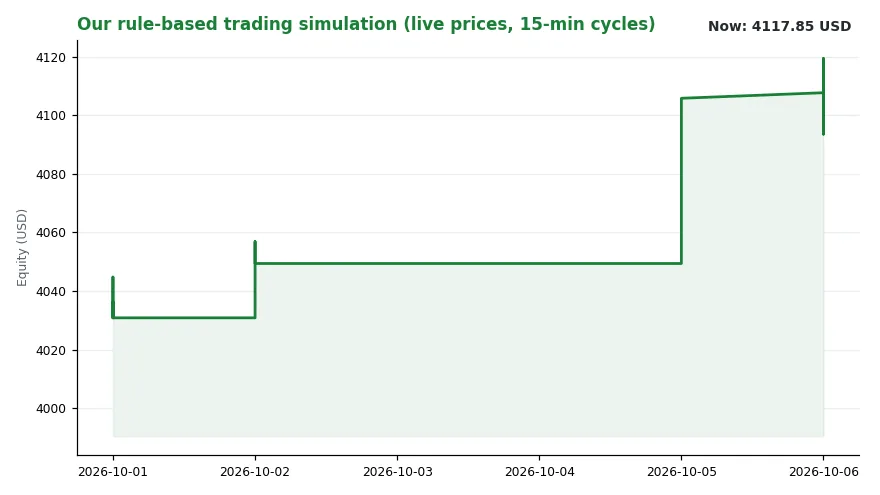
Our simulated book stood at 4,117.85 USD, up 0.29% versus the same time yesterday, with 2,081.91 in cash. The latest logged decision was WATCH KWEB at 0.00. About half the book is uncommitted, and the most recent action taken was no action at all.
The rule that sets the yardstick
There is a short piece of reporting regulation at the center of one of the fastest-growing corners of financial markets. Under the rules the Commodity Futures Trading Commission applies to prediction markets, a trade is booked as one dollar of notional volume. That holds no matter what the trader actually paid. Every event contract settles somewhere between 0 and 1. Somebody has to take the other side of every order. Both sides register.
For a plain contract, the distance between the reported figure and the cash on the table is modest. For a combo — several contracts stacked together that pay only if all of them win, the prediction-market cousin of a parlay — the distance can be enormous. A combo’s payout can run far above a dollar. A trader can put down pennies and see it counted as thousands of dollars of volume, because market makers absorb the other side of those long-odds tickets.
Where the reported figure and the cash diverge
Combos accounted for more than 50% of notional volume on Kalshi last month, driven by the start of the NFL season, and they are overwhelmingly assembled from sports contracts. At Polymarket, combos became a priority after the U.S. exchange’s official launch in May. They now make up nearly 50% of daily volume on Polymarket U.S., helped by the same football calendar.
Then comes the reality check. A CNBC analysis of Kalshi trades on Sept. 27 found the average cash placed on a single contract was less than 47 cents per trade. On combo contracts, the average per contract was roughly 9 cents. In September, combos represented 58% of Kalshi’s trading volume but less than 13% of total transactions, according to Dune data.
Chris Park, a researcher and founder of MSR Decode, said the multi-leg contracts are “helping claim a higher number with lower realistic cash output.” That is the pattern in one sentence: the reported quantity and the committed capital are not the same thing, and regulation measures the first.
The confusion travels outward. Ian Moore, an analyst at Bernstein, said he has spoken to “investors who see the notional number and compare it to [the] handle in sports betting, and then make the argument that. you know, these prediction markets have already exceeded [the] scale of sports betting. The comparison is not clean. A sportsbook handle measures dollars wagered. A prediction market counts both sides of a trade.
Rich Jaycobs, an independent advisor to prediction markets seeking regulatory approval from the CFTC, put a multiplier on the distortion: “When a client buys a deep out-of-the-money contract or a combo, prediction markets may have dollar volumes anywhere between 20 to 100 times greater than sportsbooks because CFTC reporting requires one thing and sportsbooks report the same activity differently.” His closing line is the entire problem compressed: “Same basic bet, same basic idea, but you’re getting a completely different perception of activity.”
Who wins, who loses, who sets the yardstick
Kalshi pushes back. A spokesperson, Jack Such, said the platform’s notional volume does not overstate activity: “If people are more interested in other measurements, they can look at other metrics Polymarket already looks elsewhere. Kyle Gesuelli, the company’s head of revenue and analytics, favors taker volume — the flow that lifts liquidity from market makers rather than supplying it. He said: “We really like to look at taker volume in terms of buying yes on combos.” And: “That feels like a better measure for us to just truly understand the underlying activity.” So the scoreboard reads like this. The platforms win the headline. Market makers earn the spread on high-payout tickets. The regulator decides the yardstick. Investors decide whether to believe it.
What we watch next
Three items. First, combos’ share of transactions rather than their share of notional; the 13% figure is the one that says how many people are actually doing this. Second, whether taker volume becomes a routine disclosure, since Polymarket favors it and Kalshi points users toward alternative metrics. Third, the regulatory frame itself.
That disagreement is the part that matters most for this desk. Combos are real trades with real counterparties, and NFL-season demand is real demand — none of that is in question. What is unresolved is what the number means. A metric that can record pennies as thousands of dollars describes structure and appetite, not commitment. Three named voices close to this market gave three different readings, and there is still no agreed denominator.
Sources
Mentioned organisations (context, not sources)
- Nvidia — Organisation (homepage)
- Microsoft — Organisation (homepage)
- Apple — Organisation (homepage)
- Commodity Futures Trading Commission — Organisation (homepage)
- Kalshi — Organisation (homepage)
- Polymarket — Organisation (homepage)
- Polymarket U.S. — Organisation (homepage)
- CNBC — Organisation (homepage)
- Dune — Organisation (homepage)
- MSR Decode — Organisation (homepage)