Xi Says the Thucydides Trap Can Be Overcome. Markets Shrug
Meta commentary - no external expert source; basis: Cnbc (2026-09-26). #MetaEconPol
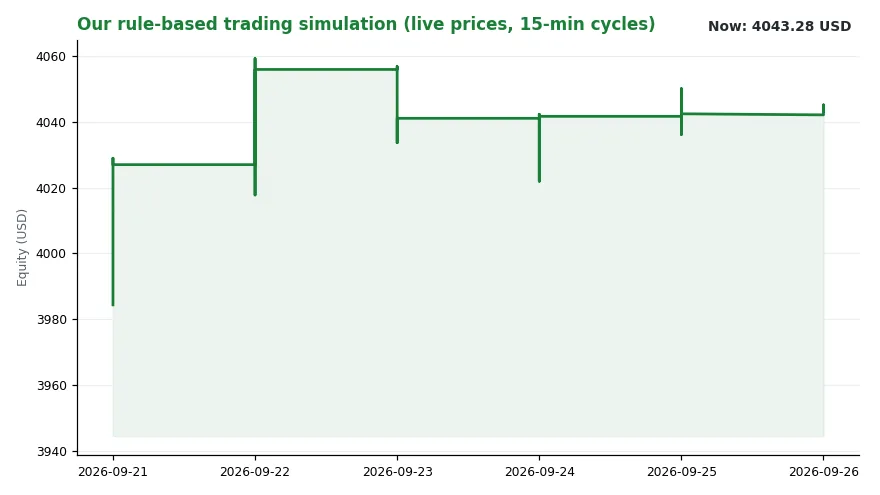
Microsoft is up 3.66 % and sitting at 85 percent of its daily range. Apple is up 1.53 % and near its high, at 92 percent of that range. Nvidia is up 0.22 % and parked mid-range, at 51 %. Tesla is down 1.54 % and near its low, at 23 percent. KWEB, the China internet basket, is down 0.45 % and mid-range, at 41 percent. Gold trades at 4,321.20, up 0.54 %, mid-range. The DAX is up 0.56 %, at a third of its range. Bitcoin sits at 83,944.46, down 0.16 %, mid-range. The quotes were taken at 05:43 UTC. Arranged side by side, the tape shows a pattern: US software and hardware bid, Chinese internet offered, havens indifferent. That is rotation, not a rally. The broader trend reading is unchanged: falling. The busiest theme in the news flow was central banks, with two events. A model portfolio tracked here holds 4,043.28 USD, up 0.02 % versus the same time yesterday, with 2,195.96 USD in cash. Its latest logged decision was to watch KWEB and do nothing. That is the honest position on the week’s biggest diplomatic story: no trade.
The story arrived from Washington, and it was phrased as a claim about history rather than about policy. “The Thucydides Trap can be overcome,” Chinese President Xi Jinping said on arriving at the White House to meet US President Donald Trump on Thursday, according to the Chinese side’s official readout. That is a change of grammatical mood. In May, at a summit, Xi posed the same concept as a question: could the two countries avoid the trap? On Thursday the question came with an answer attached to it, at least in public.
The term was popularised in the early 2010s by Graham Allison, a Harvard professor. It describes a pattern in which tension between a rising power and a ruling power has historically often ended in war. The name comes from Thucydides, an Athenian general in ancient Greece. His record of the Peloponnesian War described how Athens’ rapid rise in power alarmed Sparta and made war between the two city-states inevitable. Allison has met Xi and visited China multiple times, including in June 2026 for a World Economic Forum event. He was founding dean of Harvard’s Kennedy School, which for decades trained many of China’s government officials. He later served in the US government, as Assistant Secretary of Defense under Bill Clinton in the 1990s and as Special Advisor to the Secretary of Defense under Ronald Reagan in the 1980s. Xi used the phrase in a rare interview published by HuffPost in 2014. “We all need to work together to avoid the Thucydides Trap — destructive tensions between an emerging power and established powers, or between established powers themselves,” he said then. His state visit this week was his first in 11 years. After his 2015 visit, a state media article said his interest in the trap reflected a view that suspicion between major powers, rather than inevitability, produces the conflict the term predicts.
On Thursday, Xi paired the phrase with a formula for coexistence. The US and China can have “healthy” competition without confrontation, he said. “It should be a race of catching up with one another, not a wrestle in which one either wins or loses,” he said. He added that the two countries’ militaries should improve crisis communication and prevention. Cui Shoujun, a professor at Renmin University of China’s School of International Studies, called the bottom line — intense competition without military conflict — the “most significant political outcome” of the summit. “This injected certainty into the volatile bilateral relationship,” he said, in Chinese, translated by CNBC. Trump’s own comments on Xi’s arrival at the White House emphasised general collaboration.
Before Thursday, the two governments were talking and markets had already priced a wide range of outcomes. The open question was whether the Chinese side would describe the relationship in the language of unavoidable conflict or of managed rivalry. Beijing now argues publicly that the trap can be escaped, and Washington is not contradicting it in the same breath. Whether the framing changes a single underlying policy remains unanswered.
The mechanism matters more than the mood. The channel here is not interest rates and not earnings. It is the price of uncertainty. When two large economies describe their rivalry as a contest short of war, the discount rate applied to assets exposed to that rivalry should, in theory, fall. That shows up as a lower geopolitical risk premium, cheaper hedging, and more willingness to hold cross-border positions overnight. So the channel that is actually working is expectations, and expectations are the cheapest thing a government can move. A readout costs nothing to publish. A crisis-communication line costs something, but not much. A tariff schedule costs a great deal, and nobody announced one.
Four sets of actors are visible in the story. The two presidents: Xi supplies the framing, Trump supplies the ambiguity. The academics and the institutions around them: Allison and the Kennedy School belong to a back channel whose vocabulary both governments now borrow. The militaries, which Xi explicitly asked to improve crisis communication and prevention. And the market, which has to decide how much of a sentence to believe. Winners, if the framing holds, are exporters, shippers, and every asset whose valuation is dragged down by war risk. Losers, if it holds, are the sellers of inevitability. Who decides is not the professors, and not the analysts. The two governments decide, and the evidence of a decision is paperwork, not prose.
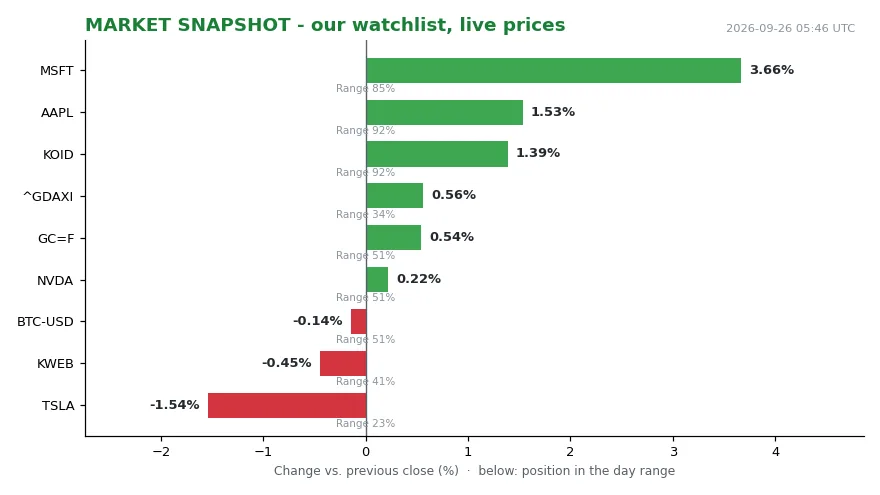
The tape does not show a relief trade yet. KWEB, our cleanest listed proxy for Chinese internet equity, remains in the middle of its range, down 0.45 %. If Beijing’s framing were being bought, that line would look different. US megacaps are strong, but their strength has other explanations, and nothing in our measurement ties it to Thursday’s arrival. The busiest theme in the news flow was central banks, not geopolitics.
What to watch next, with the uncertainty kept where it belongs. Whether the two readouts converge in wording, and whether Taiwan appears in US public remarks. Whether the military channel produces an announced mechanism rather than a sentence. Whether KWEB stops underperforming the US tape. Whether central banks keep outnumbering geopolitical signals in the event counts. Which way this resolves is unknowable from here. A phrase changed. Phrases are not treaties.
The last sound of the week is the arrival at the White House on Thursday: shutters, footsteps on stone, and then a voice speaking in Chinese with the English running half a second behind it. Anyone positioned in the bilateral trade is standing in that gap.
Mentioned organisations
- Microsoft — Organisation (homepage)
- Apple — Organisation (homepage)
- Nvidia — Organisation (homepage)
- Tesla — Organisation (homepage)
- White House — Organisation (homepage)
- Harvard University — Organisation (homepage)
- World Economic Forum — Organisation (homepage)
- Harvard Kennedy School — Organisation (homepage)
- US government — Organisation (homepage)
- HuffPost — Organisation (homepage)