
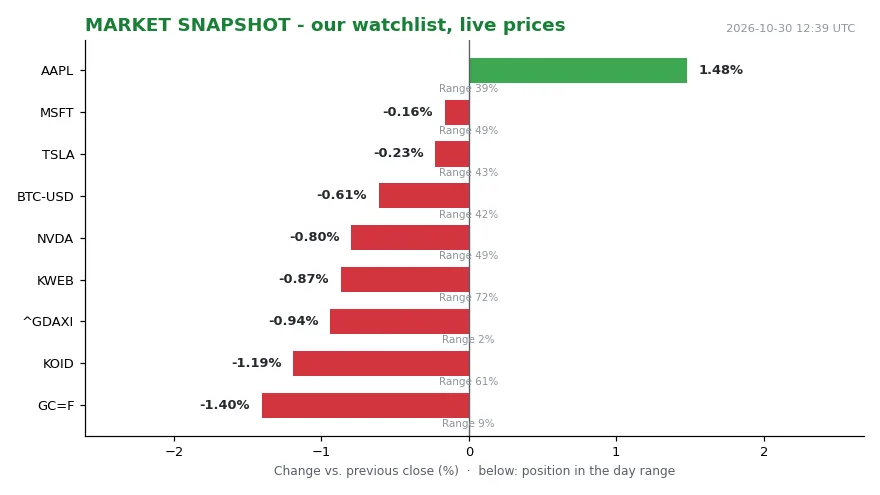
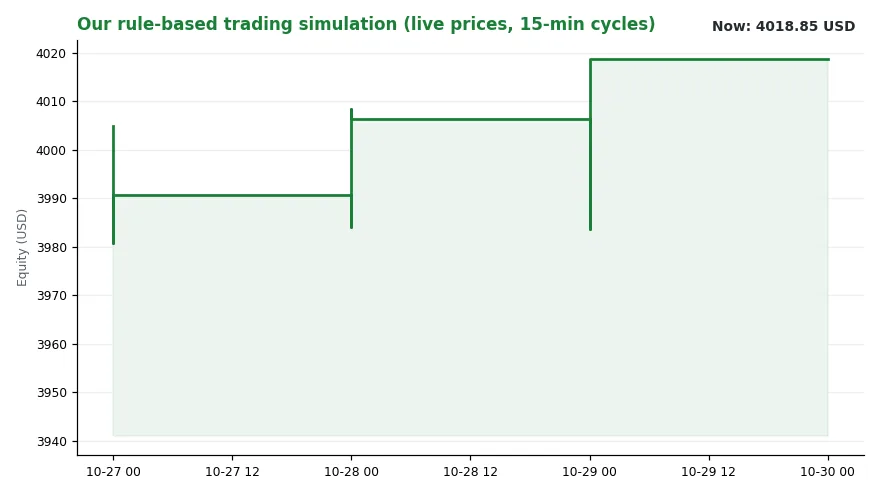
Our own measurement, fetched at 12:35 UTC on 30 October 2026, shows a tape with no war premium left in it. NVDA printed 213.66, down 0.80% against the previous close and parked mid-range at 49% of the day’s span. AAPL traded at 348.91, up 1.48%, also mid-range at 39%. Gold — the instrument that usually carries geopolitical risk — fell 1.42% to 3974.10 and sat near its lows, at 8% of its range. The DAX stood at 25796.22, down 0.93% and wedged at 3% of range, the weakest positioning in the set. Our regime reading is trend=falling, level 3.63, and the busiest signal channel of the day was “central banks”, with two events. The simulated book held 4018.85 USD of equity against 1999.02 USD of cash, flat on the day, with the latest rule-based decision logged as WATCH KWEB. BP is not on our watchlist, so the earnings reaction cannot be measured in our prices. What we can measure is the tape around it, and that tape shows dispersion, not alarm.
There is a German compound for what BP has just reported: Kriegskonjunktur — the conjunctural luck of a war, an economy that runs hot because something far away is burning. English must split it into “war” and “boom” and loses the fuse in between.
The number
BP’s underlying replacement cost profit, the company’s key income measure, almost quadrupled to $8.46bn (£6.3bn) from $2.2bn a year earlier. Analysts had expected $7.3bn. It was the highest quarterly figure since the $8.9bn booked in 2008 — an 18-year high. The surprise sat in refining rather than in production: BP earned almost $47 for each barrel produced, a spread inflated by the gap between crude costs and the price of diesel and gasoline. Shell and TotalEnergies reported their strongest profits since 2022 on the same arithmetic, and in the spring quarter Chevron posted its highest quarterly earnings ever while ExxonMobil doubled its year-on-year result, according to NPR’s tally.
The chief executive’s own framing:
[1] “It really was a banner quarter for the refining business. We had very strong margins from the BP-operated refineries, we also had very strong underlying performance. We were able to capture the opportunity provided by the market.” — Meg O’Neill, BP chief executive “Refineries have been running close to capacity to make up for shortfalls, shipping has been taking different and longer routes, and releases from strategic and commercial reserves are helping to bridge supply gaps.” [1] — O’Neill
The channel
Three mechanisms are doing the work, and none is a simple “oil price up” story. The first is the refining margin, or crack spread. Global crude benchmarks have stayed below their 2022 peaks, yet pump prices for refined fuels reached all-time highs across the UK, Europe and the US in recent months, because Gulf-region and Russian refining capacity has been disrupted. The war with Iran has effectively shuttered the Strait of Hormuz, a waterway that previously carried about a fifth of the world’s oil and gas; Kpler data cited by NPR counted only five confirmed ship transits on a single Thursday. Ukrainian attacks on Russian refining infrastructure removed another slice of product supply. The result is a market where the raw barrel is comparatively available and the finished litre is not — and the margin between them is where BP’s quarter was made.
The second channel runs from the pump back to the household. UK diesel averaged 198.79p a litre, with petrol at 172.92p, against 132.83p in late February before the latest Middle East conflict began, according to RAC estimates. In the US, regular gasoline averaged $4.11 a gallon on the Friday of the earnings round, against below $3 before the strikes. That is the pass-through side of the same margin.
The third channel is regulatory, and it is where the argument becomes explicit. The UK already operates a windfall tax and has extended it to 2030; the EU imposed one after the 2022 price spike; US Democrats have introduced per-barrel levy proposals aimed at companies producing or importing at least 300,000 barrels a day in 2025, with proceeds redistributed to consumers. The deciding institutions are legislatures, not refineries.
“It’s fair to put a windfall profits tax on inordinate windfall profits rather than cut off children’s food programs.” [1] — Sen. Sheldon Whitehouse
“We canceled investments that we had planned for Europe based on the last time they passed a windfall profits tax.” — Darren Woods, ExxonMobil chief executive, who has called windfall taxes a “misguided policy”
Who wins, who pays, who decides
The winners are legible from the filings: in the spring quarter ExxonMobil booked $14.53bn, Chevron $12.07bn and Shell $9.8bn — an average of roughly $404m a day across those three, per NPR — and BP has now added $8.46bn to the same pile. Six of Europe’s largest oil companies posted combined first-quarter profits of $22bn, more than 40% above the prior year.
“There are constituencies around the world who are having a very good crisis, and the oil producers are one of them.” — Patrick Galey, fossil fuels lead at Global Witness
The losers are equally legible, and they are downstream: drivers, households, airlines. Campaigners have made the distributional point the centre of their response.
“obscene that polluters are continuing to cash in on the fallout of the war in Iran, making more bumper profits from spiralling oil prices while innocent civilians suffer” — Jonathan Noronha-Gant, Global Witness “As millions of households brace themselves for a cold winter, huddling under blankets and clutching hot-water bottles as they struggle to pay their bills, BP is raking in huge profits while doubling down on gas and oil production and slashing investment in renewables.” — Danny Gross, Friends of the Earth
BP has begun answering the allocation question that follows a windfall. The company stated it would use excess cash flow to pay the remaining liabilities from the 2010 Deepwater Horizon spill in full, after a deal granting Louisiana an accelerated lump-sum $350m payment and settling long-running coastal damage litigation brought by local parishes. It is also preparing to sell UK North Sea oil and gas assets in a deal that could be worth between £2bn and £2.5bn, covering five production hubs — Andrew, ETAP, Glen Lyon, Clair and Clair Ridge — with Neo Next+, Ithaca Energy and Adura named as potential suitors. And it has a new chair, Ian Tyler, appointed last month after the ousting of Albert Manifold, intended to close a period of boardroom turmoil.
What we watch next
The dated item is 15 December, when BP is expected to set out its first major strategy update under O’Neill, with market observers expecting plans to grow oil and gas production and potentially to restart share buybacks from next year. Around that: whether the North Sea sale finds a buyer at the indicated range; whether refining margins mean-revert once Gulf and Russian capacity returns; whether Hormuz transit counts recover; and whether any windfall levy proposal acquires legislative momentum in Washington.
Woods, on Exxon’s earnings call, said he could not predict when things in the Strait of Hormuz would settle down. O’Neill’s contribution was about adaptability under stress rather than about foresight. Our own tape shows nothing energy-related driving today’s signal layer — the pattern is elsewhere. That is a description of what we measured, not a recommendation; nothing we publish is investment advice under FINMA rules.
The coldest fact available is a pair of numbers from the same Friday. BP earned $8.46bn in three months. Diesel in the UK cost 198.79p a litre.
Sources
Mentioned organisations (context, not sources)
- Shell — Organisation (homepage)
- TotalEnergies — Organisation (homepage)
- Chevron — Organisation (homepage)
- ExxonMobil — Organisation (homepage)
- NPR — Organisation (homepage)
- Kpler — Organisation (homepage)
- RAC — Organisation (homepage)
- Friends of the Earth — Organisation (homepage)
- Adura — Organisation (homepage)
- Neo Next+ — Organisation (homepage)