Israel Tech Economy Europe R and D Gap Market Rotation
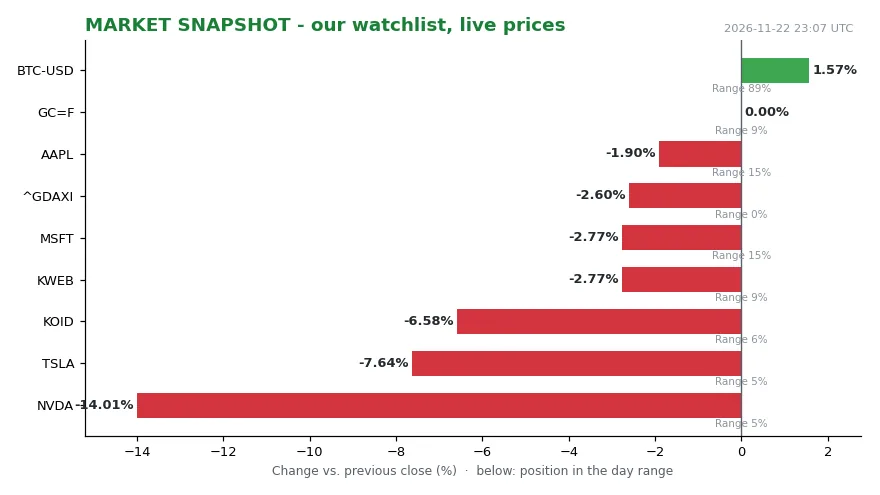
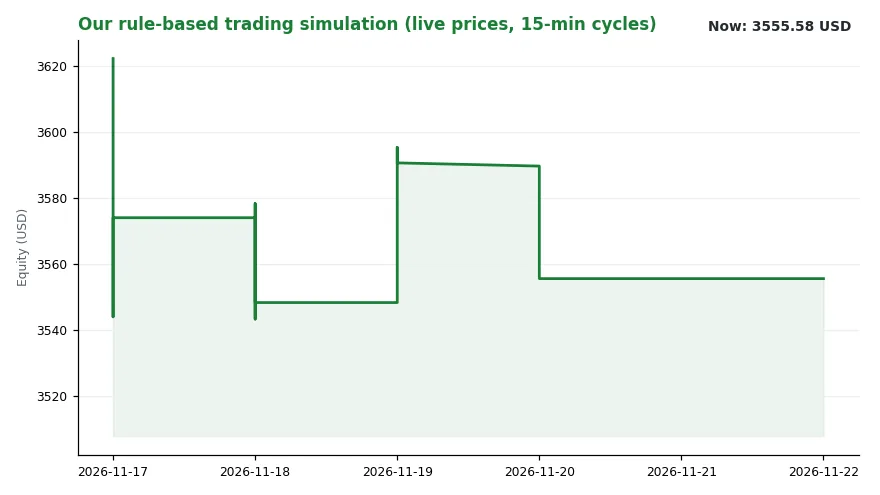
Our own measurement, taken at 23:04 UTC on 22 November, shows rotation rather than rout. Nvidia closed at 125.53, down 14.01 per cent against the previous close and parked in the bottom 5 per cent of its daily range. Tesla fell 7.64 per cent to 345.82, also 5 per cent off its floor. The DAX at 24802.78 lost 2.60 per cent and finished at 0 per cent of its range — the literal low of the session. Microsoft (-2.77 per cent, 484.52) and Apple (-1.90 per cent, 342.56) both held 15 per cent above their lows, while the KOID basket dropped 6.58 per cent to 28.68, 6 per cent from the bottom. The counterweight is the interesting part: bitcoin at 61,061.13 gained 1.61 per cent and traded near the top of its range (90 per cent), gold at 3515.40 was flat at 0.00 per cent and sat near its lows, 9 per cent of its range. Our regime reading is trend=falling, level 3.63; the busiest signal channel of the day was “central banks” with two events. Simulated equity stood at 3555.58 USD, unchanged versus the same time yesterday, with 1798.25 in cash and the last logged decision a watch on KWEB, which closed at 20.72 (-2.77 per cent).
The tape matters here because the price of ideas is set against the price of money. On the same day that growth assets repriced lower and capital rotated toward bitcoin rather than gold, more than 700 policymakers, diplomats and investors were due in Jerusalem to talk about how innovation becomes output.
What is actually on the table
The trigger document is the IMF’s October 2026 outlook. It projects nominal gross domestic product of roughly 747 billion dollars for Israel by the end of the year — a figure that would move the country into 25th place in the global ranking, ahead of Sweden and Ireland. [1] The same outlook forecasts real growth of 4.5 per cent in 2026. The Bank of Israel goes further, at 5.6 per cent this year and 7.5 per cent in 2027, though those larger numbers include production abroad by Israeli companies; stripped of that activity, the central bank’s domestic estimate is 3.4 per cent for 2026 and 5.1 per cent for 2027.
The venue is the ELNET Jerusalem Summit, running 22 to 24 November, with more than 700 participants, over 200 of them European guests. Security, technology, research and trade cooperation sit at the top of the agenda. The listed European speakers span the political spectrum: former French prime minister Manuel Valls, former Italian foreign minister and current EU Special Representative Luigi Di Maio, former Czech foreign minister Jan Lipavský, Germany’s ambassador to Israel Alexander Graf Lambsdorff, Polish Senate deputy speaker Michał Kamiński, Greece’s deputy minister of national economy and finance Dimitrios Markopoulos, and Jekaterina Rojaka, who chairs Lithuania’s parliamentary innovation committee. Israeli President Isaac Herzog is scheduled to address the conference.
The channel: one number against another
Set the ranking aside and one ratio does the work. Israel devoted approximately 6.8 per cent of GDP to research and development in 2024, per OECD statistics — among the highest shares measured anywhere. [1] The European Union spent around 2.3 per cent in the same year, on Eurostat’s figures. That is roughly a threefold gap in the latest comparable year.
The output side mirrors the input side. The Israel Innovation Authority’s State of High-Tech 2026 report puts the tech sector at 18.3 per cent of Israeli GDP in 2025 and around 58 per cent of the country’s exports. [1] Those two figures describe an economy where a relatively narrow slice of activity carries a majority of its foreign-currency earnings.
The mechanism is not a single lever. It is a transmission chain: universities produce research, venture capital funds the earliest and riskiest stage, the state — through the Israel Innovation Authority — supports technological research, early-stage businesses and industrial innovation, and because the domestic market is small, companies look abroad almost from day one. International customers, investors and commercial partners are not an expansion phase; they are the business model. The 1985 US-Israel Free Trade Agreement gave that outward orientation a legal frame early on.
There is a cost side that the growth headline hides. Military operations, reservist mobilisation, labour shortages and disruption to business activity have all pressed on the economy, and higher defence expenditure has increased demands on public finances. Elbit Systems, Rafael and Israel Aerospace Industries have built advanced capabilities in missile defence, radar, drones and military electronics, and some of that research spills into civilian cybersecurity, communications and advanced engineering — but defence spending is a cost, not a prosperity engine, and it competes directly with education, transport and healthcare for the same resources. The OECD’s Economic Survey of Israel 2025 makes exactly this point about safeguarding investment in infrastructure, skills and productivity.
The IMF’s July 2026 assessment added a shorter-term warning: inflation could rise temporarily on higher energy prices and supply shortages, even with a stronger shekel. It also flagged structural drags — relatively low employment rates among ultra-Orthodox Jewish men and Arab Israeli women — as constraints on medium-term growth.
Who gains, who pays, who decides
The potential winners from closer EU-Israel commercial ties are identifiable: cybersecurity, AI, semiconductor and medical-technology firms on the Israeli side; European industrial and scientific institutions that gain access to that pipeline on the other.
The losers are harder to name, but the political constraint is not. Within the EU, member states and parliamentarians disagree over the future of relations with Israel; some call for trade restrictions or for reassessing parts of the EU-Israel Association Agreement. That is a regulatory channel, and it is the one that can override an economic one. A summit agenda does not settle an association agreement.
Europe’s own stake is a productivity problem it already knows it has. The bloc holds world-class universities, scientific institutions and a single market of around 450 million consumers. Its documented weakness is conversion: turning research into companies that scale internationally. The source draws five lessons from the Israeli case: make innovation a long-term economic priority, strengthen university-business cooperation, make it easier for start-ups to grow and to take commercial risk, deepen cooperation across strategic industries, and adopt a stronger international business outlook from the outset.
What we watch next
Three observable things, and one caveat.
First, the IMF’s 747 billion dollar projection and the 25th-place ranking are forecasts with a stated date, year-end. We will watch whether the nominal figure survives the revision cycle, and whether the Bank of Israel’s wider 5.6 and 7.5 per cent figures hold once production abroad is separated out again.
Second, the summit’s participant list is a signal in itself: which European governments send working-level officials and which send ministers may say more about the Association Agreement debate than any communiqué.
Third, our own tape. With the regime reading trend=falling and central banks the busiest signal channel, the discount rate applied to long-duration innovation is the variable that decides whether a tech-heavy economy’s growth forecast gets paid for or priced out.
The caveat: none of this settles causality. Israel’s R&D intensity, its export share and its growth forecasts appear in the same documents, but a country cannot simply copy a 6.8 per cent ratio and expect an 18.3 per cent sector. The source itself frames the lesson as selective: learn from Israel’s achievements while preserving what makes European economies distinctive.
Sources
Mentioned organisations (context, not sources)
- Nvidia — Organisation (homepage)
- Tesla — Organisation (homepage)
- Microsoft — Organisation (homepage)
- Apple — Organisation (homepage)
- International Monetary Fund — Organisation (homepage)
- Bank of Israel — Organisation (homepage)
- ELNET — Organisation (homepage)
- European Union — Organisation (homepage)
- Polish Senate — Organisation (homepage)
- OECD — Organisation (homepage)