Fed Hikes Rates as Market Looks Green but Feels Red
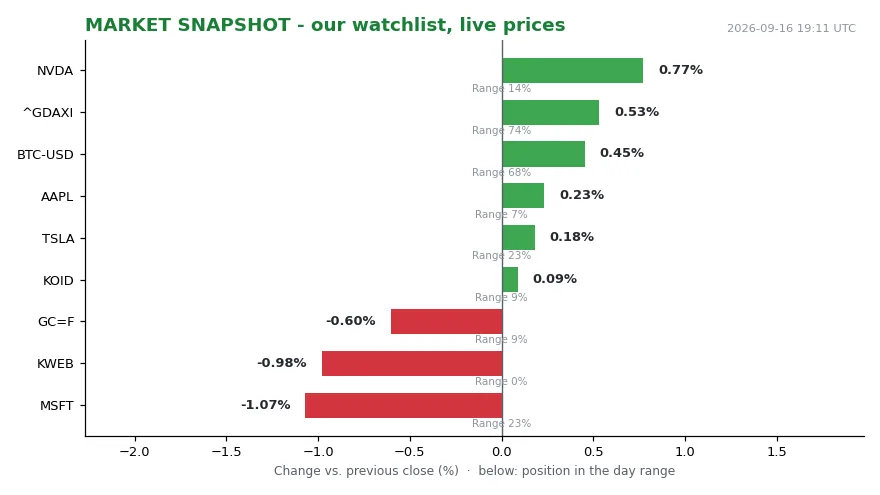
On 16 September, the watchlist closed mostly green and mostly pinned to the floor of the day’s range.
NVIDIA closed at 213.97, up 0.85% against the previous close, yet finished at just 19% of its daily high-low range
Apple closed at 332.18, up 0.25%, at 8% of its daily high-low range
Microsoft closed at 491.41, down 1.15%, at 16% of its daily high-low range
Tesla closed at 357.02, up 0.12%, at 21% of its daily high-low range
Four large-cap names, three green and one modestly red, all four glued to the bottom of the session.
Then the assets that behave differently.
Bitcoin traded at 75,880.57, up 0.39%, roughly midway through its range at 63%.
Gold traded at 4,308.80, down 0.55%, near its lows at 9% of its daily high-low range.
The DAX held 25,537.75, up 0.53%, at 74% of its daily high-low range.
A China internet ETF fell 0.92% to 24.26, sitting at 2% of its daily high-low range.
A thematic ETF traded at 34.58, up 0.23%, also at 2% of its daily high-low range.
Two funds pinned at the very bottom of their band, one European index near the top, and a metal that gave ground.
That is not a broad rally. It is money rotating out of one group of assets and into the ones that historically hold up when growth slows.
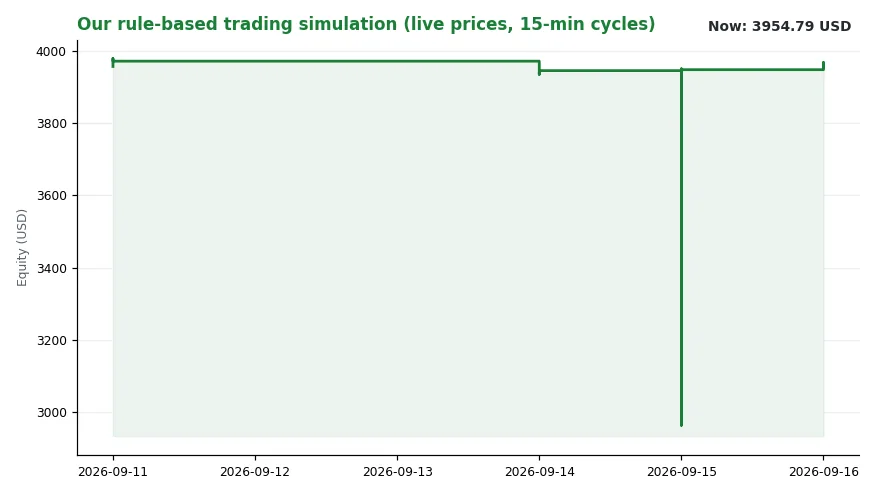
The rule-based book closed the hour at 3,954.79 USD, up 0.16% from the same time a day earlier.
Cash stood at 1,984.99, meaning roughly half the book was exposed to nothing at all.
The last decision on the sheet looked like a mistake at the time.
At 21:05 the book sold bitcoin at 75,958.04, because the daily rhythm said the price had travelled to 71% of its daily high-low range.
Selling into strength reads like an error. It was not.
The rule was simple: use the second wave, then stop being greedy.
This is a documented simulation, not advice — but it is honest bookkeeping, and the bookkeeping matched the mood of the market.
The model described the market as trending down.
The most active signal channel on 15 September was “zentralbank”, with one event logged.
That channel pointed at the central bank a day before the central bank did anything.
What the Central Bank Did
The Federal Reserve raised rates on Wednesday for the first time since 2023. [5]
The Federal Reserve’s policy-setting committee voted unanimously to lift its policy interest rate by a quarter of a percentage point, to a range of 3.75% to 4%. [5]
The committee described inflation as still elevated and said the action supports a timelier return to its 2% goal.
That is the news. Here is why it moves markets.
This is the first hike since July 2023, and it puts Kevin Warsh, the sitting Fed chair, on a possible collision course with Donald Trump.
Trump nominated Warsh in the expectation that he would cut rates.
Trump has said the US should carry the lowest rate in the world and threatened to stop trading with deficit countries if rates are not lowered.
Warsh has said he maintains his independence from the White House.
The vote was unanimous, and unanimity matters more here than the quarter point.
The Mechanism
A policy rate is a price for money.
Mortgages, car payments, student debt and card balances all reprice off that anchor.
Higher borrowing costs slow activity, and slower activity cools prices — eventually.
That “eventually” is the entire problem.
New projections showed a majority of officials penciling in another hike before the year’s end.
Four officials see the benchmark reaching 4.25% to 4.5% by December. [5]
Estimates for growth and unemployment were upbeat.
Inflation, by the committee’s own view, does not return to 2% until roughly 2029.
So the tool works, and it works slowly. On the benefit side, that is credibility. On the cost side, it is time households do not have.
Energy is the part of the mechanism the Fed does not control.
The ongoing war involving the US, Israel and Iran has driven energy prices higher.
Gasoline has averaged about $1 a gallon more than a year ago.
Diesel recently reached an all-time high of $6.31, and diesel moves buses, trains and trucks.
The bond market is the second transmission channel.
Inflation concerns triggered a sell-off in US government bonds.
The yield on the 10-year US Treasury bond hit a 19-year high earlier this week. [7]
The US Treasury tried to calm the market. It did not fully succeed.
When the asset normally treated as the safest gets volatile, the rate on consumer and business loans tends to follow it upward.
History supplies the scale of the fight.
In June 2022 inflation reached a generational high of 9.1%.
The Fed raised rates 11 times across 2022 and 2023.
The target range reached 5.25% to 5.5%.
Cuts followed in 2024 and 2025. Now the direction has flipped back.
At the start of this year, inflation ran about a percentage point below current levels.
Back then a hike looked highly unlikely, and a majority of officials expected a cut instead.
Stubborn August inflation, with unemployment steady, changed the calculus.
Who Wins, Who Loses, Who Decides
Savers and holders of cash-like instruments that are barely affected by rate moves are the usual winners in a hiking cycle.
The book’s own 1,984.99 in cash is a small, unglamorous version of that position.
Borrowers lose, and so does anyone holding long-duration bonds, whose prices are most sensitive to rate changes because they pay far in the future and were purchased at lower yields.
Households are already on the losing side of the wage line.
In August, hourly earnings fell 0.1% year-over-year after accounting for inflation.
They also fell 0.3% from the month before.
The University of Michigan’s monthly survey shows consumer sentiment declining while inflation expectations rise. [8]
Voters head to the polls in November, and candidates on both sides have pushed the cost of living to the front of their campaigns.
Pew Research Center data shows voters split on which party holds the advantage on the issue. [9]
Then there is the fiscal layer.
Trump has urged Republican voters to treat their midterm ballot as a vote for him.
He promised every American a $5,000 “Trump dividend” if Republicans retain Congress. [10]
Critics have called the offer akin to bribery and warned about the financial implications.
US government debt reached a record $40tn last month. [7]
The deciding actors are easy to name: the FOMC sets the rate, the chair speaks for it, the bond market prices it, and the household absorbs it.
What We Watch Next
The next inflation print, because that is the input the committee says it needs.
The 10-year yield, because a 19-year high is a level that changes behaviour by itself.
Diesel and gasoline, because they are the fastest pass-through into headline inflation.
Whether the second hike actually lands — four officials penciled it in, and four is not a majority on its own.
Gold and cash, which the tape showed moving differently from risk assets.
The uncertainty here is real, and it is not decoration.
The war could ease, and energy could fall quickly.
Or energy could stay expensive while growth slows, which is the least comfortable combination available.
The Fed’s own projection places the 2% target around 2029, which is an admission about timing rather than a plan.
Warsh says he is independent. Trump says rates should be the lowest in the world. Both statements are on the record, and only one can hold.
The good news is that the Fed still has a 2% goal, still has a unanimous committee, and still believes its instrument works.
The bad news is that the damage did not wait for the hike.
It was already in the August earnings numbers, already in the sentiment survey, already in the diesel price.
The tape said it a day early, when the “zentralbank” channel lit up and everything equity-shaped closed near the floor of its range.
Sources
1. NVIDIA
2. Apple
3. Microsoft
4. Tesla
6. White House
7. US Treasury
10. Republican Party