
Two Pounds a Litre: The Diesel Shock, and a Tape That Refuses to Panic
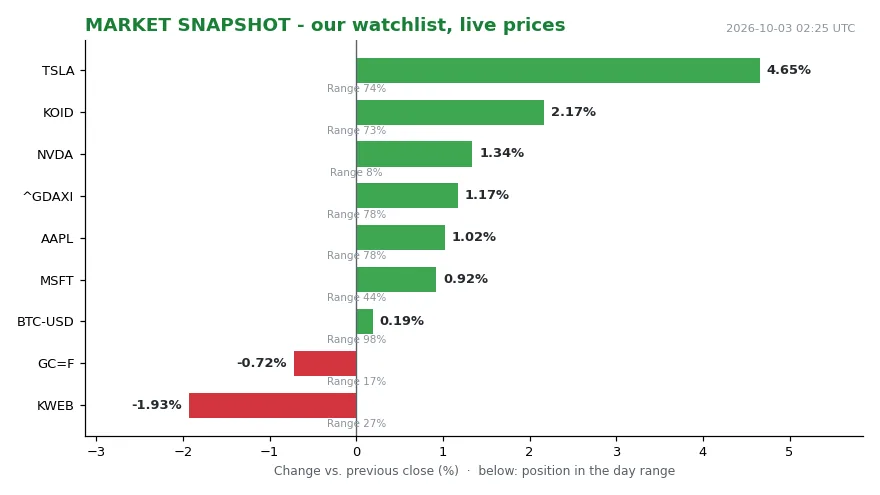
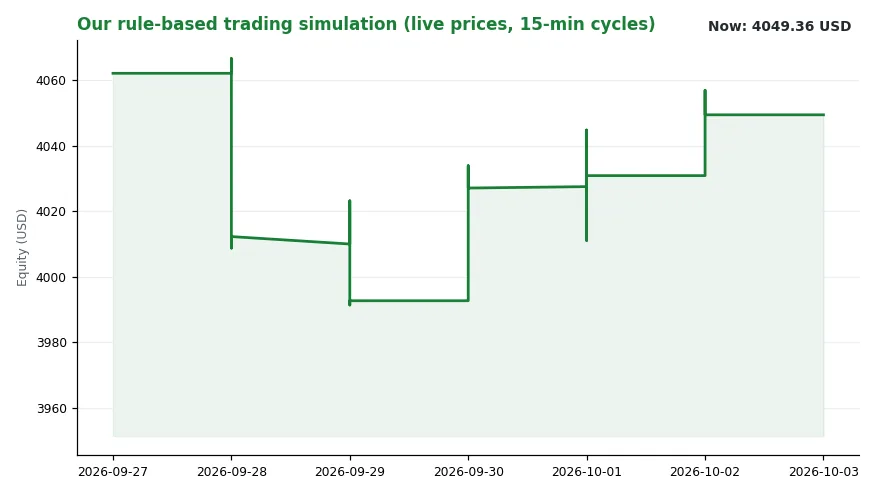
Our own measurement, fetched at 02:21 UTC on 3 October, comes first. Nvidia printed 233.95, up 1.34%, at 8% of the span between its daily high and low. That is near the low. Apple printed 333.69, up 1.02%, at 78% of the span between its daily high and low. Gold printed 4,172.10, down 0.72%, at 17% of the span between its daily high and low. Also near the low. The DAX printed 25,231.20, up 1.17%, at 78% of the span between its daily high and low. Tesla was 4.65% higher at 370.59, in the upper portion of its daily high-low span at 74%. Bitcoin sat at 84,652.98, up 0.17%, at 93% of the span between its daily high and low. The top of its day. KWEB was the outlier: 23.86, down 1.93%, at 27% of the span between its daily high and low. Our simulated equity book stood at 4,049.36 dollars. That is flat against the same time yesterday. Cash: 2,020.64. The model classified the market as falling, with a state value of 3.63. The busiest model category on 2 October was “central banks”, with one event.
That is not the anatomy of a panic. Gold sits near the bottom of its daily high-low span. Most equities and crypto sit near the top. That is rotation, not flight. Money is moving between assets, not out of them. Which matters, because on the same day the UK got a number that should have rattled a tape more than it did.
The average price of diesel in the UK climbed to a record £2 a litre on 2 October. [1] A litre at UK forecourts has risen 40.5% since late February. [1] The US-Israel war on Iran began disrupting supplies of crude and refined oil products from the Gulf. The result was cost increases across the economy. One litre, one price, one war, one 40.5% move across roughly seven months. That is the news.
Diesel is not a niche fuel. It is the single biggest cost for many independent traders and small business owners. It powers transport, tools, machinery and services. It is also the economic lifeblood for farmers. The same goes for logistics and haulage businesses. The chain from there is short and unforgiving. Disruption to Gulf supply raises the price of crude and of refined oil products. The largest line on a haulier’s cost sheet gets heavier. The operator absorbs the increase, or hands it on to customers. Absorbed, the margin thins. Handed on, the price of everything that moves goes up. That is how a fuel cost becomes a general price story. And a general price story becomes a monetary policy story. Our model category logged exactly one event on 2 October, in the category we label “central banks”.
What our tape cannot measure is how much of the cost increase is handed on to customers. We can see Apple and Nvidia. We cannot see the margin of a van owner in Leeds. That gap is not a flaw in the measurement. It is the boundary of it.
The structure of this particular news item matters too. It is not a closing price or a rate decision. It is a call-out. The Guardian is asking people in the UK how the cost of diesel is affecting them, and whether they are making cutbacks in light of the price increases. [1] Contributions can be anonymous. The form is encrypted and only the Guardian has access. Personal data is deleted once the feature no longer needs it. There is also a secure messaging route and a tips guide.
Late February: the US-Israel war on Iran begins. Gulf supply is disrupted. The months after: costs spread through the economy. 2 October: UK average diesel touches a record £2 a litre. That is 40.5% above the late-February level. The paper has already covered one downstream effect — a piece published on 4 September on the fuel price surge and farmers.
The reporting names them: independent traders, small business owners, farmers, logistics and haulage businesses. These are operators with thin buffers. For them, diesel is not a line in a spreadsheet. It is the condition of working at all.
Winners exist in principle, of course: unrefined petroleum producers outside the disrupted Gulf, refiners holding spare capacity to make middle-distillate fuels such as diesel. But that is inference, and we mark it as inference. We do not dress it up as a finding.
Who decides? Upstream, the war and the supply disruption it created. Midstream, central banks, which read energy costs through the inflation numbers they watch.
The £2 is a threshold, a headline, a round number. The 40.5% is a rate of change. Rates of change are what squeeze budgets. A price that is high but stable can be planned around. A price that has moved 40.5% in seven months cannot.
The outlook, stated as uncertainty rather than forecast. Revisions are routine. That is the point at which a fuel price can become a demand story. The answers people send in will be the first granular evidence of a cost that aggregate statistics smooth away.
Our own posture is worth stating too, because we publish it either way. The simulated book took no position. The latest decision was WATCH KWEB at 0.00. Roughly half the book is uncommitted. Flat performance against the same time yesterday is not a view about diesel. It is what an uncommitted rule-based system looks like on a quiet day. Our regime reading, trend=falling at level=3.63, has no validated mapping onto fuel-exposed businesses. We do not know what it means for a haulier. No model we run does.
One more piece of context, from a report published the same day. A near-record strong El Niño is expected to combine with existing supply chain pressures and raise prices on coffee, chocolate and palm oil. Christopher Barrett, who teaches food and agricultural economics at Cornell University, is quoted in that report: “We’re not in normal times.” That sentence is about crops, not diesel. But it describes the same environment. Supply shocks are stacking on top of one another. They are not arriving one at a time.
For everyone filling a van, the environment is not a model. It is a sign above a pump.
Two pounds a litre, recorded on 2 October. A 40.5% rise measured from late February. And a question now attached to both, still open, still being asked.