
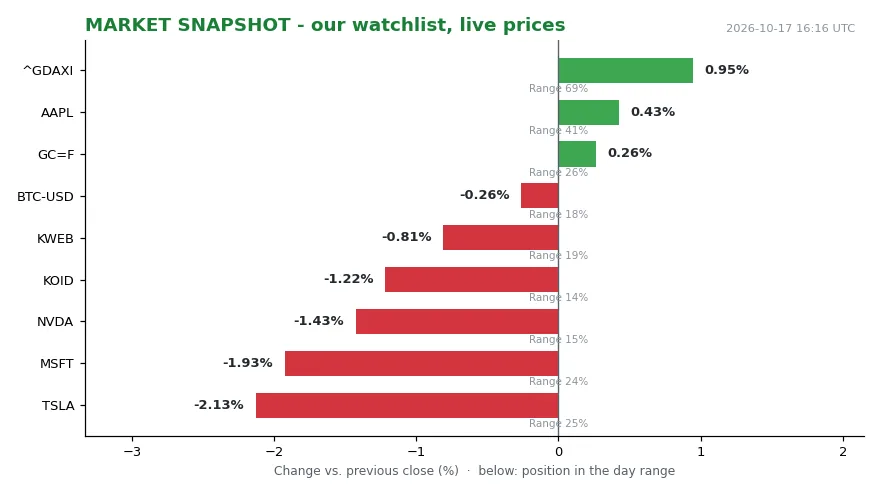
Start with our own tape, pulled at 16:12 UTC on Oct. 17. Nvidia printed 214.13, down 1.43% and sitting at 15% of its daily range — close to the lows. Microsoft traded at 529.05, off 1.93%, at 24% of range. Tesla was 2.13% weaker at 354.72. None of those single moves is dramatic. Together they point in one direction.
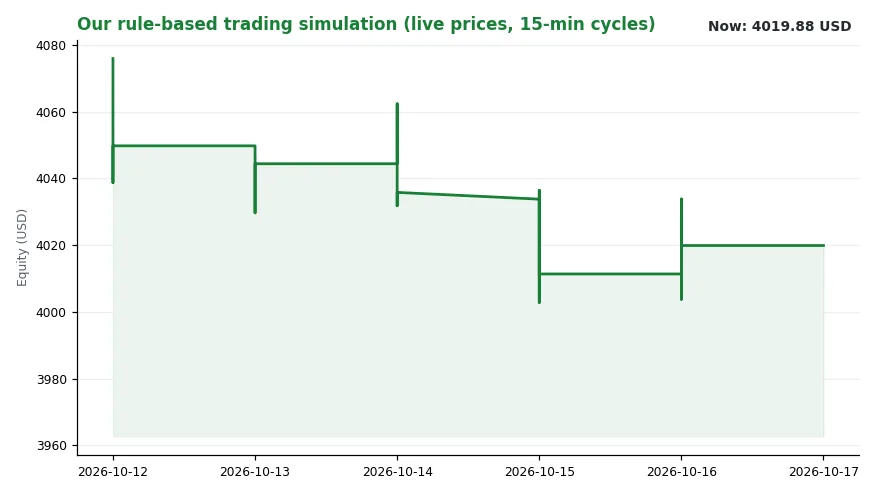
The other half of the same screen tells the opposite story. The DAX stood at 25,622.61, up 0.95% and sitting in the upper part of its range at 69%. Gold held 4,181.10, up 0.26%. Apple was the lone green line among the US single names on our watchlist at 343.46, up 0.43%. Our signal layer logged “central banks” as the busiest channel of the day, with five events. We read that combination as rotation, not retreat. Money is not leaving risk. It is changing which risk it wants to own. Our rule-based simulation stayed flat through it: equity at 4,019.88 USD, unchanged against the same time yesterday, cash at 2,014.07, latest decision WATCH KWEB at 0.00. No trade was the trade.
Now one piece of arithmetic that frames the week’s biggest story. In late 2021, Miro carried a valuation of $17.5 billion. Last month Bending Spoons agreed to buy it for $1.36 billion. That is roughly eight cents for every dollar of that peak. Airtable, agreed in August at about $1.3 billion, changed hands almost 90% below its late-2021 valuation. [1] This is the aisle Bending Spoons shops in. This week the shopper got a reference letter from the most famous holding company on earth.
Berkshire Hathaway disclosed a $330 million stake on Wednesday. Its total investment in the Milan-based firm now exceeds $900 million. Bending Spoons describes Berkshire as a “longstanding inspiration” for its strategy. The stock jumped 41% on the disclosure, gave some of it back later in the week, and settled at a market capitalization of roughly $30 billion. Friday’s close was $47.07, against a $29 offer price at the June 30 IPO — a gain of about 62% in under four months.
The implication runs wider than one ticker. Mizuho analysts framed it after the announcement: “Berkshire’s decision to add to its position just a few months after the IPO and at these levels provides another vote of confidence in the Bending Spoons model from one of the world’s most respected long-term investors.” What the Mizuho note actually prices is not a product but a model — the machinery that buys faded software and squeezes cash out of it.
The channel: cost of capital, running both ways
The mechanism here is not a new feature release. It is the price of money and the price of credibility. On one side, a Berkshire endorsement lowers what Bending Spoons pays to borrow and what it costs to be believed in a negotiation. On the other, it validates a strategy built without exits, in a market that has stopped offering them.
For a decade, the leading buyers of discounted software were private equity firms — Thoma Bravo and Vista Equity Partners chief among them. Their logic was financial engineering with a door at the end: cut costs, consolidate, then sell or list at a higher multiple. Bending Spoons runs different machinery. It does not plan to sell what it buys. It plans to keep it and harvest it, closer to the Buffett template than to the buyout template, with an operating hand on product, software and personnel decisions.
The company’s own history explains the instinct. Bending Spoons launched in 2013, founded by friends Luca Ferrari, now CEO, Matteo Danieli and Francesco Patarnello. A mobile app they had built, Evertale, failed to take off. According to the IPO prospectus, they took the $40,000 they had left and built an operating company instead of “products nobody wanted.” The deal list has since become the strategy. Evernote came in 2022, Brightcove in 2024, then Vimeo, AOL and Eventbrite in 2025. The AOL purchase followed $2.8 billion in debt financing. The Eventbrite agreement was worth roughly $500 million. Airtable was the first post-IPO acquisition, and Miro followed last month.
The first public scorecard arrived in August. Revenue more than doubled year over year to over $700 million, with growth almost entirely driven by acquisitions, while net income climbed 171% to $177 million. Ferrari told CNBC that the “overwhelming majority” of future growth comes from doing more deals, and added: “There are certain opportunities for improvement we can unlock over the first few years, and then the business will have whatever organic growth is intrinsic in that market.” [1]
The bill for the model
The second big announcement this week was the cost side. Bending Spoons said Monday that a “large portion of the pre-acquisition team” at Airtable would be leaving, with “substantial separation packages.” The same pattern ran earlier through Evernote, Vimeo, WeTransfer and other portfolio companies. In our reading, the job cuts are not a side effect of this strategy. They are its arithmetic.
The backdrop has a name now. Shares of Intuit, HubSpot and Adobe are each down at least 30% this year, as Anthropic and OpenAI march toward trillion-dollar valuations and budgets that once bought seats buy agents instead. [1]. Private SaaS companies that were venture darlings a few years ago are struggling to find capital, and the public market shows no appetite for their IPOs. Ethan Kurzweil, founder and managing partner at Chemistry VC, put the binary bluntly: “You’re either like a hot thing or you’re nothing.” He uses Airtable himself and says there are plenty of good SaaS products led by solid teams, “but they’re not on the frontier anymore.” We map the winners. Berkshire gets a technology vehicle that behaves like a cash-flow vehicle. Sellers get liquidity in a market that offers very little of it. Bending Spoons gets scale, plus a currency — its own stock — that just got re-rated. We map the losers. Employees of acquired companies carry the visible cost. Customers carry the quieter one. And the incumbent buyout funds carry the strategic one.
Nick Mehta, former CEO of Gainsight, explained why private equity is on the sidelines: “They paid much higher prices and have so many troubled companies that it’s difficult for them to take swings now.” He added: “Unfortunately, a lot of my friends in that game are stuck,” and: “Investors want out but there are no buyers. Anything pre-ChatGPT is legacy now.” In Silicon Valley, Mehta said, “Bending Spooned” became a verb — companies scooped up for pennies on the dollar. [1]. Bending Spoons told CNBC it had not been outbid for a target in “several years.” [1] Thoma Bravo and Vista did not respond to interview requests.
Where the model becomes visible
The customer-facing mechanics are the part anyone can check. Months after buying Evernote, Bending Spoons lifted the annual personal subscription to $130 from $70. Later it restructured the lineup entirely: $100 for a starter plan and $250 for “Evernote Advanced,” against the $170 it had charged for pro. Lloyd Walmsley, the Mizuho analyst who covers the name, described his own reaction: “My first reaction was like, Oh man, I guess I have to switch to OneNote.” He stayed. His reason is the thesis compressed into a sentence: “They’re really savvy at finding these things that they provide a lot of value, and the switching costs are really high.” He added: “The price isn’t that high relative to the switching cost.” Walmsley also drew the line between this operator and the buyout crowd: “I think there aren’t a lot of people that do what these guys do in terms of the depth of operations and the willingness to make substantial product changes.” And: “It’s not typical of traditional private equity firms to make anywhere near this level of change.” Ferrari’s account of why enterprise software suddenly looks cheap is less dramatic than the “SaaSpocalypse” label. “Most enterprise SaaS businesses were valued at irrationally high levels until somewhat recently,” he said. “We never saw those prices making any sense.” On the August call, an analyst asked whether Airtable signals a permanent shift toward enterprise. Ferrari’s answer: about half of revenue already comes from professional businesses, largely through Brightcove and Vimeo, which has an enterprise component. The recent focus on software reflects where he finds value after a heavy selloff.
What we watch next
Three things, in order of information value. First, the next two quarterly reports. The August numbers predate the Airtable close and predate the Miro announcement entirely, so nobody outside Milan yet knows whether cost cuts and price increases compound or cancel. Second, retention after the increases — each of these businesses sells a habit, and habits are priced in switching costs, not feature lists. Third, whether Berkshire adds again. A $330 million add-on shortly after an IPO is a signal; a second one at a higher price would be a conviction statement.
The honest uncertainty sits in one place. The whole model rests on customers deciding that leaving costs more than paying more. The products have to remain desirable enough that customers keep paying, at a time when AI is squeezing margins across much of the software sector. [1]. Whether AI raises or lowers switching costs is unsettled. If agents make migration cheap, the moat narrows. If agents make software stickier through data and workflow, it widens. Bending Spoons is buying the question in bulk.
There is a limit to what our data can say, and it is worth naming. Our tape measures prices, not retention. It can show that Nvidia sits near the low end of its range while the DAX sits near the top of its own. It cannot show whether an Evernote user renews in March. The deal record measures prices paid, not post-deal churn. It tells us Airtable went for a tenth of its peak. It does not tell us how many of its users will still be there in two years.
That gap is the interesting part rather than a flaw. A market that prices software at eight cents on the dollar is making a claim about the future of software. Bending Spoons is the first company to take that claim to public markets at scale, with the most credible balance sheet in the world standing behind it. The scoreboard arrives quarterly, in revenue, in renewals and in headcount. We will keep watching the tape — and the renewals.
This article is educational analysis, not investment advice.
Sources
Mentioned organisations (context, not sources)
- Nvidia — Organisation (homepage)
- Microsoft — Organisation (homepage)
- Tesla — Organisation (homepage)
- Apple — Organisation (homepage)
- Miro — Organisation (homepage)
- Airtable — Organisation (homepage)
- CNBC — Organisation (homepage)
- Mizuho — Organisation (homepage)
- Evernote — Organisation (homepage)
- Brightcove — Organisation (homepage)