Australia AI Build-Out Meets Its Own Grid
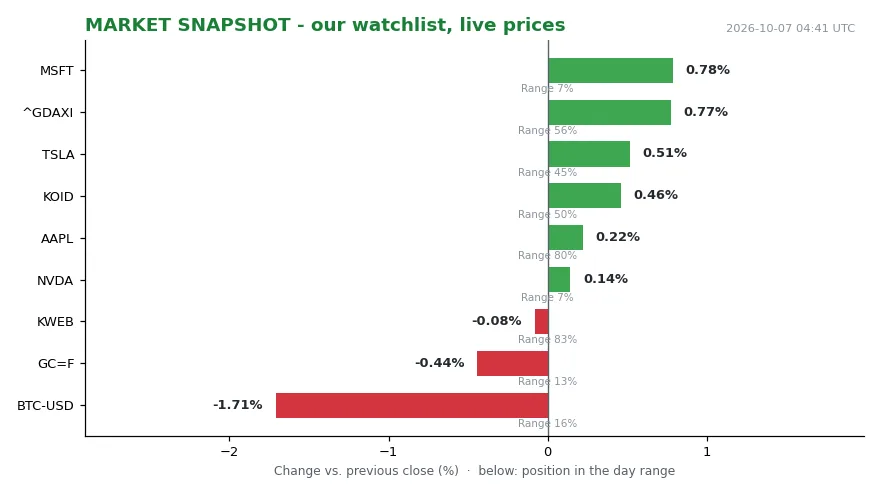
Nvidia traded at 239.24 in our watchlist snapshot of 2026-10-07 04:38 UTC, up 0.14 % against the previous close but pinned near the bottom of its daily range, roughly 7 % of the way up from the session low. Microsoft printed 529.30, down 0.78 %, and it too sat at just 7 % of its range. Apple moved the other way, at 333.63 and up 0.22 %, holding near day highs at 80 % of range. Bitcoin was the weakest line on the board at 84,039.88, down 1.76 % and near its low at 13 % of range, while gold slipped 0.43 % and also sat near the bottom, at 15 % of its range.
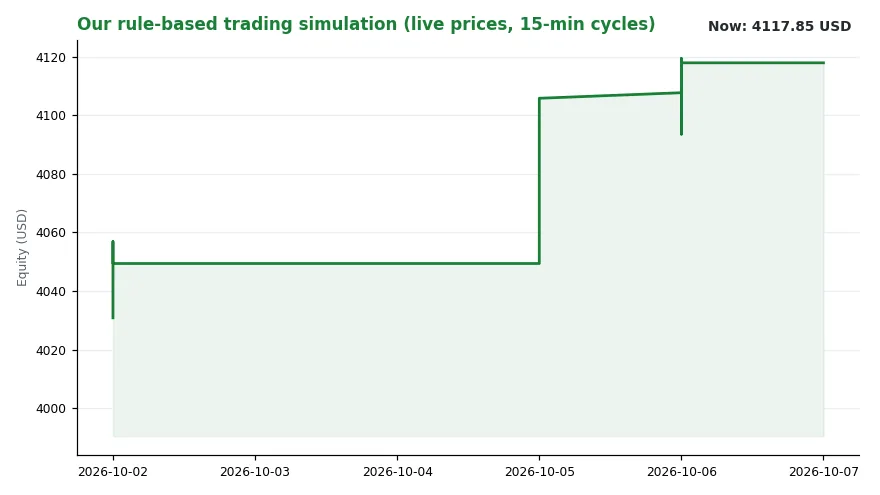
That is not a broad risk-off tape. It is a split one. The compute-linked names sit on the floor of their daily ranges while Apple sits at the ceiling, and the two lines that usually catch flight capital, gold and bitcoin, both lean low. Our regime reading says trend = falling, level 3.63. The busiest signal channel on the day was central banks, with 2 events. The sim book stands at 4,117.85 USD, flat against the same time yesterday, with 2,081.91 USD in cash and a latest decision of WATCH KWEB at 0.00.
This is the weather into which a very physical story arrives: whether Australia can host the datacentres its AI build-out requires, and what happens when the neighbours object.
What the news actually says
Rural Queenslanders have seen gas projects come and go. The 725-hectare datacentre now proposed for the region is a different kind of arrival, and the local reaction has been correspondingly sharper.
The Guardian’s Full Story episode, published 6 October 2026 and presented by Reged Ahmad with technology reporter Josh Taylor, frames the question directly: technology companies are pushing to expand AI infrastructure across Australia, and residents from suburban Melbourne to regional Queensland are raising concerns over noise, power demands and local impacts. The episode asks whether growing community opposition could slow a nationwide infrastructure boom, and whether government regulation can address those fears. It was produced by Taylah Strano and Lu Hill, who also handled sound design and mixing, with Hannah Parkes as executive producer.
Three linked reports give that frame its weight. A Guardian report dated 5 October 2026 describes a 725-hectare datacentre in Queensland, its headline rendering the local reaction as a “whole new level of ‘stupidity’”. [1] A 3 October piece covers questions over a multibillion-dollar ASX float by Firmus amid datacentre backlash, under the headline quote “These guys are just coming from nothing”. [1] And on 28 September, a plan for a controversial $1.2bn datacentre in Sydney was scrapped due to “emerging” regulations. [1] Three concrete findings, then: a 725-hectare proposed site in Queensland, a contested multibillion-dollar listing, and a $1.2bn project that died before it was built.
The mechanism: permission is a price
Datacentres are not ordinary buildings. The concerns the episode attributes to residents are specific — noise, power demands, local impacts. Those are physical effects with planning consequences.
The channel into markets runs through permission, not demand. The Sydney outcome shows the shape of it: when regulations are described as emerging, a developer cannot price the conditions under which it will be allowed to operate. Unpriced permission behaves like a risk premium, and a risk premium is a discount on the asset.
Delay is the second channel. A datacentre that slips two years does not lose its revenue; it pushes that revenue into the future while capex and financing costs run today. For a company in the middle of a listing process, that mismatch lands directly in the valuation conversation, which is why the Firmus coverage and the community backlash sit in the same headline.
Expectations form the third channel. If opposition does slow projects, that assumption gets revised at the margin. Our snapshot is consistent with hesitation rather than rejection: Nvidia and Microsoft both finished near the floor of their ranges, even as the German index held mid-range at 25,449.19, up 0.77 %.
Consistent is not causal, and the tape alone does not prove that datacentre politics is what moved these names.
Who wins, who loses, who decides
Residents are the actors with the least formal power and the most immediate stake. Noise, power demand and local impact are lived costs that appear in no model until they become planning objections.
Developers and hyperscalers carry the capital risk, and their exposure is now reputational as well as financial. The Queensland proposal at 725 hectares, the Firmus float and the abandoned Sydney project are three different attempts to turn land and electricity into compute, and each has run into a different kind of friction.
Regulators and planning authorities hold the decisive lever, because “emerging” regulation is also a decision to move slowly. Their choices will determine whether Australia’s build-out is set by grid capacity and planning law or by withdrawal and dispute.
Investors sit downstream, repricing all of it. The question the market will eventually answer is whether Australian AI infrastructure is a permitted asset class or a contested one.
What to watch next
Three things. Whether more projects follow Sydney out of the door under regulatory uncertainty — one withdrawal is an incident, a pattern is a policy. How the Firmus float prices against visible community objection, since a float is the moment private doubt becomes a public number. And our own tape: whether Nvidia climbs out of the low end of its range, whether the rotation into Apple persists, with central banks still the busiest channel at 2 events and the regime still reading trend = falling at level 3.63.
What remains open is the question the episode raises and does not settle. If a country can build the datacentres but cannot persuade the people who live beside them, does regulation resolve the objection or merely relocate it? That is not a forecast. It is the thing the next planning decision will have to answer.