
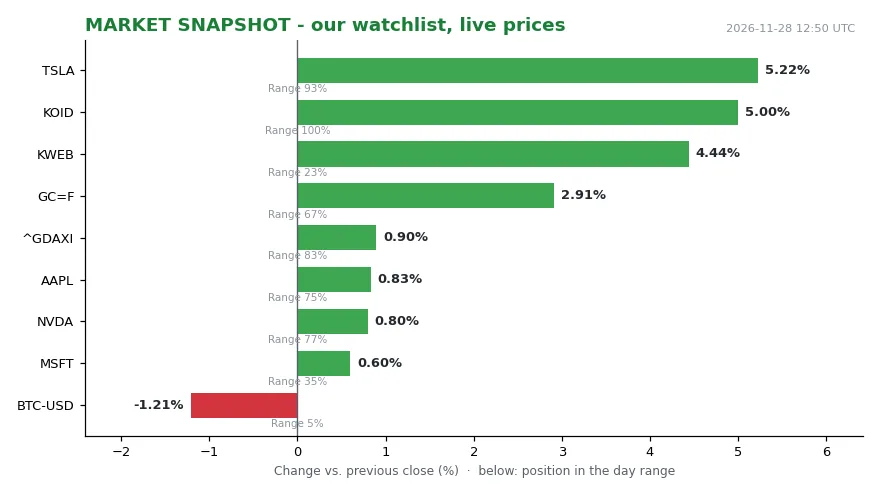
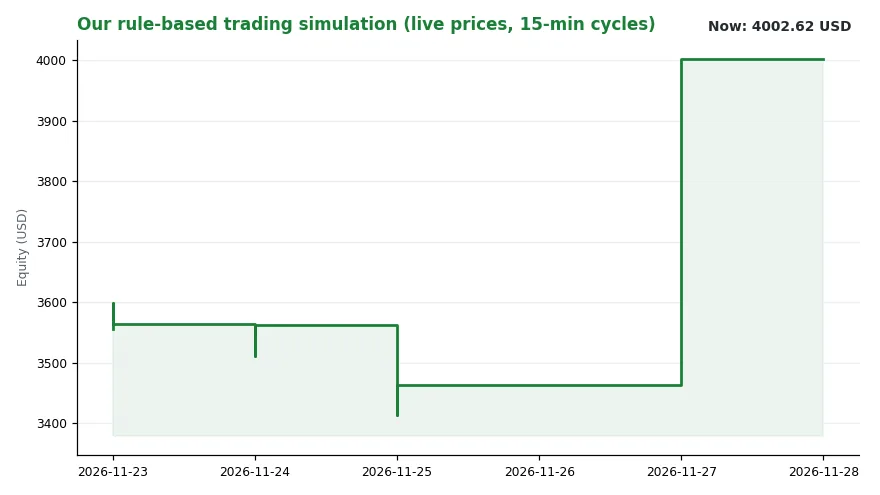
At 12:47 UTC on 28 November 2026 our watchlist showed TSLA at 400.00, up 5.22 percent and sitting 93 percent of the way between its daily low and high. KOID printed 32.15, up 5.00 percent, at the extreme top of its range — 100 percent. Gold, GC=F, stood at 3668.50, up 2.91 percent and at 67 percent of range. Bitcoin declined the invitation: BTC-USD at 59165.87, down 1.17 percent, at 7 percent of range, close to the day’s low. NVDA at 150.49 was up 0.80 percent at 77 percent of the way between its daily low and high; the ^GDAXI (the German DAX index of blue-chip shares) at 25441.24 was up 0.90 percent at 83 percent. That is not one broad wave of appetite. It is a split tape: buyers were paying the asking price for single names and indices near their highs, buyers were paying the asking price for gold, and sellers were accepting the highest bid for crypto. That is a rotation, not a mood. Our rule-based classification of market direction says the trend is falling and the strength level is 3.63. Our rule-based simulated, not real-money, portfolio stands at 4002.62 USD, flat against the same time yesterday, with 1996.72 in cash. Its latest logged decision is WATCH KWEB @ 0.00. The busiest signal channel of the day is “central banks”, with two events. None of this is a forecast, and we will not treat it as one.
Here is the comfortable story that gets told about a tape like that. Prices are near highs, therefore the economy underneath is holding up. A rising index gets read as a health certificate for the shop on the corner. That reading is wrong, and a butcher’s shop in Lincolnshire is the cleanest reason to say so plainly. Large listed firms get priced on expectations about distant cash flows. A high street counter gets priced on next month’s wage bill and next quarter’s electricity bill. The two can drift apart for a long time without either one lying.
What actually happened on Winsover Road
Bennett Butchers sits on Winsover Road in Spalding, Lincolnshire. Henry Bennett opened it in 1899. Andrew Parsons, his great-grandson, runs it today as the fourth generation of the family to do so. On 18 October the shop announced it would close. After 127 years of trading, it is closing later this year. This is not a story about empty shelves. The shop has been heaving. In the owner’s account it “sold more meat over the last six weeks than we would over two Christmases”. Customers filled freezers and posted. An anonymous individual paid homage to the business with a plaque. Parsons said it “arrived unannounced on Wednesday evening” and called the wording — which celebrates the shop’s long-standing customer service — “fantastic” and “amazing”. A profitable shop with record demand is closing.
What the quiet counter hid
Two explanations compete for this closure. The first says demand failed: the town drifted to supermarkets, the trade went online, the counter went quiet. The reported facts undermine that theory. Parsons said the shop was still popular and profitable [2]. The owner’s own words are: “We’re still a profitable business, but we’re not as profitable as we were” [2]. The second theory says cost base and reinvestment threshold failed. That one survives contact with the facts. “We’re a labour-intensive business. We’re also high energy users,” the owner says, adding the National Insurance rise (a UK tax on wages, paid by employers and employees) from the previous year and “all these [things]”. The result, in his phrasing, is “very, very difficult” [1]. Then comes the sentence that matters most: “we’ve reached a point where we need to invest a lot of money in the business to drive it forward” [2]. [2] Profitable is not the test. Investable is the test. A shop can pass the first and fail the second.
The mechanism is cost structure, not sentiment
The channel here runs through inputs, not through consumers. Labour-intensive firms carry costs that scale with headcount. Energy-intensive firms carry costs that scale with kilowatt-hours. Neither of those costs scales with revenue. A National Insurance increase lands on the first line directly. A high electricity price lands on the second. For a business with thin margins, both land in the same year, and the fixed base grows while the sales counter stays the same size. Policy has an answer, and the Treasury gave it. A spokesperson points to “business rates support and action to cut costs for firms”; business rates are a UK property tax on commercial premises. The Employment Allowance — the amount of employer National Insurance a firm can offset — is being doubled to £10,500. Electricity bills are “being cut by up to 25% for over 10,000 eligible businesses”. That 25% is the figure to hold on to. It is a real number and a real relief. It is also gated by eligibility and capped by design. Cost scales with input; relief scales with a threshold. When input grows faster than the threshold, the gap widens quietly, and it never shows up in a demand statistic. It shows up in a decision about whether to put money into a shop.
Who decides, who pays, who watches
Four sets of actors meet in Spalding. The owner decides whether to invest, and he has decided not to — though he is not leaving the trade. He plans to “relax” first, because this is “the first Christmas that I haven’t worked for 44 years”. He hopes to stay in the meat industry. The staff face redundancy and, in his description, have “been amazing”; he is relieved that many of them already have new jobs. Customers decided something too, and they decided it hard for six weeks, in the form of freezers and a plaque. The Treasury decides the reliefs, and whether the eligible group is wide enough is a policy question rather than a market one. On our tape a fourth kind of actor prices all of it from a distance. Gold at 3668.50 and bitcoin at 59165.87 are two different answers to the same question about safety, and they were given on the same afternoon.
What we watch next
First, delivery: whether the allowance figure and the 25 % cut reach the firms named as eligible, and whether firms just outside the eligibility line notice. Second, whether the pattern repeats. Alongside this closure sit three further long-history closures — a century-old cafe, a garage after 107 years, a store after 104 years. Three links are not a trend, and we will not dress them up as one. They are, however, the kind of evidence that would confirm the cost-threshold reading over the demand reading. Third, our own tape: a falling trend reading at level 3.63, with gold bid and bitcoin offered, is a configuration that can resolve either way. Fourth, the sim book, sitting at 4002.62 USD with 1996.72 in cash and a logged decision to watch KWEB rather than act. The honest position is cash and attention.
The caution matters, because this case is easy to misuse in two directions. One misuse reads a single butcher’s closure as proof that the whole economy is cracking. The other reads a green index and a doubled allowance as proof that nothing needs fixing. Both moves overreach the evidence in front of us. One shop is one shop; one relief is one relief. The narrower and more defensible statement is this: here was a business that was popular, profitable, and still not worth reinvesting in. The Treasury has published its relief numbers and will be asked about them; the staff have largely moved on; the town has a plaque to look at. On our side the position stays cash, a falling trend reading and no filled orders.
Quoted material (verbatim from source):
[1] “We’re a labour-intensive business. We’re also high energy users. The hike in National Insurance from the government last year and all these [things], they all make it very, very difficult.” [2] “We’re still a profitable business, but we’re not as profitable as we were. And we’ve reached a point where we need to invest a lot of money in the business to drive it forward.” HM Treasury spokesperson: “business rates support and action to cut costs for firms”; “doubling” the Employment Allowance to £10,500; electricity bills “being cut by up to 25% for over 10,000 eligible businesses”. “sold more meat over the last six weeks than we would over two Christmases” “arrived unannounced on Wednesday evening”; “fantastic”; “amazing”
“relax”; “the first Christmas that I haven’t worked for 44 years” staff “been amazing”; many now in new jobs. Data note: Market figures are our own measurement, quotes fetched 0 min before the timestamp 2026-11-28 12:47 UTC, from our watchlist and rule-based sim book. Company reporting from BBC News (syndicated via Yahoo). Educational analysis only.