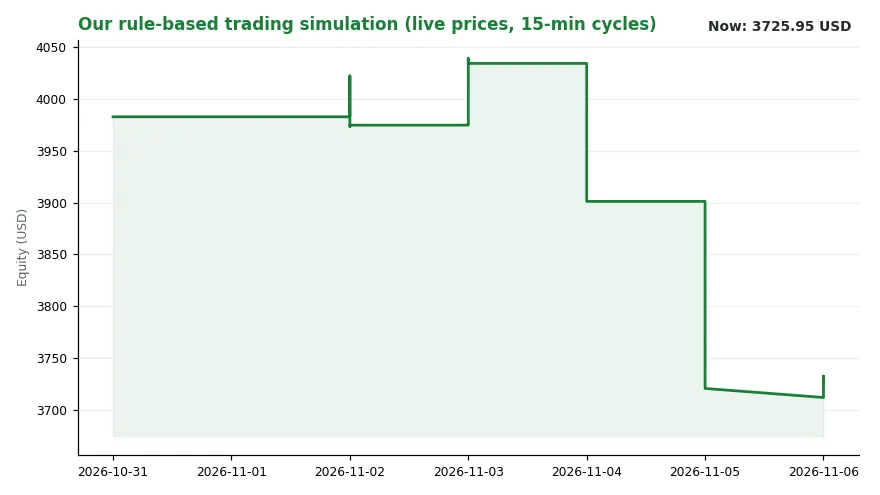
At 03:22 UTC on November 6, our watchlist told a split story. NVDA printed 181.60, down 9.26 percent against the previous close, sitting 1 percent of the day’s range above its low. TSLA traded at 343.69, down 10.77 percent, 9 percent of the range off the bottom. MSFT showed 535.93, down 3.58 percent, near the lows at 13 percent of range. AAPL stood at 344.17, down 1.53 percent, 3 percent of range from its low. Gold, GC=F, was 4065.50, down 1.17 percent. BTC-USD was 75911.58, down 0.09 percent, near its low at 12 percent of range. The German DAX was 26325.01, down 0.43 percent, 22 percent of range from the low. And then the outlier: KWEB at 24.76, up 1.81 percent, sitting mid-range at 55 percent.
That is not a uniform risk-off day. It is a rotation with a direction, and the direction is visible in the tape. The U.S. AI and semiconductor complex sold. Chinese internet exposure bought. Both readings come from the same two-minute fetch, so the comparison is clean. Our regime flag reads trend=falling, level=3.63. The signal layer logged “other” as the busiest channel on November 6, with 5 events. Our simulated book sat at 3729.03 USD, up 0.23 percent versus the same time yesterday, with 2208.19 in cash. The latest simulated decision was WATCH KWEB at 0.00. None of this is investment advice; it is a documented, rule-based paper book.
Now the news that sits underneath that tape.
The news on the table
Democrats swept this week’s U.S. midterm elections. They took majorities in the House and in the Senate. They flipped governors’ offices in Texas, Nevada and Iowa. Most of the new winners will not begin their terms until January.
That calendar matters as much as the result. Before January, President Donald Trump and Chinese President Xi Jinping will likely meet twice, according to the source. [1] One meeting is slated for Shenzhen this month. The second is slated for Miami, Florida, next month.
The immediate market question is narrower. Does a Democratic Congress change the price of tariff risk, of export-control risk, or of a Taiwan shock? And in what order?
Gabriel Wildau, managing director at Teneo, framed the president’s incentive structure in an email: “As a lame duck who is increasingly focused on his personal legacy rather than the Republican Party’s success, Trump may resist increased pressure for confrontation with China and continue his pursuit of ‘strategic stability.’” [1] That is a claim about incentives, not about outcomes. A president with two summits booked has a reason to keep the calendar intact.
The legislative side follows. High on the Democrats’ agenda is removing Trump’s tariffs, CNBC has learned, as part of a broader focus on domestic inflation. [1] That is the disinflationary channel, and it runs through prices rather than through geopolitics. It also runs into a wall. Tariff authority has sat largely with the executive branch, and a new majority cannot simply switch it off in January.
Scott Kennedy, senior advisor and trustee chair in Chinese business and economics at the Center for Strategic and International Studies, described the net effect this way: “On balance as a result of the midterms the Democrats may nudge the U.S.‘s China policy in a more hawkish direction through hearings and legislation, particularly on economic security issues and Taiwan.” He added the constraint in the same breath. Any such effort will “be constrained by the executive branch’s wide range of latitude and China’s growing power and leverage, which can’t be easily undone.” So the mechanism is not a single lever. It is three channels moving at different speeds.
The channel
Channel one is expectations about tariffs. A Congress that wants tariffs gone changes the forward curve for import prices and for inflation. It does not change the current tariff schedule. Markets can price the first without ever seeing the second.
Channel two is regulation and export controls. Over the last several years, the U.S. government tightened restrictions on the ability of Chinese companies to buy advanced chips from Nvidia. That spurred Beijing’s efforts to develop its own version of the technology. George Chen, partner and co-chair of digital practice at The Asia Group, pointed to an “emergence of a broader consensus in Washington that America’s technological lead should not be used to strengthen China’s military or strategic capabilities.” He noted that a Democratic Congress may be motivated to be more aggressive. His conclusion: “As a result, Beijing may discover that technology becomes a growing source of friction even if Trump and Xi continue to maintain relatively cordial summit diplomacy.”
Channel three is Taiwan, and it carries the fattest tail. Chen wrote: “Taiwan remains the most dangerous issue in U.S.-China relations and, in my view, the area where a Democratic Congress is most likely to challenge Beijing.” He grounded that in an observed pattern: “Congress has repeatedly shown a willingness to pursue Taiwan initiatives even when administrations are more cautious.” Nancy Pelosi visited Taiwan in 2022 while serving as House Speaker, and the trip angered Beijing, which considers the democratically self-governed island part of its territory. The U.S. maintains unofficial relations with Taiwan under a “One China” policy. Minority Leader Hakeem Jeffries of New York, who is poised to become the first Black Speaker of the House in U.S. history, met in 2023 in New York with Tsai Ing-wen, then president of Taiwan.
Beijing has also set its own marker. During Trump’s trip to Beijing in May, Xi warned that mishandling Taiwan would put U.S.-China relations in “great jeopardy.” The Taiwan channel now runs straight through the AI trade. The island is home to semiconductor giant TSMC, which manufactures many of Nvidia’s chips. Maintaining stability there has grown more critical as the AI race has intensified. That link explains why a legislative calendar in Washington can show up in a semiconductor multiple in Santa Clara.
The actors
The executive branch holds most of the operational latitude. It negotiates, it sanctions, it controls much of the export-control machinery, and it sets the tone of summit diplomacy. Trump holds two summits and, on Wildau’s reading, a legacy argument.
Congress holds hearings, legislation and the microphone. Hearings move expectations before they move law. Legislation moves law slowly. Neither is trivial for a market that trades on the next headline.
Beijing holds leverage of its own. It has hosted a flurry of global leaders this year, while major economies have struggled to slow a surge of imports from China. Chinese dominance in rare earths has given Beijing leverage in trade talks with the U.S. and with the EU.
On the equity side, our own tape shows the split already. WisdomTree’s Liqian Ren attributed part of the support to Beijing’s latest regulatory intervention, while tying performance ultimately to global investor sentiment on AI: “There’s a lot of uncertainty on how much AI can deliver for U.S., or for China.” Our snapshot is a single timestamp, not a trend. The source reports that U.S. stocks surged Wednesday after Trump accepted the Democrats’ election wins, and that Apple and most “Magnificent Seven” tech stocks surged despite declines in Nvidia. [1] A one-day pop and a next-morning sell-off are compatible. They simply describe different horizons.
The midterm result is real. The two summits are scheduled. The January seating date is fixed. The tariff agenda is reported, not enacted. The hawkish tilt is Kennedy’s expectation, not a vote count.
What we watch next
First, whether the Shenzhen meeting happens and what emerges from it. Second, whether Miami follows. Third, the January seating and the first committee chairs. Fourth, whether tariff legislation reaches a floor vote, and on what timeline. Fifth, export-control actions, which remain largely executive. Sixth, the spread between KWEB and NVDA in our own data, the cleanest read we have on whether the rotation persists or reverses. Seventh, gold at 4065.50, down 1.17 percent in our snapshot, is not pricing a Taiwan shock in our reading. Eighth, our regime flag, still trend=falling at level 3.63.
Kennedy’s constraint cuts both ways: a Congress can push, and an executive can absorb. Chen’s friction forecast can be right about direction and wrong about speed. Ren’s AI question has no answer yet.
What we can say with the data in hand is narrower and more useful. The truce has two dates on the calendar. The Congress has none until January. Between a scheduled handshake and an unscheduled hearing, the tape has already begun to answer in two directions at once.
Sources
Mentioned organisations (context, not sources)
- Democratic Party — Organisation (homepage)
- U.S. House of Representatives — Organisation (homepage)
- U.S. Senate — Organisation (homepage)
- Teneo — Organisation (homepage)
- Republican Party — Organisation (homepage)
- CNBC — Organisation (homepage)
- Center for Strategic and International Studies — Organisation (homepage)
- U.S. Congress — Organisation (homepage)
- U.S. Government — Organisation (homepage)
- Nvidia — Organisation (homepage)