
A Field Guide to Europe’s Stressed Factories
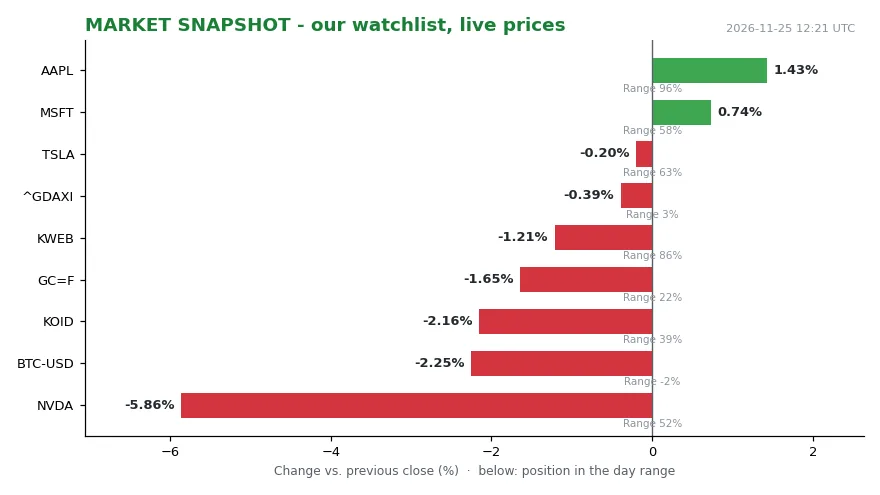
At 12:19 UTC our watchlist described a market that was sorting itself rather than falling. NVDA printed 155.38, down 5.86% and parked mid-range at 52%. AAPL traded at 354.07, up 1.43% and near the day’s highs at 96% of range. ^GDAXI stood at 24,946.99, off 0.28% and pinned to the floor of its range at 0%. Gold at 3,526.50 (-1.80%, 16% of range) and bitcoin at 58,505.88 (-2.08%, 6% of range) both leaned toward their lows. MSFT added 0.74% at 496.13, mid-range at 58%, while TSLA slipped 0.20% at 384.68, mid-range at 63%. Our regime reading logged trend=falling, level=3.63. The busiest signal channel of the day was “central banks”, with two events. Sim equity was 3,562.15 USD, unchanged against the same time yesterday, with 1,779.94 in cash and the last logged decision a WATCH on KWEB. Read together, those numbers look like rotation rather than flight: out of AI hardware, out of hedges, into mega-cap software (MSFT +0.74%). That is one afternoon of positioning among US names, and it proves nothing about factories.
The phenomenon
A report that landed next to that tape describes the slow version of the same sorting. McKinsey & Company’s Industrial Financial Health Index tracks almost 1,200 listed and privately held European manufacturers, each with more than €100 million in revenue. Its 2025 scores rest on full-year figures from S&P Capital IQ. The headline is arithmetic: about 45% of the firms in the study were classed as stressed or distressed in 2025. That compares with 39% in 2023 and 42% in 2024. Preliminary figures for 2026 suggest the share is rising even faster. Behind the percentage sits roughly 3.7 million jobs that the consultancy says are directly at risk. [1] Behind it also sits more than €500 billion in value added, a measure of these companies’ contribution to economic output rather than their revenue.
Scale is what makes the number a market story instead of a corporate one. Industrial companies account for about 36% of European value added. They carry 29% of jobs and more than 45% of research and development. A sector with that footprint transmits weakness into credit, into hiring, and into the investment figures that growth forecasts are built on. Yet McKinsey describes the problems as “structurally fixable”. [1] That phrase is the hinge of the entire document. And because privately held firms sit inside the index, much of the stress will never appear as a share-price move.
The characteristics
The index does not rest on a single ratio. It tracks five financial warning signs. Two are named directly in the report: a sharp drop in earnings, and high debt relative to earnings. Stress, in this taxonomy, is not a mood; it is a measurable condition on a balance sheet, visible year after year.
The habitat
The habitat matters as much as the condition. Portugal ranked worst among the countries covered, holding the highest share of stressed or distressed industrial firms in 2025. Luxembourg, the Netherlands and Spain came next in the ranking. Germany, the EU’s largest economy, saw its share rise by 12 percentage points last year. Volkswagen, the German carmaker, is going through what it has called its “deepest restructuring” in 89 years. One company is not an index; here it functions as an illustration of the index’s direction.
The mechanism
The channel the report identifies is cost, not demand alone. Higher labour and energy costs have eroded advantages European industry used to hold, particularly against China. McKinsey’s automotive R&D analysis puts labour productivity in China at 1.5 times Europe’s level. Industrial electricity prices in Europe averaged more than 1.5 times those in China and in the US. Those two gaps push more than half of the EU industrial value chain’s costs into a disadvantage against China. Cost gaps of that size do not appear as a single bad quarter. They appear as a quiet relocation of the next investment decision.
The investment numbers make that relocation visible. McKinsey measures gross productive investment: infrastructure, non-residential buildings, machinery, software and R&D. China’s spending on those assets climbed over three decades to about $6 trillion in 2025, or €5.5 trillion. Europe’s spending has barely moved and stands at roughly $3 trillion, or €2.7 trillion. Slow build on one side, near-flat line on the other: that is how a two-to-one ratio forms. Mario Draghi’s 2024 report on EU competitiveness framed the same gap as a financing task. It called for an extra €750 billion to €800 billion of investment a year to keep pace with China and the US.
The behaviour
The report is not only a diagnosis. It also studies five recent turnarounds in the sector. In one of them, a chemicals conglomerate generated more than €1 billion of free cash flow, meaning the cash left after operating costs and investment. Six success factors recur across those cases. They range from running the overhaul through a dedicated task force to selling or closing weak business units. Using AI to lighten administrative work is on the list as well. The consultancy that built the index also advises companies on restructuring, so the remedy and the measurement come from the same house.
The labour chapter will be read most closely in works councils. European rules, the report notes, allow companies to cut salary or benefit costs and to extend working hours for the same pay. Headcount can be trimmed through hiring freezes and natural staff turnover. Separation agreements are described as the last resort. At Mercedes-Benz, which has put new investment at its German plants on hold, one proposal under discussion would extend working time without extra pay. Three of the five turnaround companies cut labour costs by more than 15% within 12 to 18 months. Those cuts came without major protests or strikes. The report partly credits supervisory boards on which workers hold seats, and cooperative talks with labour representatives.
The distribution is uneven. Balance sheets with cash and a credible plan gain room to manoeuvre. Suppliers and regions attached to weak business units lose first, because selling or closing them sits early in the playbook. Workers give up hours or pay where the negotiated version prevails, and keep the site where it does not. Governments inherit the fiscal side of a closure without controlling the input the report ties to geopolitics: energy. The decisive actors are therefore boards, supervisory boards and works councils, plus the electricity market.
What to watch
Four checkpoints are narrow and verifiable: the 2026 index reading, where the preliminary figures already suggest acceleration and the full-year print will test that; Germany, where the share rose by 12 percentage points last year; Mercedes-Benz, where the working-time proposal is a live test of the negotiated model; and the investment line, where Europe’s $3 trillion has hardly moved and another flat year widens the gap to China’s $6 trillion by construction.
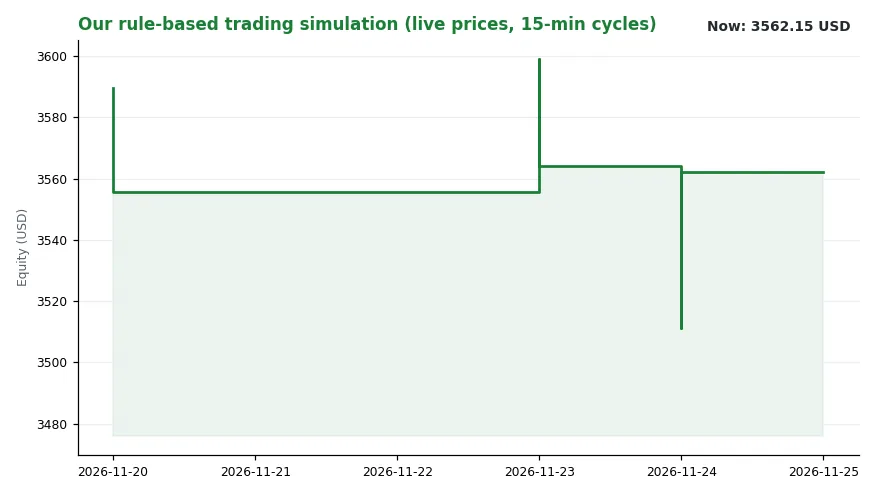
Energy costs hinge on geopolitics and other external factors that no index controls. Five turnarounds are a small sample, and survivorship may flatter them. A “structurally fixable” problem remains a problem until someone fixes it. The report’s own urgency is blunt: Europe’s industrial comeback “needs to start soon”. [1] Our tape offers no verdict on any of this. NVDA’s 5.86% decline and AAPL’s 96% of range describe one session among US names. Gold near its lows (16% of range) and bitcoin near its lows (6%) argue against a classic fear trade. Our regime reading, trend falling with level at 3.63, is a description and not a forecast. The sim account’s flat day and its WATCH on KWEB are recorded because the process is documented, not because they say anything about European manufacturers. Nothing above is a recommendation to buy or sell any asset.