The Score With No Ticker
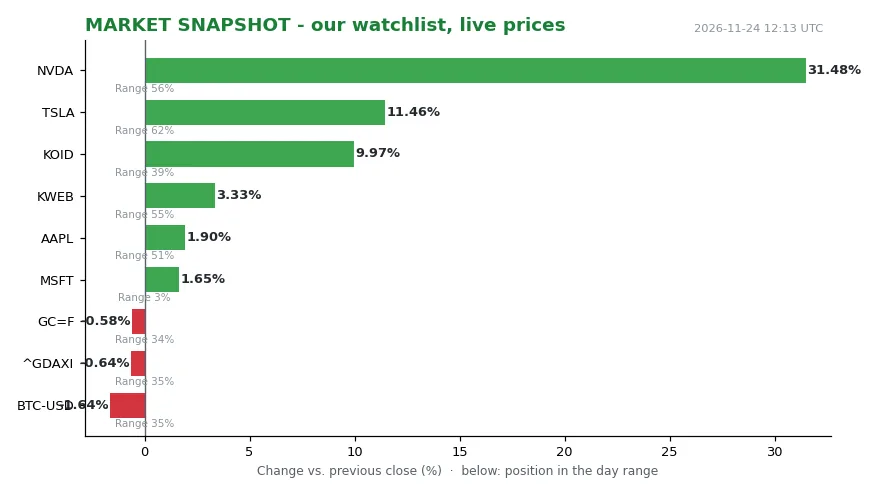
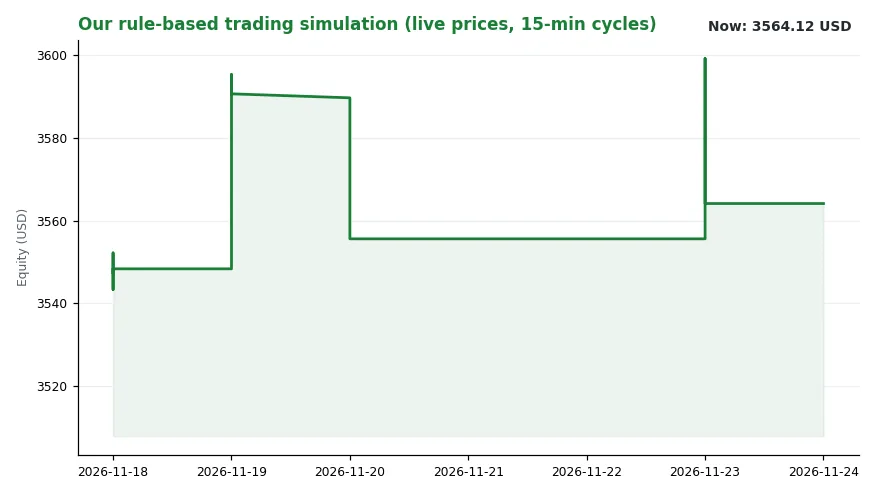
At 12:09 UTC on 24 November 2026 our watchlist showed dispersion rather than direction. Nvidia printed 165.05, up 31.48% against the previous close and sitting at 56% of its daily range. Tesla traded at 385.46, up 11.46%, at 62% of range. Microsoft stood at 492.50, up 1.65%, but pinned near the day’s low at 3% of its range. Gold slipped 0.41% to 3,636.40. Bitcoin fell 1.62% to 60,219.69. The DAX lost 0.62% to 25,180.63. Read together, that is rotation inside a falling regime: our reading has trend at falling and level at 3.63, and central banks were the busiest signal channel of the day on a single event. Our simulated book held 3,564.12 US dollars, flat against the same time yesterday, with 1,800.97 in cash and a latest rule-based decision to watch KWEB at 21.41. None of those quotes is a credit score. Experian, Equifax and TransUnion price nothing on a screen, and FICO — the score most US lending decisions hinge on — has no ticker in our watchlist either.
The anomaly in a mortgage file
Sophie Hope, a Brighton-based nail technician and content creator, applied for a mortgage and was turned down. Her own account of the sequence is blunt: “When I first checked my credit score, it was excellent. But then my mortgage application was suddenly denied by the lender because of my credit report. It was a massive shock as I’d never had bad credit. When I looked into it, my score had gone to ‘very poor’.” [1] The cause was not her spending. It was identity fraud. “Someone had opened accounts in my name across various catalogue sites and ordered multiple items, including a PlayStation 4 and Nike socks,” she recounts in the report. The merchandise is almost comic; the mechanics are not. “Without me knowing, the debt was transferred to a secondary finance company. It spent three to four years accumulating in the background. It was only when I went to apply for a mortgage that I discovered how severely it had dragged down my credit score.” Four years of invisible accumulation, then one visible decision, then a refusal.
The second anomaly: not wrong, just absent
Evangeline Atkinson’s case is the opposite failure and lands in the same place. While at university she was paying rent and bills, and was refused a phone contract costing 30 pounds a month. Her explanation: “When I dug into it, it was because I was completely invisible to the system. No record could be found for me at any of the big three credit reference agencies.” One borrower is misdescribed. The other is not described at all. Both are read by the same machinery.
What the file actually contains
Three firms — Experian, Equifax and TransUnion — produce credit scores in the UK, and they work from roughly the same underlying data. Consumer finance lawyer Funmi Olufunwa, founder of the financial education business Hoops Finance, names the design flaw directly: “A credit score is backward looking. It’s looking at what has happened in the past, which doesn’t necessarily predict the future.” [1] She adds a cultural diagnosis: “As a nation, we are overly obsessed with credit scores.” The distinction that matters is between a history and an affordability test. As Olufunwa puts it: “But when somebody’s looking to lend you money, they’re looking at what actually is affordable.” Traditional scoring also penalises so-called “thin-file applicants” — young people and recent immigrants to the UK who have not had time to build a record. Atkinson was one of them: at university, paying rent and bills for years, she was refused a 30-pound-a-month phone contract because no record of her existed at any of the big three agencies.
The mechanism: a gate, not a price
This is not a story about an index level. It is a story about a gate. A credit score sits between a household and the cost of borrowed money, and the gate determines who gets a mortgage, a car loan, or a phone contract. When the gate widens, credit volume and consumption can rise; when it jams, would-be borrowers are priced out or excluded outright. Three channels transmit any change. The first is data: the more variables a lender can lawfully read, the more applicants can be assessed at all. The second is regulation: who is authorised to hold and interpret that data, and on what terms. The third is trust, which is less measurable and moves slower. Our own tape reading shows how differently these things are priced. Nvidia moved 31.48% in a session and still sat in the middle of its range, while a person’s file can move from excellent to very poor without any visible print at all.
Who offers the wider gate
Two US firms, Upstart and Zest AI, have built businesses on the proposition that machine learning reads a borrower better than a score does. Upstart’s own description of its method: “Thanks to our machine-learning models that look at more than 2,500 variables, we believe we can make significantly more loans at low prices to borrowers from every demographic group.” Mortgage expert Sarah Tucker, founder and CEO of The Mortgage Mum, sees a broader analytical opening: “AI has the potential to help lenders analyse much broader sets of information, identify patterns more quickly and build a more individual picture of someone’s affordability and risk.” If thin-file applicants can be understood rather than filtered, she argues there is “a real opportunity to improve financial inclusion”. The three bureaus have already moved in the same direction. Experian announced a partnership with OpenAI in August 2026 that lets users check their credit score inside ChatGPT. Equifax launched a platform called Equifax Amplify AI, which it says uses machine learning to sharpen credit assessment and fraud detection. In March, TransUnion announced it was integrating Google’s Gemini models “within its proprietary analytic data assets”.
Who pays for the wider gate
Not everyone in the report treats the widening as progress. Sandra Wachter, professor of Technology and Regulation at the University of Oxford, points at what a model is actually doing when it scores a person: “We are not assessing if past decisions were right.” Her concern is that a model trained on historical lending decisions could “replicate what it has seen in the past”, including the inequalities already embedded there. Her warning is unambiguous: “Not putting any safeguards in place will fortify, foster, and enhance discrimination.” [1] Upstart counters that it has “invested in creating objective, automated evaluations to identify bias” and built them into its model training so the model “evolves to become even more accurate and more fair over time Atkinson, who built her own credit reference agency — Noggin HQ, founded in 2021 with a school friend and authorised by the FCA in June — deliberately avoided the technique, arguing it “carries the risk of inbuilt bias”. Her practical version of the worry: “It’s very sensitive data and it would be very easy for the models to be inferring various kind of protected characteristics.” Noggin HQ instead analyses current account transactional data. Tucker’s condition for any of this is procedural rather than technical: “Consumers need to understand what information is being used to make decisions about them, and they need to be able to challenge something when it is wrong.”
What we watch next
Three observable things, and honest uncertainty about all of them. First, whether regulators demand contestability as a condition of AI-assisted underwriting, which would turn Tucker’s “challenge something when it is wrong” from an aspiration into a workflow. Second, whether the new entrants and the incumbents converge on the same data — if current account transaction data becomes the standard input, the thin-file problem shrinks and the surveillance question grows. Third, whether consumers actually use the interfaces now being built on top of scores; a score inside a chat window changes how people check, not necessarily how lenders decide. Our own numbers offer no comfort either way: a falling trend reading, more than half the book in cash, a watch rather than a position on KWEB, and a signal layer that produced exactly one central bank event today. That is what low conviction looks like in a quote. In a credit file it looks like nothing at all — which is the point. The open question that remains is not whether a model can predict repayment better than a backward-looking score. It is whether the person being scored will ever be able to see the reason, and to say that the reason is wrong.
This article is educational analysis of a reported news story and of our own published measurements. It is not investment advice, and nothing here is a recommendation to buy or sell any security.
Sources
Mentioned organisations (context, not sources)
- Nvidia — Organisation (homepage)
- Tesla — Organisation (homepage)
- Microsoft — Organisation (homepage)
- Experian — Organisation (homepage)
- Equifax — Organisation (homepage)
- TransUnion — Organisation (homepage)
- FICO — Organisation (homepage)
- Upstart — Organisation (homepage)
- OpenAI — Organisation (homepage)
- Google — Organisation (homepage)