
World Space Interface Lets Novices Operate Excavators Like Experts
The most valuable skill in heavy construction has never been strength or endurance. It is the ability to translate a two-dimensional hand movement into a three-dimensional machine action, a cognitive leap that takes years to internalize. For decades, the joystick has been the bottleneck in this process, forcing the human brain to perform a translation that no amount of training can make truly natural. MIT’s new World-Space Interface does not refine this translation; it eliminates it entirely, replacing the abstract language of controls with the intuitive language of the body itself. 1 This is not an incremental improvement in training technology, but a fundamental redefinition of what it means to be qualified for the job.
The Unnatural Act of Driving a Digger
Consider the arcade claw machine, that glass-encased monument to failed coordination. The player moves one joystick to position the claw horizontally, another to drop it vertically, and the entire operation feels like a test of patience rather than skill. Now imagine scaling that challenge by a factor of ten, where the machine’s arm has multiple joints that must move in concert while the cab itself rotates. The traditional excavator demands exactly this mental gymnastics, requiring operators to build a neural map that connects hand position to boom angle, arm extension, and bucket tilt simultaneously.
This cognitive burden explains why the construction industry faces its current crisis. Japan’s excavator operator workforce is graying rapidly, and the pipeline of new talent has run dry. Training replacements through the conventional method, which involves months of supervised practice on real machines, cannot keep pace with retirements. The problem is not a lack of willing workers, but a training process that takes far too long because it asks novices to master an inherently unintuitive interface. The joystick, designed decades ago for mechanical simplicity, has become the industry’s greatest bottleneck.
The Body as the Control Scheme
Hermano Krebs, the MIT principal research scientist leading this project, understood that the solution was not to make the joystick training more efficient, but to abandon the joystick altogether. 1 His team built a controller shaped like a miniature excavator arm, complete with a small bucket at its end. The trainee grasps this physical proxy and moves their own arm the way they would move a real digger, while a six-screen display mirrors those motions onto a virtual excavator. The connection between intention and action becomes direct, bypassing the mental translation layer that has stymied novices for generations.
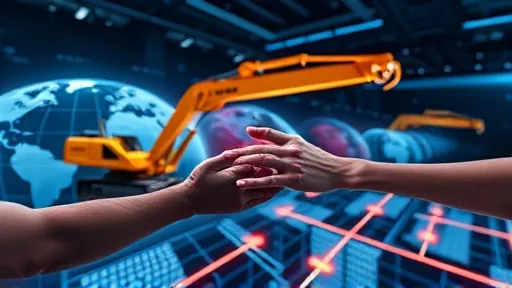
The logic here is deceptively simple. When a person wants to scoop a pile of dirt, they already know how to move their arm to do so. The problem has always been converting that natural arm movement into the language of joystick inputs. The World-Space Interface removes that conversion step, so the operator’s body becomes the controller. This is a philosophical shift in human-machine interaction, moving from symbolic control to kinesthetic control, where the machine responds to the operator’s embodied understanding of the task rather than their ability to decode a control scheme.
Measuring the Gap Between Novice and Expert
The researchers tested their system against a traditional joystick-based simulator with volunteers ranging from complete novices to experienced operators. Participants trained for one hour daily across seven days, navigating fifteen realistic virtual environments that included construction sites, highways, mining areas, and riverbanks. With the joystick simulator, the results followed an expected pattern: novices improved steadily but never caught up to the experts, who maintained their advantage throughout the training period. This gap, so familiar in every skill-based domain, seemed immutable.
With the World-Space Interface, however, the results defied expectations. Novices performed on par with experts from the very first session, not after days of practice or gradual acclimation, but immediately. The study, published in the Journal of Computing and Civil Engineering, reports that the interface erased the distinction between experienced and inexperienced operators entirely. 1 This is not a matter of speeding up the learning curve; it is a matter of removing the curve altogether, flattening the landscape of skill acquisition into a level playing field where expertise becomes less relevant than embodied intuition.
What Happens to the Expert
This raises a question that the construction industry has not yet confronted: if a novice can perform like an expert on day one, what value does the expert’s years of experience hold? The answer is more complex than it might appear, because the study measured task completion in a virtual environment, not the nuanced judgment that comes from real-world problem solving. An expert operator knows how to read a site, anticipate ground conditions, and adjust their approach when something unexpected happens. These are not skills that can be encoded in an interface, no matter how intuitive it becomes.
Yet the trend is unmistakable. The World-Space Interface is not just a training tool; it is a direct control method for operating real machines, whether the operator sits inside the cab or works remotely from a trailer. The team is already adding haptic feedback, so the device will generate resistance that mimics the physical sensation of scooping something heavy. This is a clear trajectory toward a future where the machine’s interface adapts to the human body, rather than the human body adapting to the machine’s interface. The expert’s monopoly on competence is being challenged by a device that makes competence accessible to anyone.
The Contradiction at the Core of Progress
Manufacturers like Caterpillar, Hyundai, and Komatsu are already developing their own virtual excavator simulators for training and eventual remote operation, but those systems remain built around traditional joystick controls. 2 The MIT team envisions their arm-and-bucket design eventually replacing that approach entirely, letting even first-time operators start working from day one. The industry is moving toward this future, but it is doing so while still clinging to the interface that created the shortage in the first place.
The deeper contradiction is that this technology solves a labor crisis by making labor less valuable. If a machine can be operated by anyone with a working arm, then the scarcity that gave operators leverage in the job market evaporates. The aging workforce that prompted this innovation will be replaced not by new operators, but by an interface that makes operator skill irrelevant. This is the pattern that repeats across every industry touched by artificial intelligence: the technology that promises to solve a human problem often ends up making the human element of that problem obsolete.
The World-Space Interface is a remarkable achievement, a genuine leap in human-machine interaction that will likely reshape construction training and operation. But it also embodies a troubling truth about the direction of technological progress. The interface does not elevate the novice to expert status; it simply eliminates the need for expertise. The skill that took years to build, the judgment that came from countless hours of practice, the pride of mastering a difficult craft, all of this becomes surplus to requirements. The machine does not need the human to be skilled anymore, only to be present, moving an arm that the machine interprets as command. The operator becomes less of a craftsman and more of a gesture, a living input device for a system that has learned to read the body better than the mind. Whether this shift ultimately empowers workers or diminishes their craft remains an open question that the industry must answer deliberately.
Sources
1. Massachusetts Institute of Technology
2. Hyundai
3. Komatsu