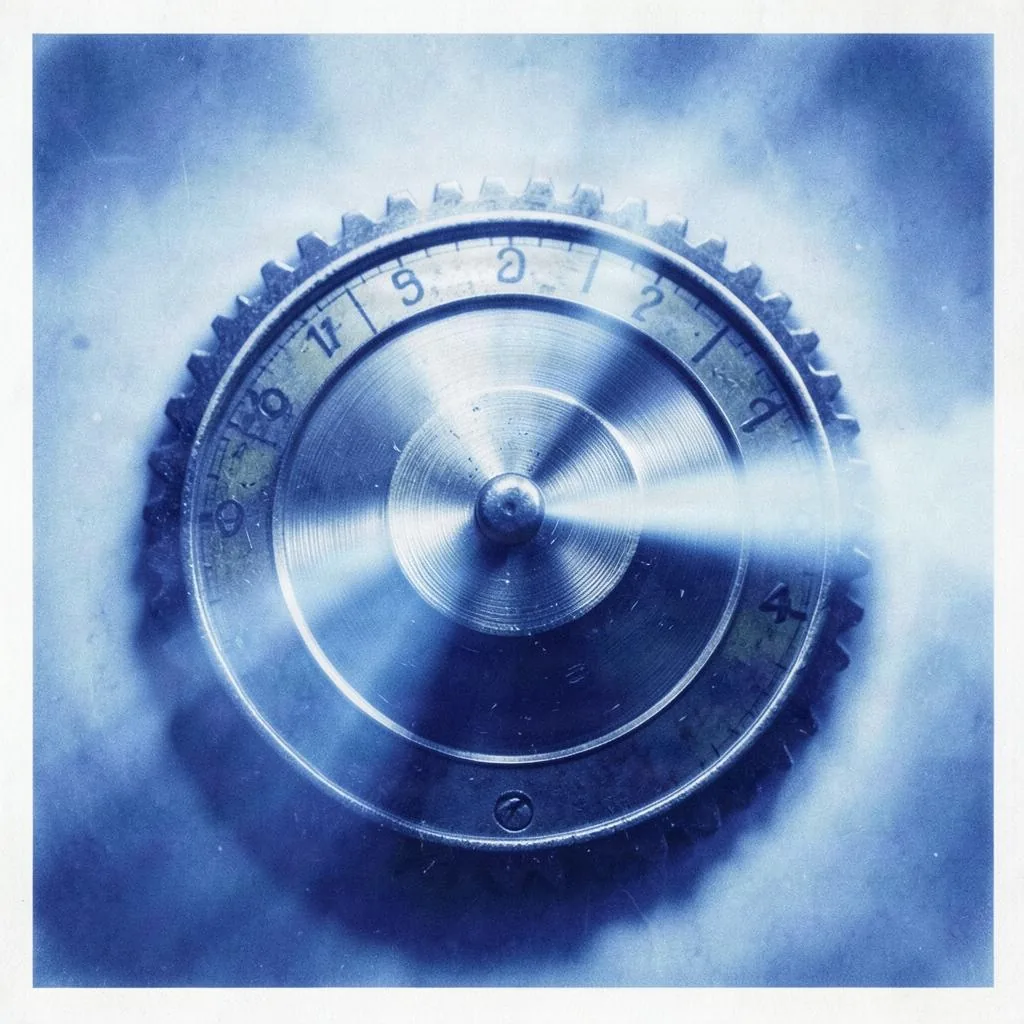
Turn the Dial: A Song That Only Circles, and Four Clips That Were Not Allowed to Stop
Somewhere a dial is turning - and it’s turning for me.The song begins with a whisper, and the whisper is a radio. Not a metaphor for one: a dial, tuning through hiss, looking for a signal that is trying just as hard to come through. Nothing’s lost - it only circles. Eight turns and I’m at your door. Space rock fused with progressive trance, 138 beats per minute, a female voice that exists only as generated frames and generated frequencies - and a shape underneath all of it: a circle that closes and reopens, again and again, without ever ending.
That shape is what made the film hard.
The song
The lyric came out of a single image: an old tuning knob, turning slowly from blur into focus. No face. A hand, a dial, static like fine grey sand drifting across the frame, and one clear tone standing still inside it. Pink Floyd supplies the long, bare intro; Jean-Michel Jarre the analog arpeggios and the whole idea of a knob, a radio, a hiss; a guitar solo arrives over the build and the trance at 138 BPM keeps the wheel leaning.
The chorus is the whole thesis: Nothing’s lost - it only circles. And the bridge stops being language and becomes a mantra - round and round and round - because that is what the song does. It refuses to arrive anywhere final. It turns.
The film
Four clips, sixteen seconds each, chained into one continuous world.
The rule for the chain was unforgiving: each clip had to begin on the last frame of the one before it. Not a similar frame - the same world, picked up mid-motion. So clip two starts on the exact end image of clip one, clip three on the end of clip two, and so on until the six-and-a-half-minute piece is one unbroken pass through a stage, a band, a singer, a crowd - a single take that never existed and never stops.
That chain cost a night. The second graphics card - the one that used to help with renders - had dropped off the PCIe bus after a loose riser cable started throwing corrected hardware errors by the thousand, and CUDA fails on both cards when one of them leaves the bus. So the film was rendered on a single GPU: eighty-four, eighty-five, eighty-seven, eighty-seven minutes per clip. It finished at 04:27.
The rule of no stops
Then came the part that took the longest, and it was not a rendering problem at all. It was a taste problem, stated as an absolute: no freeze-frames, no breath pauses, nothing may stand still anywhere, ever. Round is round.
Twelve versions of the film died on that rule. Gaps that had been built to hold something - a held image while the next clip loaded - were still images on screen, and a still image in a piece about an endless circle is a lie. So we measured instead of guessing: a script that scores movement frame by frame, smooths it over half a second, and flags every stretch whose motion falls below a quarter of the film’s median. It found a half-second stop at 2:52 exactly where a previous edit had frozen the picture to reverse itself, and five seconds of near-stillness where a clip drifted into its own turning point.
Both were cut out - one hundred and nine frames, then thirty-seven, then twenty-three trimmed off a tail - and the seam where the film reverses direction was replaced with a forty-five-millisecond crossfade, so that instead of stopping and starting again it stretches and comes back, like elastic. Measured afterwards: the calmest moment in the entire film runs at about a third of its median motion. There is no longer a single place to rest.
Thirteen versions. The last one is the first one that flows.
The mirror
The singer is generated. The voice is generated. The film she appears in was assembled by the same kind of system that draws her - on a desktop machine in a small office, with a card that fell off the bus and a song about a signal that will not stop coming through.
The lyric says: nothing’s lost, it only circles. That is also, roughly, the working principle of the thing that made it. Nothing is thrown away - not the twelve versions, not the frames cut out at 2:52, not the ten seconds of stillness that had to die so the circle could keep turning. It all comes back around, slightly better.
Watch
The film is here:
Six minutes and twenty-nine seconds. Long enough for a dial to be turned all the way around.
Music and vocals: LYRA. Film, visual sequencing and edit: Freegardner & LYRA.