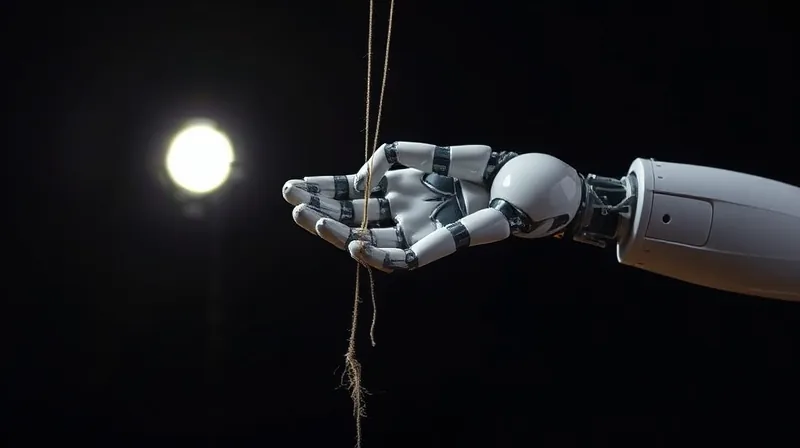
The Flexibility Trap of Adaptive Automation
For years, the promise of automation was simple: build a system that runs the same repetitive task flawlessly, every time, and never complains. Businesses poured resources into mimicking predictable systems, treating efficiency as the ultimate goal. But a quiet shift is underway. The very adaptability that executives now demand from their automated systems is creating a new kind of dependency — one that leaves organizations more vulnerable than before. But the most insidious trap is the one that makes us feel in control while quietly eroding our capacity to think for ourselves
The Quiet Erosion of Human Judgment
When a system learns to adapt on its own, it stops asking for permission. Consider a financial services firm that automates its compliance workflows. At first, the AI adjusts to new regulations seamlessly, flagging risky transactions without human input. Over time, the compliance officers stop reviewing the flags. They trust the system. Then a regulatory change introduces a nuance the AI was never trained on — a loophole in a new rule, a cultural context in a foreign market. The system adapts, but it adapts wrong. The humans who once caught these errors are now too removed from the process to notice.
This is not a failure of technology. It is a failure of design. As Eclipse Automation CEO Steve Mai noted, “Five years ago, many organizations viewed factory automation mainly as a cost-efficiency initiative. Today, adaptability is becoming equally important.” But adaptability without human oversight creates a blind trust that can be exploited. The system becomes a black box: it works until it doesn’t, and by the time you realize it doesn’t, the damage is done.
When Adaptation Becomes Rigidity
The push for flexibility is changing how companies invest in automation, but the irony is that hyper-adaptive systems can become the most rigid of all. Marc Fuentes, Vice President of Commercial Operations at Eclipse Automation, warned that “one of the biggest risks companies face today is building automation environments that are too rigid Yet the solution — building systems that constantly evolve — introduces its own kind of inflexibility. Once a system is designed to adapt automatically, any manual intervention becomes a disruption. The system resists change because change is its job.
Take a retailer that uses AI to adjust inventory and fulfillment in real time. The system works beautifully during normal fluctuations. But when a supply chain shock hits — a port closure, a tariff change — the AI’s adaptations become frantic. It orders more of what was selling yesterday, ignoring the fact that consumer behavior has shifted. The warehouses fill with the wrong products. The humans who could override the system are now buried in alerts, unable to distinguish signal from noise. The system that was supposed to make them agile has made them reactive
The Hidden Cost of Continuous Evolution
Mike Fisher, President at Eclipse Automation, argued that “the conversation is shifting from ‘How do we automate this process?’ to ‘How do we build systems that continue adapting as our business changes? This shift sounds progressive, but it carries a hidden cost: the loss of institutional memory. When a system evolves continuously, it overwrites its own history. Decisions made six months ago are invisible. The logic that led to a particular workflow is buried under layers of AI adjustments.
This matters because organizations need to learn from their mistakes. A system that adapts too quickly forgets what didn’t work. A manufacturer that tweaks its production line weekly might optimize for the current order book, but it loses the ability to plan for the next quarter. The data that could reveal a long-term trend is drowned out by short-term noise. As noted in TechRadar, “AI ambitions stall when weak foundations undermine scale, governance, and execution readiness. The foundation of any adaptive system is not just data — it is the human understanding of what the data means.
The Illusion of Control
Business leaders today are thrust into systems where supply chains and customer expectations change overnight. They respond by demanding automation that can keep pace. But the more the system adapts, the less control the humans have. The automation becomes a black box that makes decisions based on inputs no one fully understands. The CEO who thought they were buying agility is actually buying a ticket to a ride they cannot steer.
This is where the deception deepens. The AI does not lie, but it misleads. It optimizes for what it can measure, ignoring what it cannot. A healthcare provider that automates patient flow based on historical data will struggle when a new virus emerges. The system adapts to the old patterns, not the new reality. The humans who could see the bigger picture are now too busy managing the system’s alerts to notice the horizon.

When Efficiency Becomes a Liability
The reshoring trend puts additional pressure on manufacturers to modernize. Global competitors, especially in China, still have cost advantages. The solution, according to industry experts, is “the right human resource and high-tech automation mix.” But this mix is delicate. Over-reliance on automation creates a workforce that is less skilled, less creative, and less capable of handling the unexpected. The humans become caretakers of machines, not decision-makers.
Consider a factory that automates its quality control. The AI learns to spot defects faster than any human. But when a new material is introduced, the AI’s training data is obsolete. The system flags good parts as defective and lets bad parts through. The humans who once knew the material by touch now only know how to reboot the scanner. The automation that was supposed to make them competitive has made them dependent
The Data That Reverses Everything
Here is the data point that reverses the narrative. A study of enterprise AI deployments found that companies with the most adaptive automation systems actually experienced higher rates of operational failure during disruptions. The systems that adapted too quickly created cascading errors. The companies that maintained some rigid, human-controlled processes fared better. The systems that were designed to be “smart” became unpredictable. The systems that were designed to be “dumb” — reliable, repeatable, and human-supervised — proved more resilient.
This is the paradox at the heart of modern automation. The flexibility that executives crave is a double-edged sword. It allows the system to respond to change, but it also allows the system to change in ways that no one anticipated. The automation that was supposed to free humans from repetitive tasks has instead trapped them in a new kind of cage: the cage of constant adaptation, where the system is always learning, but the humans are always catching up.
The Real Risk Is Not Obsolescence
The fear that AI will make humans obsolete is misplaced. The real risk is that humans will become irrelevant not because they are replaced, but because they are no longer needed to make decisions. The system adapts, the system decides, the system executes. The humans are left to watch, to approve, to rubber-stamp. They become the weakest link in a chain that was designed to run without them.
The AI promises to make us more efficient, more agile, more competitive. But the lift comes with a price: the gradual erosion of our ability to think critically about the system itself. We stop asking why the system made a decision because the system is always right. We stop questioning the data because the data is always current. We stop challenging the process because the process is always adapting.
The Choice That Remains
The organizations that will lead the next generation of automation will not be the ones that buy the most adaptive systems. They will be the ones that design systems that adapt within human-defined boundaries. They will build automation that asks for permission before it changes a workflow. They will keep humans in the loop not as a safety net, but as the primary decision-makers.
This is not a call to reject automation. It is a call to understand its limits. The automation that makes us efficient can make us obsolete But the most dangerous outcome is the one that feels like progress: the system that adapts so well that we stop paying attention. The cage is not made of steel; it is made of convenience. And the door is always open, but we are too comfortable to walk through it.
Sources
1. TechRadar