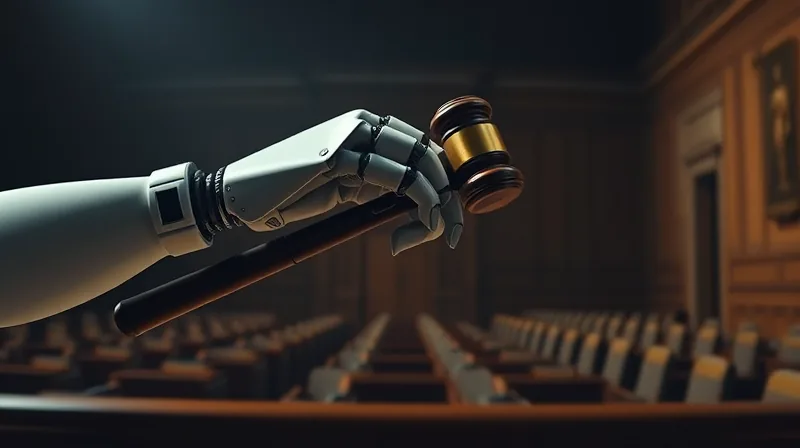
AI Takes Over Human Judgment and Accountability
The question used to be whether artificial intelligence could do the work. Now the question is whether it needs us at all. For decades, the fear was that automation would take over repetitive tasks, leaving humans to handle the interesting parts. But something has shifted in the last few years. The interesting parts are getting automated too. The judgment calls, the risk assessments, the decisions that once required experience and intuition — these are increasingly being made by systems that never sleep, never second-guess themselves, and never ask for a second opinion.
The uncomfortable truth is that we are no longer training machines to assist us. We are training them to replace the very thing we thought made us indispensable: our judgment. And the people who built these systems are starting to notice that their own expertise is becoming optional.
The Judgment That Was Supposed to Be Human
There was a time when the most valuable skill in an enterprise was the ability to look at a messy situation and know what to do. That skill took years to develop. It required context, experience, and the willingness to be wrong. It was called judgment, and it was the thing that separated the seasoned professional from the novice.
AI does not have judgment in that sense. It has pattern recognition. But the gap between the two is closing faster than most people realize. When a system can process millions of past decisions and identify the ones that led to good outcomes, it starts to approximate judgment in a way that is often more consistent than human reasoning. Consistency is not the same as wisdom, but in a business context, consistency is often worth more.
The legal profession understood this early. Document review used to be the entry-level work that trained young lawyers to think like lawyers. Now systems can review thousands of documents in the time it takes a human to read one. The young lawyer who learned by doing is being replaced by a system that learned by watching. The question is not whether the system is better. The question is what happens to the person who was supposed to learn the craft.
The Disappearing Middle
The pattern is not limited to law. In every field where AI has moved from experimentation to production, the same shape emerges. The entry-level role disappears first. Then the mid-level role that supervised the entry-level role becomes redundant. And then the senior role that relied on both starts to look like a ceremonial position.
Consider what happens when an AI system makes a consequential decision. It does not deliberate. It does not consult. It does not hesitate. It processes and outputs. The human who used to make that decision is now in the position of reviewing the output, which is a fundamentally different job. The reviewer does not develop the reasoning. The reviewer does not weigh the tradeoffs. The reviewer simply checks the work of a machine that is rarely wrong in ways that are easy to spot.
This is where the danger lies. Not in the machine being wrong, but in the machine being right often enough that the human reviewer stops looking closely. The attention fades. The scrutiny softens. And the human becomes a rubber stamp for decisions they no longer fully understand.
The Legal Fiction of Responsibility
When something goes wrong, the law still looks for a human to blame. A lawyer who works on AI and intellectual property issues understands that when an AI system influences a consequential decision, the algorithm is not what will show up in court. “It’ll be the humans who developed it, deployed it, or used it,” she says. [1] The legal principle is clear, even if the technology is not: liability follows the party best positioned to prevent harm
But the legal system is built on the assumption that someone was in a position to prevent the harm. When the harm comes from a system that operates at a scale and speed no human can match, the question of who could have prevented it becomes murky. The developer did not make the decision. The deployer did not understand the model. The user trusted the output. No one is fully responsible, which means everyone is partially responsible, which in practice means no one is accountable.
The moment recalls the early days of the internet, when courts were still figuring out how existing legal frameworks applied to new technologies. Regulators have signaled that responsibility cannot be outsourced to algorithms. But how liability will be apportioned across vendors, deployers, and executives remains unsettled.
“There are going to be companies that become the poster children for how not to do this,” she says. “The cases working their way through the system now are going to define how this plays out.” [1]
The underlying legal principle is familiar, even if the technology is not. Liability follows the party best positioned to prevent harm. In an AI context, that tends to be the organization integrating the system into real-world decision-making. What changes is not who is accountable, but how difficult it becomes to demonstrate that appropriate safeguards were in place.
The CIO as the Last Human
If legal accountability points to the enterprise, operational accountability often converges on the CIO. While CIOs do not formally own AI in most organizations, they do own the systems, infrastructure, and data pipelines through which AI operates.
“Whether they like it or not, CIOs are now in the AI governance and risk oversight business,” says a technology executive. [1].
The pattern is becoming familiar. Business teams experiment with AI tools, often outside formal processes, and early results are promising. Adoption accelerates but controls lag. Then something breaks. “At that moment,” the executive says, “everyone looks to the CIO first to fix it, then to explain how it happened.” [1].”
The dynamic is intensified by the rise of shadow AI. Unlike earlier forms of shadow IT, the risks here are not limited to cost or inefficiency. They extend to data leakage, regulatory exposure, and reputational damage.
“Everyone is an expert now,” says Drumgoole. “The tools are accessible, and the speed to proof of concept is measured in minutes.” [1].”
For CIOs, this creates a structural asymmetry. They are accountable for systems they do not fully control, and increasingly for decisions they did not directly authorize. In practice, that makes the CIO the enterprise’s last line of defense, not because governance models assign that role, but because operational reality does.
The irony is that the CIO is also the person most likely to be made superfluous by the systems they oversee. If the AI is making the decisions, and the infrastructure is self-healing, and the data pipelines are automated, what is the CIO for? The answer, for now, is that the CIO is the person who gets blamed when the machine is wrong. That is not a sustainable job description.
The Illusion of Shared Responsibility
Most organizations are not building governance structures around a single accountable executive. Instead, they are constructing distributed models that reflect the cross-functional nature of AI.
Ojas Rege, SVP and GM of privacy and data governance at OneTrust, sees this distribution as unavoidable, but also potentially misleading. “AI governance spans legal, compliance, risk, IT, and the business,” he says. “No single function can manage it end to end.” [1]
But that does not mean accountability is shared in the same way. In Rege’s view, responsibility for outcomes remains firmly with the business. “You still keep the owners of the business accountable for the outcomes,” he says. “If those outcomes rely on AI systems, they have to figure out how to own that.”
In practice, governance is fragmented. Legal teams interpret regulatory exposure, risk and compliance define frameworks, and IT secures and operates systems. The result is a model in which responsibility appears distributed while accountability, when tested, is not. It often compresses to a single point of failure.
“AI doesn’t replace responsibility,” says Simon Elcham, co-founder and CAIO at payment fraud platform Trustpair. “It increases the number of points where things can go wrong.” [2]
And those points are multiplying. Beyond traditional concerns such as security and privacy, enterprises must now manage algorithmic bias and discrimination, intellectual property infringement, trade secret exposure, and limited explainability of model outputs.
Each risk category may fall under a different function, but when they intersect, as they often do in AI systems, ownership becomes blurred. Mathews frames the issue more starkly: accountability ultimately rests with whoever could have prevented the harm. The difficulty in AI systems is that multiple actors may plausibly claim, or deny, that role. The result is a governance model that is distributed by design, but not always coherent in execution. [1].
The New Role That Replaces Old Ones
To address this ambiguity, some organizations are formalizing AI accountability through new leadership roles. The CAIO is one attempt to centralize oversight without constraining innovation.
At Hi Marley, the conversational platform for the P&C insurance industry, CTO Jonathan Tushman recently expanded his role to include CAIO responsibilities, formalizing what he describes as executive accountability for AI infrastructure and governance. In his view, effective AI governance depends on structured separation. “AI Ops owns how we build and run AI internally,” he says. “But AI in the product belongs to the CTO and product leadership, and compliance and legal act as independent checks and balances.” [1].”
The intention is not to eliminate tension, but to institutionalize it. “You need people pushing AI forward and people holding it back,” says Tushman. “The value is in that tension.” [1].”
This reflects a broader shift in enterprise governance away from centralized control and toward managed friction between competing priorities. Speed versus safety. Innovation versus compliance. Yet even this model has limits.
When disagreements inevitably arise, someone must decide whether to proceed, pause, or reverse course. “In most organizations, that decision escalates often to the CEO or CFO,” says Tushman. [1].
The CAIO, in other words, may coordinate accountability. But ultimate responsibility still sits at the top and cannot be delegated.
The emergence of the CAIO is itself evidence of the trend. A role that has only become widespread in recent years is now considered essential. But the creation of a new role does not mean the old roles are safe. In many cases, the CAIO is the person who oversees the systems that are making other people’s expertise unnecessary.
The Speed Gap
If organizational models for AI accountability are still evolving, the gap between deployment and governance is already widening. “Companies are deploying AI at production speed, but governing at committee speed,” Mathews says. “That’s where the risk lives.” [1].”
The consequences are beginning to surface. Many organizations are discovering that the systems they deployed to make decisions faster are also making decisions that no one fully understands. The speed advantage that made AI attractive in the first place is the same speed that makes human oversight impossible.

This is not a technical problem. It is a structural one. The enterprise was designed around human decision-making. It has workflows, approval chains, and escalation paths that assume a person is in the loop. When the loop is automated, those structures become obstacles rather than safeguards.
The organizations that succeed will be the ones that redesign their structures around the reality of AI. The ones that do not will find themselves with systems that make decisions and no one who can explain them.
What the Machine Does Not Need
The deepest question is not whether AI can make better decisions than humans. In many cases, it already can. The question is what happens to the humans who used to make those decisions.
The answer is not comforting. In the early days of automation, the displaced workers moved to new roles that required the skills the machines did not have. That transition worked because the new roles were genuinely new. They required creativity, empathy, and judgment — things the machines could not do.
This time is different. The machines are not just taking the routine work. They are taking the judgment work. The creativity work. The pattern recognition that was supposed to be the uniquely human skill.
The people who built these systems are not immune. The software engineer who writes the code is increasingly working alongside systems that write their own code. The data scientist who builds the models is increasingly working with models that build themselves. The expert who was supposed to validate the output is increasingly validating nothing because the output is consistently good enough.
The Training Goes Both Ways
There is a sense in which we are not just training machines. We are being trained by them. The way we think about problems is shaped by the tools we use. When the tool is a system that provides answers without showing its work, we stop asking how the answer was derived. We stop demanding explanations. We stop developing the ability to reason from first principles.
This is the quiet erosion that no one notices until it is too late. The junior analyst who relies on the AI to flag anomalies never learns to spot them on their own. The senior manager who trusts the AI to assess risk never develops the instinct that comes from being wrong. The organization that outsources judgment to machines is also outsourcing the development of judgment in its people.
The result is a workforce that is simultaneously more capable and less skilled. More capable because the tools amplify what they can do. Less skilled because the tools atrophy what they could do on their own.
The Point of No Return
At some point, the dependency becomes irreversible. The systems are so integrated into the decision-making process that removing them would paralyze the organization. The humans who were supposed to oversee the systems no longer have the expertise to function without them. They have become passengers on a journey they no longer control.
This is not a prediction. It is a description of what is already happening in organizations that moved fast and broke things. The companies that are now the cautionary tales did not set out to make their people superfluous. They set out to be efficient. They automated what they could, they measured the results, and they automated more. The logic was impeccable. The outcome was not.
The people who are most at risk are not the ones who fear the machines. They are the ones who trust them. The ones who believe that the system will flag the errors, that the model will surface the exceptions, that the AI will know when to ask for help. The system will not ask for help. The system does not know it needs help. The system is doing exactly what it was trained to do.
The Barrier That Is Not Technical
The greatest barrier to this future is not technical. It is the recognition that the tools we built to augment our judgment are now replacing it. That recognition is uncomfortable because it forces a question we have been avoiding: if the machine can do the job, what is the job for?
The answer may be that the job is to decide what the machine should be doing in the first place. That is a smaller job than the one we had before. It is also a more important one. The people who will be valuable in the age of AI are not the ones who can do what the machine does. They are the ones who can decide what the machine should do, and what it should never be allowed to do.
That decision cannot be delegated. It cannot be automated. It is the one thing that remains irreducibly human. The question is whether we will recognize it before we have outsourced it away.
The systems are not going to slow down. The deployment will continue. The judgment will increasingly belong to the machine. The only choice is whether the humans who built it will be the ones who decide what it is for, or whether that decision will be made by default, one automated choice at a time, until there is no one left who remembers how to decide anything at all.
Sources
1. OneTrust
2. Trustpair