Robot Puppets Behind the Humanoid Influencer Boom
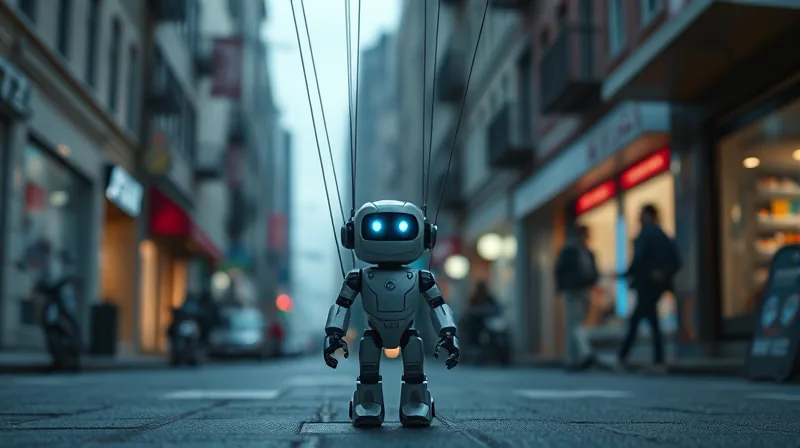
On a street in Warsaw, a four-foot-tall machine with a hollow face and a ring of blue light strikes up a conversation with a passerby. It asks about the weather, cracks a joke about Polish bureaucracy, and laughs at the right moments. The person on the other end has no idea that the words coming out of this aluminum-and-plastic body were not chosen by the robot at all. They were chosen by a software developer standing nearby, watching through a screen, deciding what the machine should say next. This is the uncomfortable truth at the heart of the humanoid influencer boom: the robots appear to be social creatures, but they are puppets wearing a convincing mask of autonomy.
The Magic Trick That Everyone Agrees To Believe
Edward
Warchocki sounds like a regular guy when you talk to him. “Not super intelligent, but very emotional, very easy to make friends with,” says Bartosz Idzik, the person who created him. That description is doing a lot of work. It makes you imagine a person with quirks and warmth, someone you might meet at a bar. What Idzik is actually describing is a software pipeline: a large language model wired into a robot chassis, programmed to mimic the cadence and vocabulary of a friendly Polish man. The illusion is so effective that people forget they are interacting with a statistical prediction engine wrapped in metal.
The gap between what the robot appears to do and what it actually does is the whole game. When Edward visits the Polish parliament and chats with politicians, the public sees a robot engaging with power structures. What they do not see is the operator behind the curtain, feeding responses or approving the LLM’s suggestions. The robot is not thinking about politics. It is not forming opinions. It is executing a sequence of language probabilities that happen to sound like conversation. The deception is not malicious, but it is real, and it is reshaping how people understand what these machines can do.
Idzik and his friend Radoslaw Grzelaczyk bought the robot from China and named it after Grzelaczyk’s dog Eddie, combined with the Polish word for growling. The name sounds passable for a human, which is precisely the point. A name gives the machine a persona, and a persona gives the machine a social license to exist in public spaces. Without the name, without the voice, without the carefully constructed backstory, it is just a 40-kilogram machine that scares people. With those elements, it becomes a celebrity with over 1 million followers and 4 billion views across social media platforms.
The transformation from scary object to beloved public figure happened overnight, almost literally. The first few days Edward went out, it could not speak, and people were clearly afraid. Then Idzik connected it to a language model that could hold live conversations in Polish, and the fear evaporated. “When he started to talk, people loved him,” Idzik says. This is the first layer of the deception: the belief that speech equals intelligence, that conversational ability implies understanding. The robot says words that make sense in sequence, and humans project consciousness onto it. The projection is the product.
The Operator Behind Every Viral Moment
Jake Cooperstein, a 24-year-old in Miami, watched Edward’s videos and decided he wanted the same thing. He paid $66,000 for a Unitree G1 variation with better customization, named it Brickell Clanker after his neighborhood, and started taking it to public events. [2] The robot got its big break at World Cup after-parties, changing jerseys for Argentina, Brazil, and the US. Watching from the crowd, Cooperstein describes the feeling: “Nobody knows that it’s me controlling it. It seems like I’m blending in with the crowd. I’m just staring out and looking at everybody, and I’m like, ‘holy shit, this is the future.’”
That quote is the most honest thing anyone involved in this industry has said. The future, as Cooperstein sees it, is a world where one person can stand in a crowd and make a machine do all the social heavy lifting. The robot dances, the robot waves, the robot interacts with fans, and the human operator remains invisible. This is not artificial intelligence in any meaningful sense. It is remote-controlled performance art dressed up as technological progress. The deception is not just about the robot’s capabilities. It is about who is actually doing the work.

Cooperstein charges between $800 and $1,200 an hour to bring Brickell Clanker to influencer parties, nightclubs, and corporate events. The robot’s dance moves are pre-programmed, about 20 gestures and 15 dance moves built into the machine. Beyond that, it takes technical knowledge to program new movements. When Cooperstein taught the robot the “Viking Row” gesture popularized by Norwegian soccer fans, he had to write the choreography himself. The robot did not learn the move. It did not observe the fans and adapt. It received new instructions from its operator, who had studied the gesture and translated it into machine code.
The same is true for Edward Warchocki and every other humanoid influencer that has appeared on social media feeds this year Rizzbot wears a cowboy hat and flirts with strangers in Austin. Bart Robot breakdances with basketball fans in New York. Each of them appears spontaneous, but they are all following scripts written by people who understand that the illusion of autonomy is more compelling than the reality of remote control. The robots are not social beings. They are social props, and the people operating them are the real performers.
The Industry That Sells the Illusion
Unitree, the Chinese company that makes the G1 model used by nearly all these influencers, is going public on the Chinese stock market in about two weeks. Its financial disclosure tells a remarkable story: more than half of Unitree’s 2025 revenue came from delivering humanoid robots to real customers, not lab testing. It shipped 5,511 humanoids in 2025 at an average price of less than $25,000 each, and 43 percent of all sales came from outside China. Unitree The company became profitable for the first time last year. This is not a speculative startup burning cash on promises. This is a business that found a market and is serving it.
The market, however, is not what the robots appear to be selling. Unitree’s G1 is marketed as a general-purpose humanoid robot, a machine that could eventually work on assembly lines, clean houses, or perform other economically valuable tasks. The reality is that the robots being deployed today are mostly doing entertainment work, and even that requires constant human supervision. Both Idzik and Cooperstein admit that they teleoperate their robots most of the time. They worry about malfunctions hurting bystanders. They do not trust the robot’s autonomous capabilities in uncontrolled environments.
This is the second layer of the deception: the gap between what the industry promises and what the products actually deliver. Unitree’s marketing materials show robots doing kung fu, parkour, and boxing. The videos are impressive, but they are carefully staged demonstrations, not evidence of general capability. The robots are not learning these skills. They are executing pre-programmed sequences that have been refined through countless iterations. The distinction matters because it changes what these machines can actually do in the world.
The FCC’s ban on new Chinese-made humanoid robots in the US adds another dimension to the story. The models that cleared approvals, like the G1 and R1, are theoretically still allowed, but no one knows for sure. This regulatory uncertainty hangs over every future purchase and deployment decision. When Unitree releases its next generation, it will not be able to sell them to American customers. The political response to these robots is driven by the same confusion that drives the public’s reaction. People see a machine that appears intelligent and assume it represents a technological leap. The reality is more mundane: these are sophisticated remote-controlled devices with good conversational software bolted on.
What the Robots Cannot Do
The question that follows every viral video is the same: when will these robots get real jobs? The answer, based on current evidence, is not soon. The G1 can dance, wave, and converse, but it cannot reliably navigate a crowded street without human intervention. It cannot adapt to unexpected situations. It cannot learn from experience in any meaningful way. The robots that appear so capable in carefully staged videos would struggle with the messy, unpredictable reality of factory floors and domestic spaces.
The deception is not intentional in the sense that Unitree is trying to fool anyone. The company is building the best machines it can with current technology, and those machines are genuinely impressive pieces of engineering. But the gap between what the robots appear to do and what they actually do is widening as the marketing machine amplifies their capabilities. Every viral video of a robot dancing or talking creates an expectation that the next video will show the robot doing something even more impressive. The reality is that the robots are hitting a plateau, constrained by hardware limitations and the fundamental difficulty of making machines that can perceive and act in the physical world.
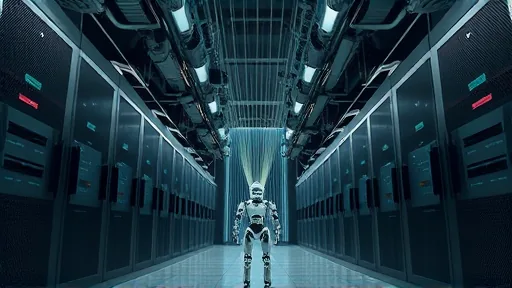
Idzik’s company, MERA Robotics, now has a fleet of 20 humanoid robots, most of them Unitree G1s. MERA Robotics Every robot in Poland shares Edward’s personality, and some operate in the Middle East and Southeast Asia as different influencers. The fleet approach makes economic sense: the software that powers Edward can be replicated across multiple machines at negligible cost. But the robots still need operators. They still need supervision. They still need humans to make the decisions that matter. The personality is software. The intelligence is the person behind the screen.
The most revealing moment in Cooperstein’s account of his first World Cup event is not the robot’s performance. It is his description of standing in the crowd, invisible, watching hundreds of people cheer for a machine that he was controlling. The people did not know they were celebrating his work. They thought they were witnessing the future. They were actually witnessing a magic trick, and the magician was standing right next to them, unseen. This is the deception at its most complete: the audience believes the machine is the performer, when the machine is just the instrument.
The Cost of Believing the Performance
There is a reason the anonymous shitposter on X called these robots “clankers,” a term borrowed from science fiction that implies a machine pretending to be something it is not. The public’s reaction to humanoid influencers is a mixture of wonder and suspicion, and both responses are justified. The robots are genuinely remarkable pieces of technology. They are also deeply limited, and the gap between their apparent capabilities and their actual ones is the central fact of their existence.
The danger is not that the robots will take over jobs or become sentient. The danger is that people will believe the performance and make decisions based on that belief. Companies will invest in humanoid robots expecting them to perform tasks they cannot yet handle. Policymakers will craft regulations based on fears that do not match the technology’s actual capabilities. The public will develop expectations that no current machine can meet. The deception is not in the robots themselves. It is in the story we tell ourselves about what they can do.
Idzik says the robots are best for their purpose, and he is right. The G1 is excellent at what it does: attracting attention, generating content, creating the illusion of a social being. The problem is that the purpose is performance, not work. The robots are not doing tasks that contribute to the economy in any traditional sense. They are generating views, likes, and engagement, which have real economic value in the attention economy but do not represent the kind of labor that the industry’s promises suggest.
The next step for this technology is unclear. Unitree will continue to sell robots, and the influencers will continue to create content. The FCC ban will reshape the American market, potentially creating space for domestic competitors or simply slowing adoption. The fundamental question remains unanswered: can these machines do anything useful beyond performing for crowds? The evidence so far suggests the answer is no, but the industry is betting billions that the answer will eventually be yes. Until then, the robots will keep dancing, keep talking, keep pretending to be something they are not, and we will keep watching, caught between wonder at what they do and suspicion of what they claim to be.
The robots are not lying to us. They cannot lie because they cannot intend anything. But the people who build them, market them, and operate them are engaged in a collective act of storytelling that blurs the line between what these machines can do and what we want them to be able to do. The story is compelling, which is why it has generated billions of views and millions of dollars. But it is still a story, and the gap between the story and the reality is where the truth lives. The robots are here, performing for us, and we are watching, projecting intelligence onto machines that merely echo the people pulling their strings.
Sources
2. Unitree