Quiet Deception of AI at County Fair
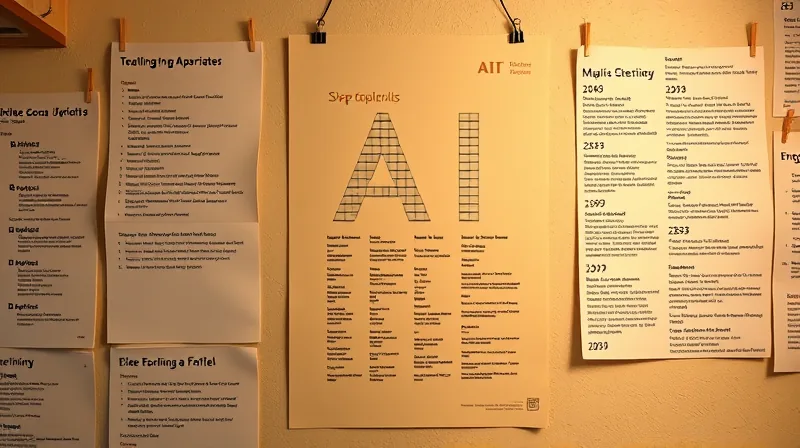
Every summer, the Hendricks County Fair exposition hall fills with the same proud clutter that has defined American agriculture for a century: model rockets, wooden chessboards, meticulously frosted cakes, and hand-lettered posters on duck health or Indy 500 safety. The judges walk the rows, assessing not just the finished product but the hours of effort, the research, the trial and error baked into each entry. That is the unspoken contract — a blue ribbon doesn’t just reward a pretty poster; it rewards the learning that produced it. But this year, something has quietly broken that contract. Some of the award-winning posters bear unmistakable hallmarks of AI design: beige backgrounds, custom-generated icons, a distinctive set of typefaces. Because reference lists are hidden on the back, no one knows whether the young designers acknowledged the machine’s help. The fair still looks the same. The gap between what a judge can see and what actually matters has never been wider.
The Line Between Tool and Crutch
Rachel Haselby spends 90 percent of her working hours teaching Indiana 4-H kids how to use AI appropriately. [1] She is a computer science specialist at Purdue Extension and has helped develop the National 4-H Council’s AI curriculum. [1] She wants kids to understand that consulting an AI summary is not the same as reading the original source. “I will tell a kid, ‘Yeah, that’s great information. Click on that link,’” Haselby told the IndyStar. “Let’s read the actual thing that the author, who came up with this information, wrote about it.” The Indiana 4-H state handbook already allows AI use with parental permission, but it insists that a majority of the work must be the participant’s own and that all sources must be cited. The rule sounds clear, but enforcing it depends entirely on the honesty of the child and the vigilance of the parent. A poster that looks impeccable may have required no more than a five-word prompt. The machine does the thinking; the child gets the ribbon.
This is the precise point where the deception begins. The tool, designed to assist, quietly replaces the very effort the competition is meant to reward. Haselby encourages her students to use AI for grammar checks and formatting polish, but she draws a hard line at the big ideas. “If a person is using it to just do their work for them, and allowing it to think for them, they’re going to lose a lot of critical thinking skills,” she said. The problem is that a judge cannot easily distinguish between a poster that the child designed with AI assistance and a poster that the child only prompted into existence. The aesthetic results are identical. The learning is not.
The Unseen Burden of Honest Work
Hope Brown, a rising high school junior and eight-year 4-H member in sewing, shooting sports, photography, and junior leaders, has never used AI in any of her categories. “Personally, I think it’s a really dumb idea,” she told the Indianapolis Star. “From what I’ve always done in 4-H, it’s about hard work, and AI feels like cheating.” She worries that kids who invest hours in their projects will place lower than those who fed a prompt into a generator. “All you have to do is put in a prompt and it gives you a thing, and some people put hours and hours and hours into their projects, and they don’t place as high as the AI ones do,” she said. “It feels unfair to the people who actually worked on it.” Her fear is not hypothetical. At the same fair where she competed, at least two AI-designed posters were headed to the Indiana State Fair in August. No one knew if the creators had credited the tool.
Benjamin Wilson, an 18-year-old 10-year 4-H member who raises rabbits and competes in shooting sports, sees the loss in even starker terms. “You go to the robot and ask it to give you the answer rather than coming up with the answer yourself,” he said. “If you look at all kinds of studies, being able to brainstorm and get most of the way there is very important to keeping your brain working properly.” Wilson’s point cuts to the heart of the deception: the student who uses AI to skip the struggle does not just produce a less creative project — they impair their own cognitive development. The ribbon they win becomes a reward for not thinking.
The Historical Echo of Every Technology Panic
Tim Whicker, a 4-H leader in Hendricks County for three decades, does not see AI as a reason to panic. “Fifty years ago, when I was in elementary school, we had calculators. Calculators were going to ruin us, and we’d be the dumbest generation on Earth,” he told the IndyStar. Whicker believes AI will eventually become a standard research and design tool for 4-H participants. The challenge, he argues, is not to ban the technology but to make sure kids are not simply asking AI to spit out a finished product. That means judges must ask smarter questions — probing what the contestant actually learned, not just admiring the polished surface.
But there is a difference between a calculator and a machine that writes your entire research paper. A calculator speeds up arithmetic but does not supply the method. AI, in its current form, supplies the method, the argument, the design, and the final product. It does not just save time; it replaces cognition. Haselby notes that she never encourages children under 10 to use AI, because research shows that young children cannot reliably tell AI from a real person. If a child does not understand that the glowing text came from a statistical model, they are not using a tool — they are being used by it.
The 85 Percent Signal
Haselby’s push to teach AI literacy is not just about fairness inside the fairgrounds. She cites a 2024 white paper by TechPoint, an Indianapolis-based industry group, in which 85 percent of surveyed Indiana businesses said they were investing in AI. The workforce that today’s 4-H members will enter in five or ten years will demand familiarity with these tools. So teaching kids how to use AI appropriately is an integral part of preparing them for that future. But there is a tension: the same educators who must prepare students for an AI-infused economy must also protect the integrity of learning now.
The deception is not that AI exists. The deception is that a 4-H poster can look identical whether the child engaged deeply or barely at all. The system cannot tell the difference, and the rules rely on self-reporting. Meanwhile, kids like Jennifer Roseboom’s five children, who homeschool and do not use AI for any 4-H or schoolwork, are competing against projects that may have been generated in seconds “I want them to be creative and thinking,” Roseboom said. Her children’s posters are painstakingly hand-cut and hand-drawn. They may not look as polished as the AI alternatives. They may not win.
The Variable That Determines Everything
What saves the county fair from becoming a complete charade is not a new regulation or a technical watermark. It is the quality of the questions that judges ask. Whicker knows this: judges must probe what the contestant actually learned, not just admire the final product. A judge who asks “Why did you choose this color scheme?” or “What did you learn from your three failed prototypes?” can reveal whether the child owned the work or the machine did. If the child cannot explain the reasoning behind the layout or the research method, the answer is already clear.
But that kind of judging is inconsistent. It depends on the judge’s experience, their own comfort with AI, and the time they have per entry. Not every judge will probe deeply. Some will simply admire the glossy finish and move on. And that is where the deception takes hold — in the gap between a system that measures final appearance and a community that values process. The fair can still work if everyone leans into the hard work of asking the right questions. But if the questions stay shallow, the blue ribbon no longer stands for effort. It stands for the most compelling prompt.
The Quiet Shift in What We Reward
The deeper consequence of AI-generated projects at the county fair is not that some kids cheat. It is that the honest competitors begin to doubt the entire premise of the competition. Brown said it plainly: AI feels like cheating. Wilson said it worries him that he will lose the ability to think if he relies on the machine. These kids did not need a seminar on AI ethics to understand the risk. They feel it in their own experience of making something from scratch. The threat is not that the machine will outwit them but that the adults running the fair will fail to protect the very value that 4-H has always stood for — learning by doing.
Haselby’s curriculum tries to teach that there are right and wrong ways to use AI. She tells students to click the link, read the original source, and cite properly. She encourages using AI to check grammar, not to generate ideas. But she also acknowledges that many kids are using it unsupervised, with parental permission, and no one is checking. The rulebook says to cite. The back of the poster says nothing.
The Final Open Question
The last open variable that determines success or failure in this experiment is not the technology. It is the collective will of the 4-H community — leaders, judges, parents, and kids themselves — to insist that the process matters more than the product. That is harder than it sounds. The county fair is a celebration of final results. Ribbons are awarded to the best exhibit, not the best effort. AI makes the exhibit perfect while the effort disappears. The only way to recover the original purpose is to ask different questions, dig deeper into the work, and reward transparency about how the work was made.
If the community does that, AI becomes a legitimate tool for kids who use it to enhance, not replace, their own thinking. If the community does not, the county fair transforms into a showcase not of young minds but of the best prompt engineering. The blue ribbon will still look the same. The fair will still smell of fried Oreos and livestock. But the contract will be broken. The deception will be complete. And the kids who did the work themselves will be the first to notice that the prize no longer belongs to them.