Socks That Stiffen the Foot and Lighten the Step
The idea sounds almost too simple to have taken this long. Since humans diverged from chimpanzees around six million years ago, human feet have become much stiffer than those of other apes, which assisted our upright walking. If that stiffness is part of why walking works, the reasoning goes, then adding more of it should make walking cheaper. Owen Beck and Hui Tang at the University of Texas at Austin set out to test exactly that, and the path they first chose was the obvious one: footwear. [1] Shoes with stiffer midsoles, or inserts built to do the same job, had been tried before. None of them delivered the metabolic savings the theory promised.
That string of failures is the key to understanding what came next. The earlier designs did reduce bending, but they also froze the foot at the moment it needs to move — right at the end of each step, when the toes flex and the arch springs back. Thomas Püschel at the University of Oxford calls the team’s insight clever precisely for this reason: they saw that the old attempts had thrown out a motion the foot cannot do without. [1] A shoe is a cage around the whole foot. A sock is something else entirely — it can squeeze one region while leaving the rest free.
So Beck and Tang moved the stiffening from the sole to the sock. They knitted three bands, each one millimetre wide, tightly into a 30-millimetre-wide strip around the ball of the foot. The material is an ordinary synthetic yarn blend, the kind found in any athletic sock. The effect is not subtle: the bands press on the forefoot with 24 times the pressure of a standard control sock. That pressure travels through the foot’s structure rather than locking it, and the researchers report that it stiffens the foot.
A Two-Percent Saving That Feels Like Two Kilograms
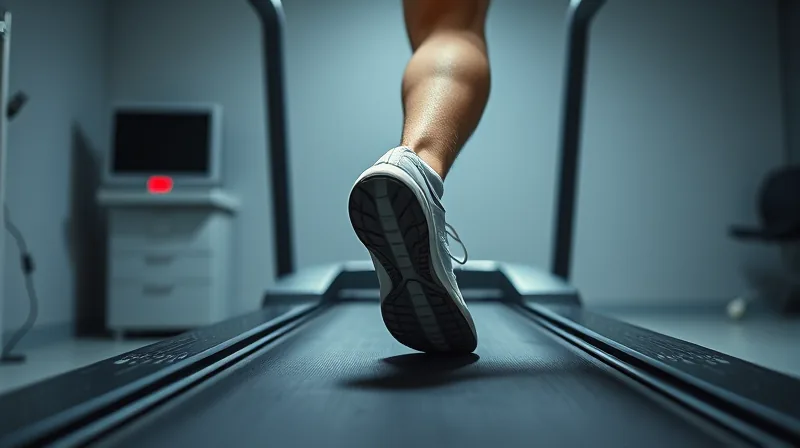
Twelve adults, men and women with no known health conditions, walked on a treadmill in three conditions: the stiffening socks, control socks, and no socks at all. Each walk lasted five minutes. The team measured VO2 max — the maximum amount of oxygen the body can absorb during high-intensity exercise — and from that calculated metabolic expenditure, the energy burned during each walk. In 10 of the 12 participants, the stiffening socks cut that expenditure by 2 per cent compared with the control socks.
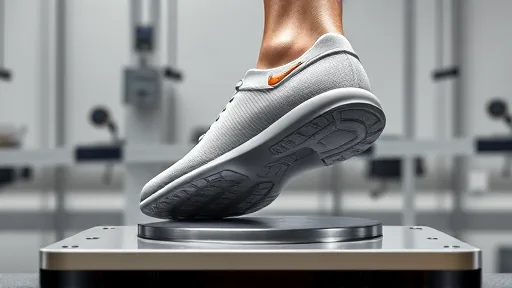
Two per cent is the kind of number that reads like trivia and is not. The researchers translate it into the energy the average person would save by shedding 2 kilograms of body mass. Beck’s back-of-the-envelope estimate pushes the implication further: wrapping the foot in these socks could improve marathon performance by one to two minutes. Beck says he hopes to see elite runners wearing them at the Los Angeles 2028 Olympics.
The mechanism runs through the ankle. The socks let the ankle and its muscles push off at a slower velocity, Beck says, which requires less activation and less metabolic energy, leading to more economical muscle contractions. Unlike a stiffened shoe, the socks also let the toes flex and the arch recoil more freely.
Beck is careful about what the saving does not mean. A lower whole-body metabolic rate during a walk does not strip the health benefits from that walk, he says. What it buys is endurance: better walking stamina, less sweating on hot days, and a faster pace for the same effort compared with commercially available socks. The body spends less to cover the same ground.
From the Lab
Treadmill to the Starting Line
Püschel treats the study as a first demonstration, and nothing more. He notes that other explanations cannot be ruled out — volunteers might have altered how they walked once they knew which socks were on their feet. In his words, it is “a promising first demonstration, rather than evidence that these socks will change anyone’s daily life.” [1] The gap between a treadmill result and a changed life is real, and the paper does not pretend otherwise.
What the work does establish is the theory’s first empirical footing in people. The idea that a stiff foot lowers the metabolic cost of walking has circulated for a long time; nobody had shown it in walking humans until this experiment. The results support the broader claim that the evolved stiffening of human feet helped make upright walking possible.
The applications remain untested. Beck suggests that in theory anyone whose feet have lost some of their shape, through old age for instance, could benefit. The commercial path is already forming: the researchers hold a sponsored research agreement with the shoe company New Balance to commercialise the socks. Before that, the science has to move past twelve walkers on a treadmill — and the next step the work names is exactly that, from a controlled demonstration toward footwear people might actually wear.
Sources
Mentioned organisations (context, not sources)
- University of Texas at Austin — Organisation (homepage)
- University of Oxford — Organisation (homepage)
DeepThink Search AI-generated, for reference only