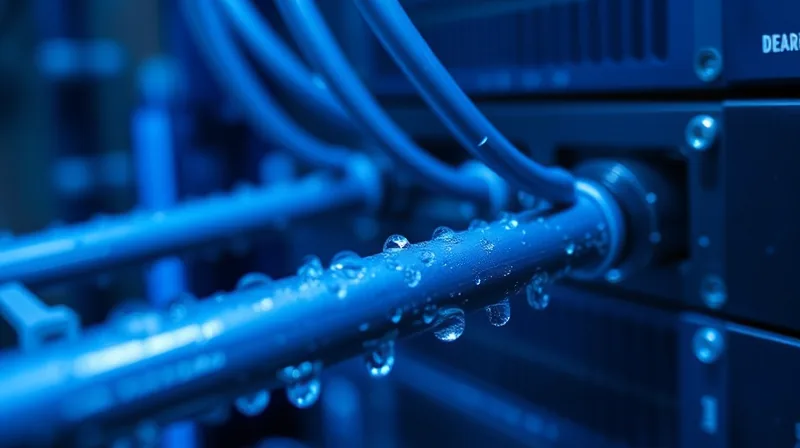
AI Water Use Threatens Drought-Stricken Regions” — and somewhere, a machine stirs. Not just in the server, but in the pipes. Water begins to flow, not for you, but for the silicon that answers. Before the first word appears on your screen, before the cursor even blinks, a cooling system kicks in. Fans hum. Pumps push water through metal plates that touch processors hot enough to cook an egg. This is the moment just before something begins: the air before the first note of a symphony that plays billions of times a day, and nobody hears it.
This is not a hypothetical future. It is happening now, in the taps of Arizona and the reservoirs of Mexico. Our world chose speed over foresight, and we are living with the consequences.
A UN University report from June 2025 forces us to see what we have been ignoring. By 2030, global data centers could use 9.3 trillion liters of water each year. [1] That is enough water to meet the basic needs of every person in Sub-Saharan Africa for a full year — for drinking, cooking, and washing. In 2025, data centers already consumed 4.5 trillion liters, enough to fill 1.8 million Olympic-sized swimming pools. [1] That is not a warning. It is an invoice for a debt we are already paying.
The water comes from places that can least afford to lose it. Google built a data center in Mesa, Arizona, a city under severe drought. The facility has a permit to use 5.5 million cubic meters of water each year — enough for 753,000 people. Meanwhile, Arizona faces a Tier 1 shortage on the Colorado River, with water allocations cut by 512,000 acre-feet. Every liter that cools a server is a liter that does not reach a farm, a household, or a river. And Google is building a second data center in Mesa.
Data centers are drawn to arid regions because land is cheap, taxes are low, and the climate reduces energy costs for cooling. But the same conditions that make these places attractive make them vulnerable to drought. It is a cruel irony: the machines that promise to solve humanity’s problems are being built in places where they create new ones.
In Queretaro, Mexico, more than two dozen AI data centers have been built even though the local reservoir has been dramatically diminished. In Montevideo, Uruguay, severe drought made tap water unsafe to drink in 2023, yet plans for another Google facility are moving forward. People protested in the streets because there was no water to drink, while the government approved permits for machines that would consume millions of liters. The disconnect is not just bureaucratic; it is moral.
The UN report does not call for stopping AI. It calls for transparency. Data center operators are not required to disclose how much water they use, where it comes from, or what happens to it after cooling. Some water evaporates. Some is treated and returned. Some is simply lost. Without disclosure, there is no accountability. The report recommends ‘standardized, comparable disclosure of energy use and the resulting water, land, and carbon footprints.’ This is basic information any community should have before a data center is built in their backyard.

The problem goes deeper than disclosure. It goes to the nature of AI itself. A short text query uses relatively little water. But an AI-generated image requires about 60 times more energy. A high-resolution video clip can use as much electricity as 200,000 automated spam filters running simultaneously. As AI becomes more visual and creative, the resource footprint grows exponentially. Every generated image, every synthesized voice, every deepfake video is a tiny act of consumption that adds up to a global crisis.
The response from the industry has been muted. Companies like Google, Microsoft, and Amazon have made vague commitments to sustainability, but they continue to build data centers in water-stressed regions and design models that require more computation. They treat water as an externality — something outside the balance sheet. Many data centers operate in a regulatory vacuum, where the only constraint is the availability of land and power.
What if, instead of building data centers in deserts, we built them in places with abundant water? What if we designed AI models that prioritize efficiency over scale? What if we required every company to report its water footprint the same way it reports financial earnings? These are not impossible questions. They are choices we have not made because the cost is visible only to those who cannot afford to ignore it.
The people of Sub-Saharan Africa are not the ones using AI. They are the ones whose water is being diverted to cool servers that generate images of cats and recipes for vegan lasagna. The UN report calculates that the water used by data centers in 2025 could have met the basic needs of 600 million people in Sub-Saharan Africa. By 2030, that number doubles. This is not a trade-off anyone voted for. It happened by default, because technology moved faster than regulation.
The water used by data centers is not just a quantity problem; it is a quality problem. Water used for cooling must be clean — free of minerals and biological contaminants that could clog pipes or corrode equipment. Data centers often use water treated to drinking-water standards. After cooling the machines, the water is often discharged at a higher temperature, which can harm local ecosystems if released into rivers or lakes.
There is a historical precedent. In the 19th century, the Industrial Revolution consumed coal and iron with little regard for consequences. In the 20th century, we burned oil and gas without understanding climate change. Now, in the 21st century, we are consuming water without understanding the limits of the hydrological cycle. Each era has its blind spot. Ours is water.
The UN report is not the first to raise this alarm. Research from the Environmental and Energy Study Institute had already highlighted the water intensity of AI data centers. [2] But the UN report is the most comprehensive, and it comes at a time when the world is waking up to the reality of water scarcity. According to the UN, 2.2 billion people lack access to safely managed drinking water. By 2050, that number could rise to 5 billion. And yet, we are building infrastructure that consumes water at an accelerating rate, often in the most water-stressed regions.
The irony is that AI itself could help solve water problems. Machine learning models can optimize irrigation, detect leaks in pipes, predict droughts, and manage water distribution networks. But that potential is undermined if the very infrastructure that powers AI consumes more water than it saves. It is like using a fire hose to fill a teacup — the tool is powerful, but the application is wasteful.

The UN report calls for “efficient designs that use energy resources wisely.” But efficiency alone is not enough. Efficiency can reduce the rate of consumption, but it does not address the fundamental question of whether we should be consuming this resource at all. There is a difference between using water wisely and using it unnecessarily. Every AI-generated image is unnecessary in the sense that it is not essential for survival. We are using water to create digital artifacts that have no physical existence, while people in the same region struggle to find clean water for drinking.
This is not a Luddite argument. It is a call for proportionality. The UN report does not want to slow technological progress; it wants to ensure that innovation and stewardship are aligned. But alignment requires awareness, and awareness requires disclosure. Right now, the industry operates in a fog of opacity. We do not know how much water each query uses, where the water comes from, or what happens to it afterward. The UN report is a flashlight in that fog, but it is not enough. We need regulations that require transparency, and we need communities that demand it.
The moment of realization comes now, as you read this. You are using a device that is connected to a network of data centers. Every time you refresh a page, send a message, or ask a question, you are part of this system. The water that cools the servers that process your request might come from a river that is already running dry. The electricity that powers those servers might come from a coal plant that heats the planet. The chain of consequences is long, but it ends with you. Not because you are guilty, but because you are aware.
And awareness is the first step. The UN report is a document, but it is also an invitation. It invites us to see the infrastructure that we have built and to ask whether it serves us or we serve it. It invites us to imagine a different world — one where the air before the first note is not the sound of water rushing through pipes, but the silence of a machine that has learned to be still.
The water that AI uses is not invisible. It is in the taps of Mesa, the reservoirs of Queretaro, the rivers of Uruguay. It is in the bodies of people who cannot afford to lose it. And it is in our hands, if we choose to act. The moment of realization is not the scientist’s discovery; it is the reader’s recognition, right now, that the world we have built is not the world we have to live in. We can choose differently. We can design differently. We can ask the question that no one is asking: What if the machines that think for us also learned to care for us?
Sources
1. UN University Institute for Water, Environment, and Health