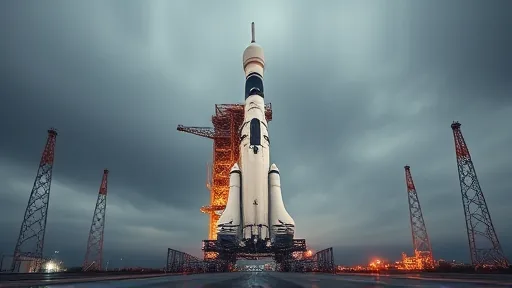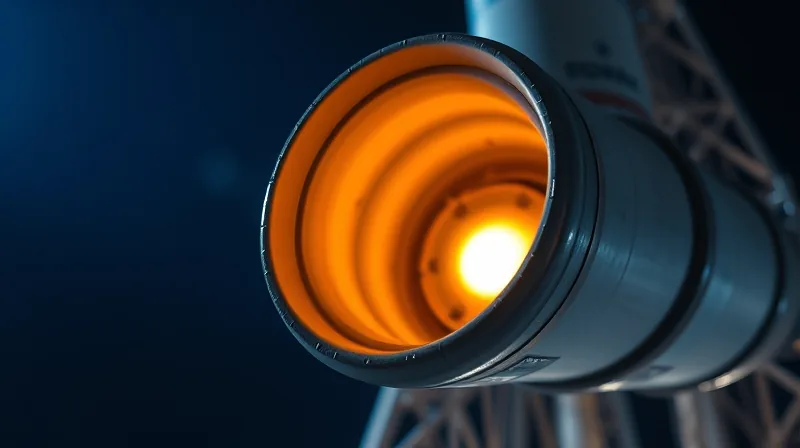
The simplest explanation for a grounded rocket is often the wrong one. The obvious story would be: a nozzle broke, engineers found the broken part, replaced it, and now the rocket flies again. What United Launch Alliance is actually doing on November 13 is closer to flying a hypothesis than flying a repair. The company has not named the root cause of the February solid rocket booster anomaly. [1] ULA and Northrop Grumman, the booster manufacturer, have identified “several potential contributors” and mitigated them through design and process improvements to the nozzle. That is a different thing, and the difference matters for everything that follows.
The data that do not fit the tidy model start with the count. Vulcan has flown four missions. Two of them produced nozzle failures on solid rocket boosters. In both cases the vehicle overcame the failure and completed its mission, which is precisely what makes the anomaly slippery. Nothing blew up. Nothing fell short of orbit. The hardware absorbed the fault and kept going, so the fault left no smoking crater to point at.
A Grounding That Cost Nine Months
Nine months separate the February incident from the planned November 13 return. [1] The mission itself is not a test flight in the ordinary sense. It carries 40 satellites for the Amazon Leo broadband constellation, the first of 38 Vulcan flights Amazon has booked to deploy the bulk of its network. The launch lifts off from Cape Canaveral Space Force Station in Florida, and the date still awaits range approval. Amazon is not launching a demonstration here. It is launching inventory.
The stakes are asymmetric in a way that a simple “return to flight” label hides. Amazon has satellites in storage waiting for rides, and it has committed to Vulcan for the bulk of a constellation meant to compete with SpaceX’s Starlink network. Amazon has an inventory of broadband satellites in storage waiting for rides on the Vulcan rocket. The rocket’s recovery is therefore not only ULA’s problem. It is a supply chain event for a customer with 38 flights on the books.
The first occurrence of the nozzle problem, in 2024, was blamed on a manufacturing defect in an insulator designed to protect the nozzle’s metallic structure from the rocket’s superheated exhaust. That explanation covered one failure. It has not been extended to February’s. The gap between “we fixed a defect” and “we understand the failure” is where this launch lives.
The Customer That Stopped Trusting
The Pentagon has entrusted Vulcan with roughly half of its major launches through the early 2030s. That is a long commitment built on a rocket that has now been grounded once. The Space Force certified Vulcan for national security launches in 2025, flew two missions on it, then halted those launches after the February booster incident.
The military has already voted with its manifest. Six missions have been moved off Vulcan to SpaceX Falcon 9 and Falcon Heavy rockets to expedite their launch, and ULA received six future missions originally assigned to SpaceX in return. The swaps included three GPS satellites that flew on Falcon 9s last year and earlier this year. One ULA launch for the Space Development Agency went to SpaceX as well. A launch carrying the Air Force Research Laboratory’s Oracle-M lunar mission now flies on Falcon Heavy instead of Vulcan, with ULA compensated by a future SpaceX-assigned launch. A large strategic missile warning satellite made the same jump from Vulcan to Falcon Heavy. So far the trades have not changed the total number of missions awarded to either provider, and Space Systems Command describes them as executed in coordination with and with the support of both companies.
Brig. Gen. Eric Zarybnisky, the chief rocket buyer at Space Systems Command, has set a condition rather than a date. The military wants to see data from commercial Vulcan flights before clearing the rocket for national security missions again. At least two Amazon Leo missions sit on the schedule ahead of the next national security flight, perhaps early next year. “Those flights will have a significant number of solids,” Zarybnisky said. [1] “It’ll depend a lot on what we see, not only on the engineering and tests that we’re doing on the ground, but also what we see from the flight data from the commercial missions they fly.” The logic is unusual: a military customer is outsourcing its confidence-building to a commercial satellite company’s launch campaign.
Wider Net, New Nose
November 13 is not a repeat of an earlier flight with one part swapped. It is the first Vulcan to fly with a full complement of six solid rocket boosters. The flight also debuts an extended payload fairing to accommodate Amazon’s satellite stack, and a shortened Centaur upper stage optimized for low-Earth orbit missions. Three firsts on one rocket, and the fairing and upper stage changes are about fitting and lifting the payload, not about the anomaly.
ULA’s own framing of the decision is that flying the improved design is the fastest route to knowledge. “To support our customers, this upcoming launch will utilize the improved nozzle design, and additional testing and analysis will continue in parallel with the mission,” the company said. “By flying the improved design, ULA gains valuable flight data that validates these improvements and is the most beneficial path in support of all our customers.” The ground tests are not finished. They run alongside the mission.
The open question is whether a fix built on “several potential contributors” holds across a manifest of 38 Amazon flights plus roughly half the Pentagon’s major launches through the early 2030s. Whether that data closes the gap between mitigation and root cause is what the Space Force is waiting to see, and what no ground test has yet settled.
Sources