Urban Trees Emit Chemicals That Worsen Ozone Pollution
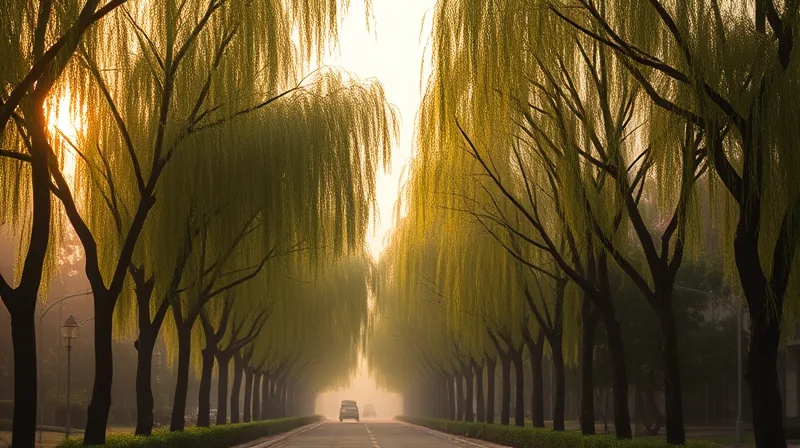
Beijing planted millions of weeping willows and poplar trees to create a green metropolis. The strategy worked — the megacity now boasts lush avenues and park networks that cool the summer heat. But those same trees carry a hidden cost that researchers only recently uncovered: they are becoming a major contributor to the city’s air pollution. The study, published in Science Advances today, shows that compounds released by these fast-growing species are driving ozone formation in ways that surprise even the scientists who found them. [3]
The finding flips a common assumption on its head. Urban greenery is typically celebrated as a natural filter that cleans the air we breathe. Trees absorb carbon dioxide, trap particulate matter on their leaves, and provide shade that reduces the need for energy-hungry air conditioning. Yet the new research reveals that certain tree species — chosen precisely because they grow quickly and withstand climate stress — release chemicals that actively worsen ozone pollution. The very plants planted to improve urban life are, in part, making the air harder to breathe.
Co-author Bin Yuan, who studies atmospheric chemistry at Jinan University in Guangzhou, China, said the team initially set out to understand how human activity drives ozone pollution. [2] They expected vehicles and industry to dominate the picture. Instead, the data pointed somewhere unexpected. “When we got this data, we did not believe it at the beginning,” Yuan said. [2] Urban vegetation, it turned out, was a much larger contributor to ozone emissions than anyone had previously estimated.
The mechanism behind this green paradox is subtle and involves a chain of chemical reactions that most people never think about. Ozone forms when volatile organic compounds — VOCs for short — react with nitrogen oxides, or NOx, in the presence of sunlight. VOCs come from many sources: vehicle exhaust, industrial solvents, paints, and also from vegetation itself. Nitrogen oxides come mainly from traffic and industrial processes. When these two families of compounds meet under the sun, a series of reactions produces ozone at ground level, where it can inflame and damage human airways.
Breathing in ozone is not like inhaling the protective layer high in the stratosphere. Ground-level ozone is a respiratory irritant that can cause coughing, throat irritation, and shortness of breath. For people with asthma or chronic lung disease, exposure can trigger serious attacks that require hospitalization. Children, older adults, and people who work outdoors face the highest risks. The new study adds a layer of complexity to how cities manage this health threat: the trees planted to beautify streets may be feeding the problem.
The Chemical Culprit Hidden in Leaves
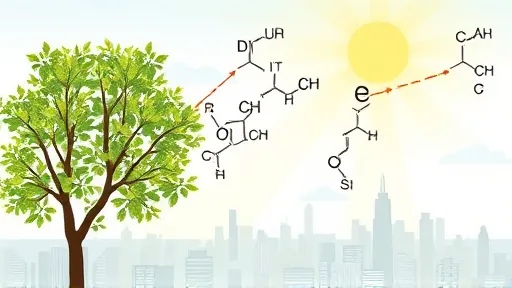
The key player in this story is a compound called isoprene, a type of VOC that trees produce as a byproduct of photosynthesis. Not all trees emit isoprene at the same rate. Some species release almost none, while others pour it out in significant quantities. Willows and poplars belong to the high-emitter category, and both have been planted extensively across cities worldwide because they grow fast, tolerate poor soil, and survive heat waves. In Beijing, the researchers found that roughly 35% of the city’s trees are isoprene emitters. [3]
The team collected air samples across Beijing to measure VOC concentrations and gathered ozone data from monitoring stations around the city. Their analysis covered May through July 2021, a period when warm temperatures and strong sunlight create ideal conditions for ozone formation. During that window, vegetation accounted for about 10% of the total VOC emissions in Beijing. [3] Human activities — vehicle exhaust, industrial chemicals, solvents — contributed the remaining 90%. On the surface, that split suggests plants play only a minor role.
But VOCs do not directly form ozone. They must first react with other chemicals in the atmosphere, and different VOCs react at very different speeds. Isoprene is exceptionally reactive, which changes the calculation entirely. The researchers estimated how fast VOCs from various sources react with hydroxyls — highly reactive molecules that act as a kind of atmospheric detergent. When hydroxyls encounter VOCs, they produce peroxy radicals, which then react with NOx to form compounds that turn into ozone under sunlight.
This reactivity-based approach revealed a very different picture. When the team calculated how much each VOC source contributed to the chemicals that go on to form ozone, vegetation accounted for 52% of that reactivity. Isoprene was the dominant contributor. In other words, although human activities released far more total VOCs, their contribution to ozone formation was substantially less than that of plants. A small amount of highly reactive isoprene outperformed a much larger volume of slower-reacting industrial chemicals.
The finding has implications that extend far beyond Beijing. The researchers examined tree species planted in 24 megacities worldwide and estimated their potential isoprene emissions. A large proportion of those cities showed predicted emission levels higher than Beijing’s. Sydney and Melbourne in Australia stood out in particular. In Sydney, about 65% of the trees emit isoprene — nearly double the proportion found in Beijing. Cities that planted willows and poplars decades ago are now discovering the long-term chemical consequences of those choices.
Why Heat Turns Up the Pollution Dial
Temperature plays a decisive role in how much isoprene trees release and how quickly it reacts in the atmosphere. The study quantified this effect with striking precision. At 35 °C, the hydroxyl reactivity rate with VOCs from vegetation was seven times higher than at 20 °C. That dramatic jump means a hot summer day transforms urban trees into much more potent pollution sources than a mild spring morning. The contribution of vegetation to chemical reactivity rose from 21% at 20 °C to 74% at 35 °C.
This temperature sensitivity creates a feedback loop that worries atmospheric scientists. Global warming is pushing cities toward more frequent and intense heat waves. As temperatures climb, trees release more isoprene, which reacts faster, which produces more ozone. The study suggests that rising temperatures from global warming could exacerbate the ozone problem in urban areas already struggling with air quality. Cities that planted these trees for climate resilience may find those same trees becoming less helpful as the climate changes.
Ian Jamie, an environmental chemist at Macquarie University in Sydney, offered context for why vegetation’s role is growing. [1] Emissions from vehicles, which used to be a large source of organic compounds, have reduced substantially over the last few decades thanks to catalytic converters and stricter fuel standards. As human sources shrink, the relative contribution from trees becomes proportionally larger. Jamie noted that vegetation as a source of VOCs is becoming more significant not because trees changed, but because the other sources cleaned up their act.
The study’s findings raise practical questions for urban planners who select tree species for new developments. Fast-growing species like willows and poplars offer undeniable benefits: quick shade, rapid carbon sequestration, and low maintenance costs. But those benefits come with a chemical trade-off that only becomes apparent over decades. The study’s data provides a framework for evaluating the ozone implications of different planting choices, though it does not prescribe specific replacement species
The Beijing study measured ambient air samples, which capture the combined effect of many sources. Isolating individual species would require controlled experiments or portable measurement devices placed near specific trees. Such data would help cities make informed decisions about which species to plant and where, balancing the benefits of shade and cooling against the chemical reactivity that feeds ozone formation.