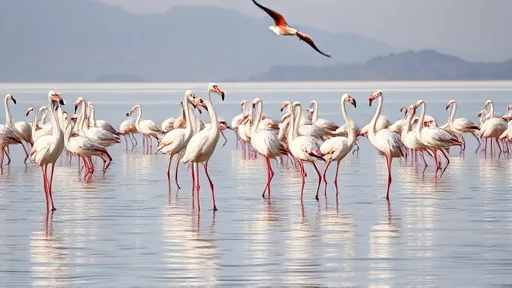
A Pond That Refused to Stay Silent
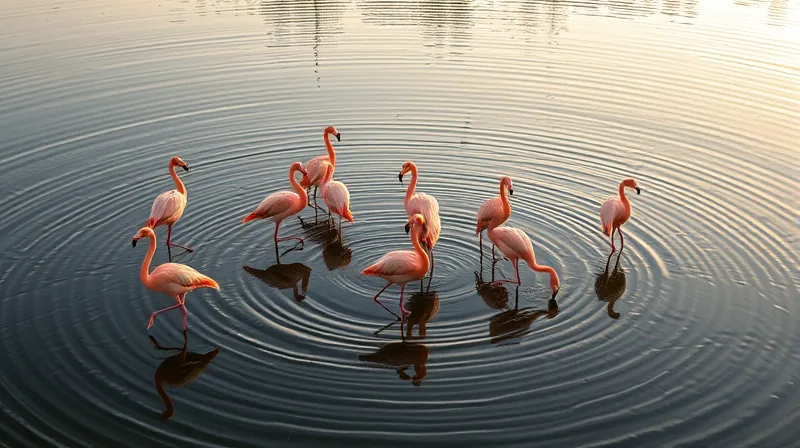
Víctor Ortega Jiménez was on a family trip to Atlanta when he noticed something in a flamingo pond that had nothing to do with the birds’ famous pink plumage or their stilt-like legs. [1] The flamingos were feeding below the surface, and the water above them was breaking into ripples he later described as beautiful. [1] He took photographs and videos. He could not explain what he was seeing.
That unexplained pattern is the kind of small anomaly that most observers would file away as scenery. For Ortega Jiménez, a researcher at the University of California, Berkeley, it became a question that resisted an answer for more than four years. The delay is the story’s quiet engine: a visible phenomenon with no visible cause, waiting for someone patient enough to keep asking.
His field is biomechanics — the study of how the mechanics of movement and structure apply to living animals. The framing matters. He is not asking how flamingos feel or what they prefer. He is asking what physical work their bodies perform on the water around them, and whether that work can be copied by human engineering.
The answer, when it came, was not about the beak alone. It was about a sequence: a head pulled back, water set spinning, feet stomping, food delivered. A feeding strategy that looks like dancing turns out to be a machine made of motion.
One Spinning Trap
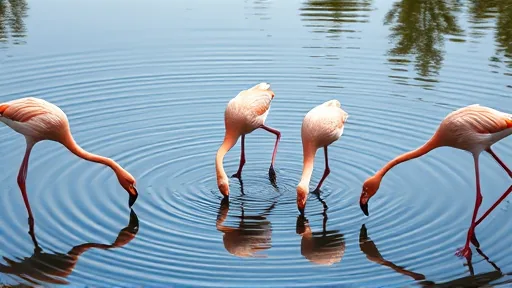
By retracting their heads, flamingos generate vortex-like traps in the water — swirling structures that gather algae and draw it toward the bird. The stomping that follows, which reads as a dance, amplifies that vortex, according to Ortega Jiménez’s findings. The combined motions carry food to the flamingos’ crooked beaks, where a filter separates the edible from the rest and releases silt and mud back out.
The precision of that filter is the finding that travels furthest. The process can weed out particles the size of a single cell. A bird standing in a pond is running a separation step at the scale of a single cell.
The work sits at the intersection of animal observation and applied engineering. Ortega Jiménez’s stated goal is to understand how animal behaviors might lead to human-made engineering feats — the bird as a blueprint rather than a curiosity. [1] The candidate applications he names are specific: removing microplastics from water, and removing PFAS — the so-called forever chemicals — from water. Both are problems defined by particle size and by the difficulty of catching something tiny without fouling the equipment doing the catching.