Chandra X-ray Census and Sonification of the Eagle Nebula
An X-Ray
Census of a Familiar Portrait Before 2001, the Eagle Nebula was a picture. Its dark towers of cold gas and dust, roughly 6,500 light-years away toward the constellation Serpens, had become one of the most recognizable portraits of star birth in the sky. What the portrait could not show was the high-energy side of the story — the X-rays thrown off by young stars too buried in dust to be seen in visible light. On July 30, 2001, the Chandra X-ray Observatory pointed at the region for 78,000 seconds (78 ks) and produced the first high-resolution X-ray image ever obtained of the Eagle Nebula star-forming region. [2] The field of view was 17 by 17 arcminutes, taken with the ACIS-I instrument, and it covered both the core of the young galactic cluster NGC 6611 and the dark columns known as the Pillars of Creation. [2] That exposure turned a beloved photograph into a census.
The census came back large. A total of 1,101 X-ray sources appeared in that single field. [1] Most of them are low-mass pre-main-sequence stars or high-mass main-sequence stars already burning steadily in this young cluster.
The sharpest part of the result concerns the pillars themselves. A handful of hard X-ray sources inside the pillars sit at the same positions as deeply embedded young stellar objects that had been seen in high-resolution near-infrared images from the Very Large Telescope, published by McCaughrean and Andersen in 2002. [1] The match is the first direct X-ray confirmation that these buried objects are genuinely young stars still gathering mass
Where the X-Rays Stop, and What That Silence Means
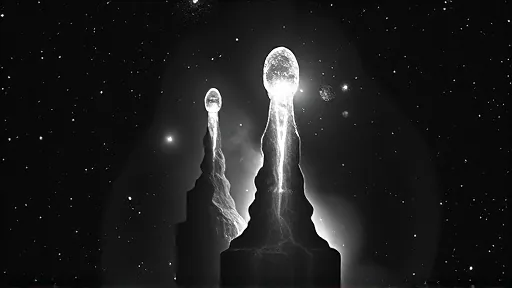
Against that careful inventory stands a striking absence. None of the X-ray sources line up with the evaporating gaseous globules — EGGs — first observed by Hester and colleagues in 1996 using Hubble’s WFPC2 camera. [1]. These small dense knots of gas had been proposed as the cradles of newborn stars. The X-ray data offer two readings: either the EGGs do not contain protostars at all, or the protostars inside them have not yet switched on as X-ray emitters.
One positive identification stands out. Eight X-ray counts coincide with the Herbig-Haro object HH216, a jet of gas thrown out by a young star. That detection implies an X-ray luminosity written as log L_X near 30.0. It is a single object, measured cleanly, in a region where hundreds of sources crowd the frame.
Here the story turns from the eye to the ear. The combined Hubble visible-light and Chandra X-ray image of M16 has been translated into sound through a process called sonification, in which a scanning line moves from left to right across the picture. [1]. Vertical position sets pitch. Stars and dust announce themselves as the line passes over them. The same pillars that were sculpted and eroded by ultraviolet light and stellar winds from the cluster’s massive stars — structures already destined for destruction — can now be followed by listening rather than looking.
What the Survey
Leaves for the Next Instrument
The 1,101 sources form a reference set. Within it, the 40 X-ray sources in and around Pillars 1 through 4 form the focused subsample the study examines most closely.
The turbulent star-forming conditions inside M16 are likely similar to the environment that formed our own Sun. [1] And the pillars are not permanent: sculpted and eroded by ultraviolet light and stellar winds, they are destined for destruction. The image we sonify today records a structure in the middle of being taken apart.