The Rate That Decides
A frog sits in water. The temperature climbs by a fraction of a degree each minute. Nothing else in the animal’s world changes — no predator, no drought, no loud noise. Only one number moves. Whether the frog lives or dies turns out to hinge on how fast that single number climbs, and on whether the frog’s nervous system is built to notice a slope rather than a level.
That is the real physics behind a story most people have heard at a conference or a climate rally. The fable says a frog will sit in a pot until it boils. The science says the frog’s fate depends on the rate of change, not the destination. Heat the water slowly enough and the animal’s alarm system may never fire. Heat it quickly and the same animal bolts.
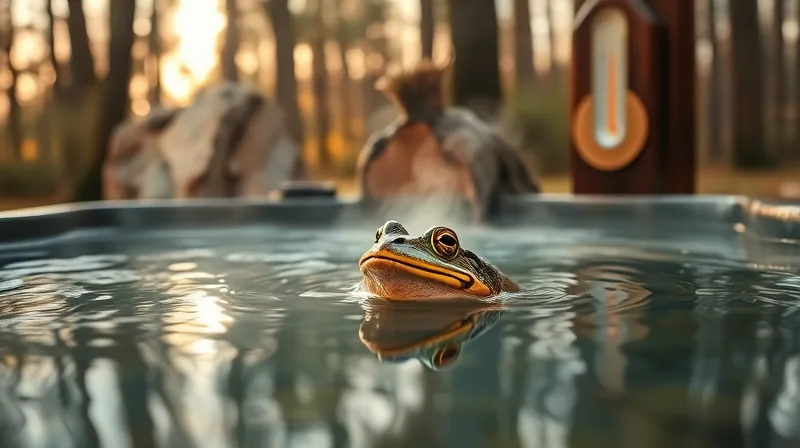
In a wood-fired hot tub on a forest property in New South Wales, Australia, the water is chemical-free — cleaned by ozone and an ultraviolet lamp — and holds hundreds of litres of what is, from a frog’s point of view, pure rainwater. [1] Heating it from below 15 degrees Celsius (59 degrees Fahrenheit) to about 38 degrees Celsius (100 degrees Fahrenheit) can take an entire day in winter. [1] Peron’s tree frogs (Litoria peronii) move in anyway. After those early slow heating days, the author found frogs floating dead, splayed out with rigor mortis and ghostly white in the hot water. [1] The ritual that followed was to catch every squatter before lighting the fire, relocate them to a nearby pond, and lift the lid at intervals to check for stragglers. The same half-dozen individuals make the short journey back from the pond to the tub each evening.
The Brain That Reads the Slope
The mechanism sits in the fly brain, and it is precise. Marco Gallio at Northwestern University in Illinois, prompted by the boiling frog parable, studied what happens when fruit flies are warmed gradually. His team found that the fly brain has circuits tuned to respond to rapid, but not slow, temperature change, alerting the fly to escape before conditions reach physically dangerous limits. What they track is the rate of change.
The circuitry then does something a thermostat cannot. In plain terms: the fly’s brain extrapolates the trajectory of the temperature and primes an escape before conditions become physically dangerous. A fast rise gets flagged early. A slow rise slips under the threshold.
Gallio’s summary is blunt about the consequence: if the rate of change is faster, the fly escapes quicker. He and his colleagues believe the result generalizes to other species, though Gallio also thinks frogs will eventually escape if the water becomes dangerous.
The old evidence rests on a series of bizarre 19th-century experiments, including one comparing lobotomised frogs with brain-intact frogs as the surrounding water warmed. In 1875, a scientist named Carl Fratscher showed that frogs stayed put when water warmed from 20 to 38 degrees Celsius over 2 hours and 15 minutes. When a large flame raised the temperature from 26 to just 29 degrees Celsius in a mere 5 minutes, they tried to escape. The old data and the new fly data agree on the variable that matters: the slope.
A Precedent for Creeping Normality
Jodi
Rowley at the Australian Museum in Sydney calls the frog-boiling myth just that — a myth. Her reasoning is ecological rather than neurological. In most situations, she says, frogs would perceive the increase in temperature, become more active, and likely jump out. Frogs are highly sensitive to even small, gradual changes in temperature in both the lab and the field, and they are among the first animals to respond to climate change.
That is the precedent worth carrying forward, and it runs in the opposite direction from the fable. If frogs are early responders, then the boiling frog story misdescribes the very creatures it borrows. The image of the frog has been doing service in climate advocacy and self-help writing for decades on the strength of a claim about frogs that the frogs themselves contradict.