The Chandelier That Could Never Ignite
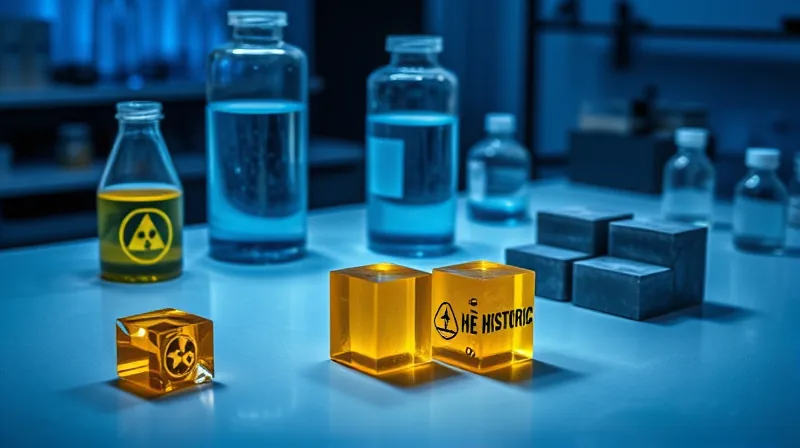
For the first time, the question of whether Nazi Germany’s last reactor experiment could have worked is being answered not by argument but by direct examination of the physical material itself. Two of the surviving uranium cubes from the B8 pile have been analyzed, alongside the heavy water and the graphite blocks that surrounded them. This is forensic archaeology applied to a machine that no longer exists. The team then built a neutronics model of the B8 pile and validated it against measurements taken in situ in 1945. It is comparable to reconstructing a fire from its cold ashes and checking the reconstruction against a photograph taken while the embers still glowed. The model and the historical readings agree. That agreement is what gives the new numbers their weight.
The B8 pile was assembled in April 1945 in Haigerloch, a small town where Werner Heisenberg had moved his Berlin group as Allied forces closed in. The team worked in a cave beneath a castle — today the site of the Atomkeller Museum. The device looked like an ominous chandelier: 664 uranium cubes strung together on aircraft cable, lowered into a tank of heavy water, the whole arrangement shielded by graphite to keep radiation away from the people tending it. It was the culmination of Nazi Germany’s nuclear program. It did not sustain a chain reaction.
The number that settles the matter is keff — the effective neutron multiplication factor, the ratio indicating whether each generation of neutrons is smaller or larger than the one before. Below one, the reaction dies. At one, it sustains itself. The B8, as built, sat at 0.94. [1] That is not a near miss in the way a photo finish is a near miss. It is a machine running at ninety-four percent of the threshold it needed, with every inefficiency already baked in.
The Gap Was Not Small
Heisenberg’s own account, published in Nature in 1947, described the B8 as “just insufficient” — lacking only a “relatively small amount of uranium.” [1] The new calculation puts the shortfall at about 2.0 times the uranium and about 2.2 times the heavy water actually used. To reach keff of 1.0, the Germans would have needed roughly double the uranium they had on hand. That is not a slight increase in size. It is a second pile’s worth of material.

Those requirements — 1.2 times Germany’s estimated available wartime uranium inventory and 1.8 times its heavy water inventory — exceed what the country could have supplied during the entire war. The heavy water figure is especially stark: the requirement equals twice the output of the Norsk Hydro plant at Vemork in Norway, the only source at the time, across all the war years combined. A program cannot close a gap that is larger than its total lifetime supply.
A 2009 neutronics study had pointed the other way, finding that the group would have needed only 50 % more uranium cubes to make the design work. [1] That estimate rested on a different accounting of the pile’s composition. The new work, anchored in the measured properties of actual surviving cubes, moves the target well beyond reach.
The Graphite That Was Never an Option
Historians have long suggested the Germans should have followed the American route and built a graphite-moderated reactor instead. The new analysis closes that door too. German graphite carried 3.4 parts per million by weight of boron impurities, and the B8’s graphite had been re-used from the earlier B7 experiment. At that contamination level, a hypothetical natural-uranium graphite pile could not have gone critical.
The root of the problem sits in the raw material. German graphite was made from metallurgical coke, which naturally carries more boron than the petroleum coke-based graphite available in America. The British naval blockade from January 1940 deprived Germany of the petroleum coke supply that did reach the country in some quantity. The Ruhr’s metallurgical coke had roughly twice the impurities of American coke. American scientists hit similar trouble until they located an unusually low-boron coke in Pennsylvania — the find that uniquely enabled Chicago Pile 1 to reach criticality. Germany never found its Pennsylvania.
The accounting of the material itself is what finally settles the question: the B8 was never a near miss, but a design short of the uranium and heavy water Germany could produce in the entire war.