EEG Tetris Study Reveals Brain Planning in Real Time
Reading Minds One
Block at a Time
For decades, scientists who wanted to understand how the brain plans ahead faced a frustrating limitation. They could observe the results of decisions, but the internal process — the tiny electrical conversations between neurons that precede a single choice — remained invisible. They were like meteorologists predicting a storm by watching clouds form, never able to measure the atmospheric pressure itself.
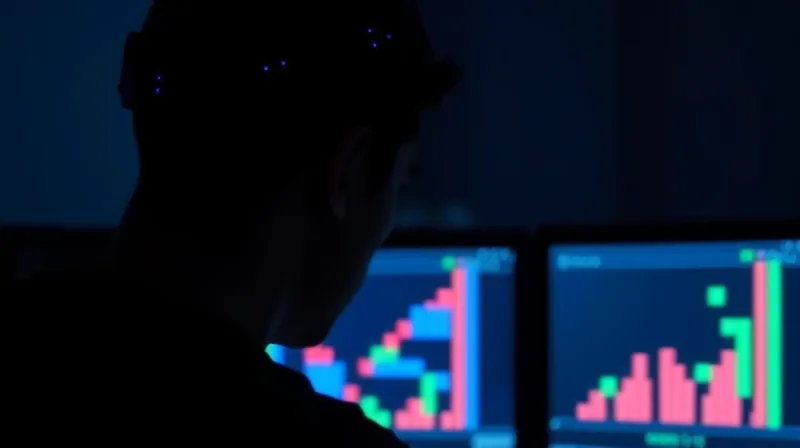
That limitation is now dissolving at the University of Minnesota State Fair Research Building, where Jean-Paul Noel, a neuroscience professor, has set up an experiment that captures planning in real time. Fairgoers sit down to play Tetris while wearing a cap studded with sensors that record electroencephalography, or EEG — the faint electrical signals produced by brain activity. An eye-tracking system follows their gaze across the falling blocks.
The setup measures three streams of data simultaneously: the keys participants press, the movements of their eyes, and the voltage fluctuations on their scalps. “These are tiny fluctuations of voltage on your scalp, and it just happens naturally,” Noel explained. “And then, we try to relate those three measures to one another.”
The question at the heart of the study is not how the brain reacts, but how it anticipates. Tetris demands that players plan several moves ahead — deciding where a falling piece should go before it lands, and how that placement will shape the landscape of blocks below. The game is, in essence, a natural laboratory for studying multi-step thinking.
“So there are responses on a keyboard,” Noel said. “Are they choosing to put the piece left or right? We’re looking at the piece they have to place as well as the landscape that exists in the Tetris border.”
By correlating eye movements with brain waves and keystrokes, the research team hopes to see the moment a plan forms. The eyes move before the fingers act, and the brain’s electrical signature shifts before the eyes move. For the first time, all three measurements can be observed together, offering a direct view of a process that was previously only inferred from outcomes.
A Century of Asking How Brains Plan
The puzzle of how brains plan ahead is not new. Neurologists and psychologists have wrestled with it since the early twentieth century, when researchers first began mapping which regions of the brain handle foresight and decision-making. Early studies relied on patients with brain injuries, observing how damage to specific areas impaired their ability to plan. The methods were crude, and the conclusions were drawn from deficits rather than direct observation.
The problem has always been access. Planning happens in milliseconds, deep within neural circuits, and the tools available to earlier generations of scientists simply could not capture it. They could ask a subject to solve a puzzle and record whether they succeeded, but the internal choreography of the decision remained locked away.
Modern neuroimaging changed some of that, but even functional MRI — which measures blood flow in the brain — produces images that lag behind the actual neural activity by several seconds. That is far too slow to catch the rapid sequence of a plan forming. EEG, by contrast, captures voltage changes in real time, making it one of the few tools fast enough to observe the brain’s planning process as it unfolds.
Noel’s study is the first time this research group has brought its work to the State Fair, and he describes this year as a baseline. The plan is to eventually follow participants over time, tracking how brain planning changes as people age. That longitudinal approach would build on a question that has been open for a century: how does the capacity for foresight evolve across a human lifetime?
Most neuroscience research relies heavily on college students, which represents only a small slice of the population. Coming to the fair gives the team access to people of different ages, education levels, and backgrounds — making the science more representative of Minnesota as a whole. “I hope people find it exciting when they come to the research,” Noel said, “and the point for us is do more naturalistic science, both in terms of the question we ask — playing Tetris in this case — as well as the environment in which we do it.”
Sixty Studies, One Building
The Tetris study is one piece of a much larger scientific enterprise unfolding inside the State Fair Research Building. This year, the University of Minnesota is running more than 60 research projects across the 12 days of the fair, its largest lineup yet. Organizers hope as many as 20,000 people will volunteer to take part.
The scale of participation matters. Ellen Demerath, Ph.D., co-director of the State Fair Research Program, emphasized that the studies span all age groups, meaning entire families can participate together. “So there’s kids studies, there’s adult studies, there’s studies for people who are older,” Demerath said. “And so when you come to the building, everyone you’re with, your whole family, the folks that are with you, your grandparents, your kids, whatever, can all come together and do some research here.”
For the Tetris study specifically, Noel is aiming to test around 240 participants total. He is especially looking for people on both ends of the age range — those closer to 14 and those closer to 80. Anyone between those ages with no history of epilepsy is welcome to participate. The study takes about 30 minutes to complete and runs through most of the fair’s second week.
The diversity of the fairground population serves a scientific purpose that a university laboratory cannot match. A typical psychology study draws from a pool of undergraduates — young, educated, and strikingly similar to one another. The fair, by contrast, pulls in farmers, teachers, retirees, teenagers, and everyone in between. The result is a dataset that reflects the broader population, not just the narrow slice that happens to be enrolled in a college course.
The research building itself has become a fixture of the fair, and the sheer number of studies running simultaneously means that a single visit can contribute to multiple projects. The hope is that the fair’s festive atmosphere makes science feel accessible rather than intimidating. For the researchers, it is an opportunity to gather data at a scale and diversity that would be difficult to achieve anywhere else. For the fairgoers, it is a chance to see — and participate in — the process of discovery firsthand.