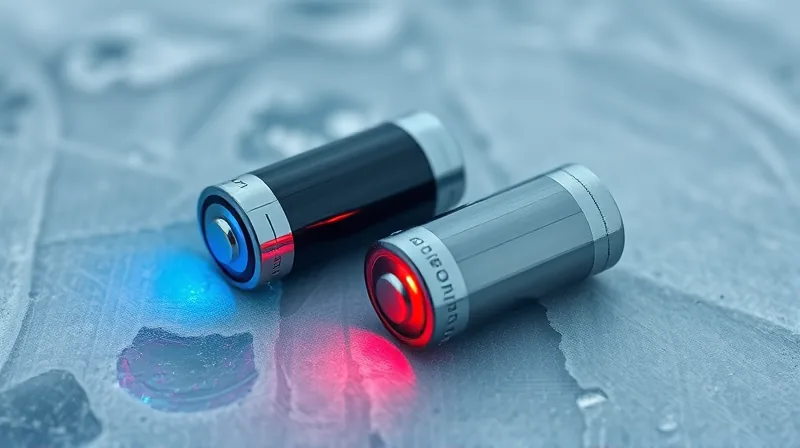
Sodium Battery Outruns Lithium in Extreme Cold
Two Chemistries, One Race to Power the Future
The lithium-ion battery has dominated the modern world for decades. It powers eight billion mobile phones, hundreds of millions of laptops, and rapidly growing fleets of electric cars and energy-storage banks. But a new contender is breaking into the battery market: the sodium-ion battery. Both chemistries were first developed in the 1980s, around the same time. Early sodium prototypes had major shortcomings — they could not hold as much energy as lithium-ion batteries, and they were not as durable, quickly losing their ability to recharge. For decades, therefore, research focused on lithium-ion technology. Now, the sodium approach is catching up fast.
The two technologies share a fundamental principle. Both store energy by moving ions between two electrodes through an electrolyte. In lithium-ion cells, the ions are lithium atoms stripped of one electron. In sodium-ion cells, the ions are sodium atoms. The key difference lies in the raw materials. Sodium is more than 1,000 times as abundant as lithium in Earth’s crust, and up to 60,000 times as plentiful in the ocean. Sodium can be extracted easily from the industrial chemical soda ash (sodium carbonate), which is plentiful and more straightforward to mine than most forms of lithium. Last month, industrial-grade sodium carbonate cost only US$200-280 per tonne, compared with $20,000-25,000 per tonne for battery-grade lithium carbonate, according to Zhang Yizhi, a spokesperson for CATL. [2]
The lithium supply chain is vulnerable. During the pandemic, rising demand for electric cars collided with interrupted supply chains, and lithium markets underwent a series of booms and busts. The world realized how little flexibility there was in the supply of this precious resource, most of which is mined in Australia and a handful of other countries. Although there is no lack of lithium reserves to electrify the world’s economy, the volatility of lithium prices — and uncertainty over how fast mining can expand to meet ballooning demand — is the main reason for Chinese firms to invest in sodium technology, analysts say. “They want to make sure they have a stable supply chain,” says Yun Zhao, a researcher at Imperial College London. [4]
How to Measure a Battery’s True Value in the Cold
The method that reveals sodium’s advantage is cold-weather testing. Conventional lithium iron phosphate (LFP) batteries lose significant capacity in extreme cold. But sodium-ion packs behave differently. In February 2026, a black sedan sped down an icy track in northern China at 95 kilometres per hour when its tyre burst, releasing a puff of white into the -32 degrees C air. The car coasted to a stop without spinning into the snow. This was meant to demonstrate that even the harshest conditions were no barrier to the auto-maker Changan’s new line of electric vehicles, which includes the first mass-produced EV with a sodium-ion battery.

The testing took place in Inner Mongolia, where temperatures regularly drop well below what most EVs are designed to handle. The Nevo A06 was able to charge without issue at around -30 degrees C (-22 degrees F) and continued operating at temperatures as low as -50 degrees C (-58 degrees F). At -40 degrees C (-40 degrees F), the battery retained more than 90 percent of its original capacity. This level of performance is very hard to achieve with conventional LFP batteries. The Mongolian testing revealed that sodium-ion packs could sustainably deliver more power in extreme cold weather than LFP counterparts, without the associated range loss.
This measurement is possible because sodium ions move more freely in the electrolyte at low temperatures than lithium ions do. The sodium ion is larger and interacts differently with the solvent molecules, reducing the energy barrier for ion transport. The result is a battery that works where lithium batteries fail. CATL’s Naxtra sodium-ion battery pack is claimed to be the first that is certified for use in passenger vehicles. The version selected by Changan has a capacity of 45kWh, which delivers around 250 miles of range on China’s CLTC test cycle. According to Changan, this puts it on a par with similar entry-level LFP-based EVs, but the cold weather performance is much greater.
Mass Production Arrives for Sodium-Ion Batteries
The announcement of mass production marks a pivotal moment for sodium-ion technology In April 2026, Chinese firm CATL — the world’s largest battery producer — announced that it will start mass-producing sodium-ion batteries before the end of 2026. CATL, headquartered in Ningde, added that it had signed deals to sell the batteries both to a car manufacturer and to a provider of energy-storage stations for electricity grids. Another Chinese firm, Shenzhen-based BYD, which is the biggest electric-car maker by global sales, is also investing heavily in sodium-ion batteries, analysts report.
Chinese companies have already introduced motorcycles and small cars powered by sodium batteries, and have developed sodium-battery manufacturing facilities CATL’s mass production promises to substantially increase the technology’s spread. The speed at which companies claim to have improved on sodium-ion’s flaws has surprised many observers Auke Hoekstra, an energy analyst at Eindhoven University of Technology in the Netherlands, says he has been taken aback by the pace of advancement. “I honestly did not expect it to go that fast — and I am usually the guy who is seen as an optimist,” he says.
Hoekstra is known for his bullish predictions about renewable energy, which have often been correct. Now he is bullish on sodium-ion. Although other researchers are unsure how strongly the technology can compete with lithium-ion devices, Hoekstra sees it as an innovation that will enable the price of batteries to keep falling, thus speeding up the electrification of the world’s economy “For the future of energy, this really would be a game-changer,” he says. CATL sees the mass production of its Naxtra sodium-ion battery pack as the beginning of a “dual-chemistry” phase for EVs, where the right technology can be selected by EV makers for the correct application. Sodium-ion batteries may appear on electric vehicles that regularly operate in freezing conditions, and Changan is considering introducing the technology to its wider range, given the potential savings it offers
Sources
1. DOI: 10.1038/d41586-026-02150-y
2. CATL
3. Changan
5. Eindhoven University of Technology
6. BYD