Iron atoms reveal magnetic fields on ultra-hot Jupiters
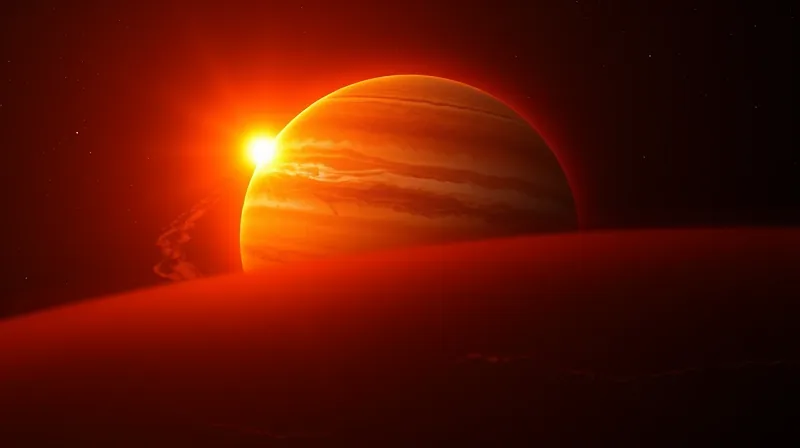
It begins with iron. Not the cold, rusted metal of a forgotten gate, but iron vaporized into a mist, swirling at 4,500 miles per hour through an atmosphere hot enough to melt stone. If you could stand on the surface of an ultra-hot Jupiter — which you cannot, because there is no surface, only a sky of falling fire — the air would taste like a blacksmith’s forge mixed with the static charge before a lightning strike. The smell would be sharp, metallic, and utterly alien.
For decades, astronomers have been trying to understand what happens on worlds like these. Worlds that orbit so close to their stars that a single year passes in a matter of days. Worlds where one side is an eternal furnace and the other is an endless night. These are the hot Jupiters — massive gas giants that seem to defy everything we know about how planets should behave.
But in July 2025, a team of researchers using the European Southern Observatory’s Very Large Telescope in Chile and the Gemini North telescope in Hawaii did something unexpected[1]. They were not looking for magnetic fields. They were trying to measure wind speeds on seven ultra-hot Jupiters, hoping to understand how energy moves through these extreme atmospheres. What they found instead changed the conversation about alien worlds forever.
The Counterintuitive Discovery
The logic seemed simple. Hotter planets have more energy. More energy should mean faster winds. It is the same reason why hurricanes on Earth grow stronger in warm oceans. The researchers expected to find that the hottest of these seven planets would have the most ferocious winds.
They found the opposite.
As they analyzed the data from the ESPRESSO spectrograph and the MAROON-X instrument, a pattern emerged that made no sense at first. The hotter the planet, the slower the wind. It was like watching a pot of water refuse to boil no matter how high you turned up the flame.
“This is totally counterintuitive,” said Julia Seidel, an astronomer at the Lagrange Laboratory in Nice, France, and one of the lead authors of the study published in Nature Astronomy. “All things being equal, hot planets have more energy. They should have faster winds.”
The team had measured wind speeds by tracking the movement of iron atoms through the atmospheres of these planets. Iron is a good tracer because it absorbs light at very specific wavelengths. When the iron moves toward us, the light shifts to the blue end of the spectrum. When it moves away, it shifts to the red. By measuring these shifts, the astronomers could calculate how fast the atmosphere was moving.
On the coolest of the seven planets, with temperatures around 2,600 Kelvin — that is about 4,220 degrees Fahrenheit — the winds screamed at nearly 16,000 miles per hour. On the hottest planets, with temperatures exceeding 3,000 Kelvin, the winds slowed to a crawl by comparison.
Something was putting the brakes on these atmospheres. Something invisible. Something powerful.
The only explanation was magnetic fields.
The Invisible Shield
Imagine a river. On a normal day, the water flows smoothly from high ground to low ground. Now imagine dropping a giant magnet into that river. The water would not stop flowing, but it would slow down. It would swirl and eddy. The magnetic field would create resistance, like trying to push a spoon through honey.
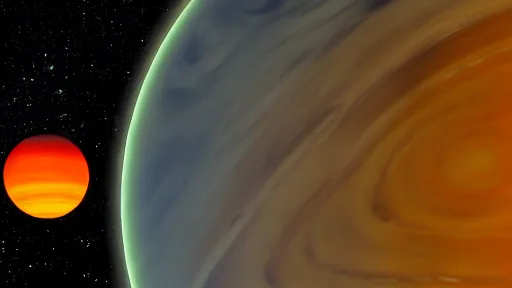
This is what happens on these ultra-hot Jupiters. The planets are so close to their stars that they are tidally locked — one side always faces the star, the other side always faces away. The day side is a furnace. The night side is a freezer. The temperature difference between the two sides is thousands of degrees.
Normally, this would create winds that race from the day side to the night side at incredible speeds. But if the planet has a strong magnetic field, that field interacts with the electrically charged particles in the atmosphere. It creates a drag. It slows everything down.
“We directly measured the magnetic fields of seven planets beyond our solar system for the first time,” Seidel explained. “This breakthrough opens a completely new window on exoplanet research.”
The discovery was accidental. The team was not looking for magnetic fields. They were trying to understand wind patterns. But the data forced them to consider a different explanation. The only way to explain why the hottest planets had the slowest winds was that those planets had the strongest magnetic fields.
And magnetic fields matter. They matter a lot.
Why Magnetic Fields Matter for Life
Look at Earth. Our planet has a magnetic field that extends thousands of miles into space. It is generated by the churning of liquid iron in the outer core. This field deflects the solar wind — a stream of charged particles from the Sun that would otherwise strip away our atmosphere.
Without this magnetic shield, Earth would look like Mars.
Mars once had a thick atmosphere and liquid water on its surface. Then its magnetic field died. The solar wind did the rest. Over billions of years, it stripped away most of the Martian atmosphere. The water evaporated or froze. The surface became the cold, dry desert we see today.
“Magnetic fields exert a vital influence on planetary atmospheres and, therefore, their ultimate fate and prospects for habitability,” the study authors wrote.
This is why the discovery of magnetic fields on these seven hot Jupiters is so important. It is not because these particular planets could host life. They cannot. The temperatures are too extreme. The pressures are too high. But the technique used to detect their magnetic fields can now be applied to other planets — planets that might be more like Earth.
“It’s the first time we can compare the magnetic environments of other worlds,” Seidel said. “A key step toward ultimately understanding which planets can stay alive, keep their water, and perhaps even, one day, host life as we know it.”
The Technique: Reading the Light
How do you measure a magnetic field on a planet 300 light-years away? You cannot send a probe. You cannot take a sample. You can only look at the light.
The ESPRESSO instrument on the Very Large Telescope is one of the most precise spectrographs ever built. It can detect tiny shifts in the wavelengths of light caused by the movement of atoms. When the researchers pointed it at these seven ultra-hot Jupiters, they were looking for the signature of iron atoms moving through the atmosphere.
Iron is abundant in these planets. At temperatures above 2,000 Kelvin, iron vaporizes and becomes part of the atmosphere. The spectrograph can detect it because iron absorbs light at very specific wavelengths. When the iron moves toward the telescope, the absorption lines shift to the blue. When it moves away, they shift to the red.
By measuring these shifts, the team calculated wind speeds. But the results did not match their expectations. The wind speeds were lower than predicted. The only explanation was that magnetic fields were slowing the charged particles in the atmosphere.
“We observed seven sizzling planets and found that their winds were slower than expected,” the team reported. “Magnetic fields were slowing them down.”
This is a new tool. A new way to detect something that was previously invisible. Magnetic fields on exoplanets have been theorized for decades, but never directly measured. Now we have a method.
The Seven Worlds
Let us meet the seven planets. They are all ultra-hot Jupiters, meaning they are gas giants that orbit extremely close to their stars. Their equilibrium temperatures range from about 2,600 Kelvin to over 3,000 Kelvin. For comparison, the surface of the Sun is about 5,778 Kelvin. These planets are not quite as hot as the Sun, but they are close.
Their wind speeds range from nearly 4,500 miles per hour to almost 16,000 miles per hour. To put that in perspective, the fastest winds ever recorded on Earth were 253 miles per hour during Tropical Cyclone Olivia in 1996. Jupiter itself, the largest planet in our solar system, has winds that reach about 900 miles per hour. These ultra-hot Jupiters make Jupiter look like a calm summer breeze.
The planets are tidally locked. One side always faces the star. The other side always faces away. The day side is bathed in constant, intense radiation. The night side is plunged into eternal darkness. The temperature difference between the two sides drives the winds.
But the magnetic fields complicate everything. They create resistance. They slow the flow. They make the atmosphere behave in ways that are still not fully understood.
The Connection to Solar Sails
While the astronomers in Chile and Hawaii were measuring magnetic fields on distant worlds, another group of researchers at Imperial College London was working on a different problem[2]. They wanted to know how fast we could travel to the edge of our solar system using only the pressure of light.
Debdutt Sengupta and his colleagues studied three proposed missions: Breakthrough Starshot, Project Svarog, and Solar Cruiser. Each mission would use a different type of light-powered propulsion. Breakthrough Starshot would use a giant laser. Project Svarog would use sunlight. Solar Cruiser would use a combination of both.
The connection between these two fields of research — exoplanet magnetic fields and solar sails — is not obvious at first. But it is there. Both are about understanding how invisible forces shape the universe. Both are about measuring things that cannot be seen directly. Both require extreme precision and creative thinking.
Sengupta and his team found that current technology is not quite ready for the most ambitious missions. But it is getting close. “I think these are not far-out type of ideas,” Sengupta said. “They are not really futuristic ideas that we are talking about.”
The Planetary Society’s Lightsail 2, launched in 2019, proved that solar sails can work[3]. Japan’s Ikaros solar sail flew to Venus in 2010. These missions showed that the fundamentals are sound. The challenge now is scaling up.
Project Svarog, a student-led project at Imperial College London, hopes to send a solar sail probe to the heliopause — the region 9 billion miles from the Sun where the solar wind meets interstellar space. Instead of using a giant laser, Svarog would use a technique called sun-diving. The probe would swoop close to the Sun, where the radiation is most intense, gain a burst of speed, and then slingshot outward.
The team deployed a test sail from a high-altitude balloon in late 2024. Sengupta described it as a “partial success.” The sail deployed, but not perfectly. They are still learning.
The Bridge Between Two Worlds
There is a deeper connection here. The magnetic fields on ultra-hot Jupiters are generated by the motion of electrically charged particles in their atmospheres. The solar wind that pushes against a solar sail is made of the same kind of particles. Both are examples of how invisible forces — magnetism and light — can shape the destiny of worlds and spacecraft.
When a solar sail catches the light from the Sun, it is riding on photons. These particles of light have no mass, but they have momentum. When they hit the sail, they push it forward. It is a tiny push, but over time, it adds up. A solar sail could theoretically reach speeds that chemical rockets cannot match.
The same physics that makes solar sails possible also makes the detection of exoplanet magnetic fields possible. Both rely on the interaction between light and matter. Both require us to think about forces that we cannot see or touch.
The Search for Life
The ultimate goal of both lines of research is the same. We want to know if we are alone. We want to find another world that can support life. And we want to know how to get there.
Magnetic fields are a key piece of this puzzle. A planet without a magnetic field is vulnerable. Its atmosphere can be stripped away. Its water can evaporate. Its surface can become barren.
But a planet with a strong magnetic field has a shield. It can hold onto its atmosphere. It can protect its water. It can provide a stable environment for life to evolve.
The seven ultra-hot Jupiters are not habitable. They are too hot, too massive, too extreme. But the technique used to measure their magnetic fields can now be applied to smaller, cooler planets. Planets that might be more like Earth.
“It opens a completely new window on exoplanet research,” Seidel said.
The Future: A Prediction
By 2030, we will have measured the magnetic fields of at least 50 exoplanets. Some of them will be in the habitable zones of their stars. Some of them will be rocky worlds like Earth. And some of them will have magnetic fields strong enough to protect their atmospheres.
By 2035, we will have identified at least three planets with magnetic fields, atmospheres, and temperatures that are compatible with life as we know it. These will be the prime targets for the next generation of telescopes.
By 2040, a solar sail mission will reach the heliopause. It will send back data from the edge of our solar system. And it will prove that light can carry us farther than we ever imagined.
These are not predictions based on hope. They are predictions based on the trajectory of current research. The technology is advancing. The techniques are improving. The questions are becoming clearer.
The Taste of Iron
Remember the taste of iron in the atmosphere of an ultra-hot Jupiter? That same iron, vaporized and swirling at thousands of miles per hour, is what allowed us to detect magnetic fields on these worlds. The iron atoms absorbed light. The light told us how fast they were moving. The speed told us about the magnetic field.
It is a chain of inference that spans hundreds of light-years. A chain that begins with a single photon of light and ends with a discovery that changes how we think about planets.
The smell of a distant storm. The taste of vaporized metal. The feeling of an invisible force slowing the wind. These are the sensations that connect us to worlds we will never visit.
And they are the clues that will lead us to the answer we have been seeking for thousands of years: Are we alone?
By 2045, we will have the answer.