The Simulation That Outruns the Track
A mathematical model, not a track, is where the newest thinking about roller coaster safety begins. Take a dive coaster’s real acceleration readings and run them through the physics of a human body that is not a rigid block. The body is soft in places, stiff in others. Its parts do not accelerate in step. When acceleration changes — the technical name is jerk — the head and the torso can move out of phase, and the body’s soft tissue damps the motion at different rates depending on the tissue. Every tissue has a frequency it answers to most strongly, a resonance frequency, and a designer who ignores those frequencies is tuning an instrument without knowing which strings are strung.
That picture is what A. Pendrill and David Eager set out in a 2020 paper in Physics Education. Their argument runs from Newton’s second law, F = m a: to accelerate any part of the body, a force must act on it. Because the body is not symmetric, the direction of that force matters. Because the body is not uniform, the timing of that force matters too. The paper’s contribution is to name the forces that ride guidelines treat as background noise — jerk, snap (the rate at which jerk changes) and vibration — and to place them on the same footing as the steady g load that standards do regulate.
The number that anchors the model is 6 g. That ceiling on acceleration exposure traces back to research conducted during the space race, catalogued in a 1959 NASA literature summary on human tolerance to rapidly applied accelerations, and it was carried into the ASTM F2291 standard for roller coaster design. What the standard does not do is set limits on the other motions a coaster imposes on the neck, head and brain — and it sets aside any force lasting less than 200 milliseconds, however intense. A jolt that lasts a fifth of a second is invisible to the rulebook. The paper argues this is where the interesting physics lies.
Jurnan Schilder, a mechanical engineer at the University of Twente in Amsterdam who teaches roller coaster design, pushes the point to its limit. Every tiny imperfection and variation in the circumference of a track — and older coasters, built before modern manufacturing, are full of them — produces a jolt. At each such imperfection, his research suggests, “theoretically, you experience infinite jerk.” [1] On a fourth-dimension coaster, the kind whose seats rotate on their own separate tracks, there are two sets of track, so double the variations. “Not only is the train sometimes shaking, but also the tilting mechanism is shaking.”
A Century of Building Higher Than the Rules
The question is not new. It is older than the standards by roughly a century. The Flip Flap Railway opened in 1895 at Sea Lion Park in New York City as the first American coaster to loop upside down. It seated riders two by two on bench seats, held them with a single seat belt, and subjected them to an estimated 7.5 times the force of gravity — some accounts put it closer to 12 g. It reportedly strained backs and wrenched necks, and it dazzled spectators until the park closed in 1902. The pattern was set in that first loop: the ride outran the body’s tolerance, and the spectacle was the point.
For most of the twentieth century, no federal hand touched the machinery. The U.S. Consumer Product Safety Commission lost its authority over fixed-site amusement rides in 1981. The first ASTM standards for roller coaster design followed in 1982, published by Committee F24 on Amusement Rides and Devices, a body of more than 1,000 industry professionals whose recommendations function as the de facto rulebook. Brian Avery, an event and tourism management researcher at the University of Florida in Gainesville who studies risk and amusement ride safety protocols, describes what came next as a “roller coaster arms race,” defined by attempts to “build it taller, faster, longer.” The standards arrived alongside the race, not ahead of it.
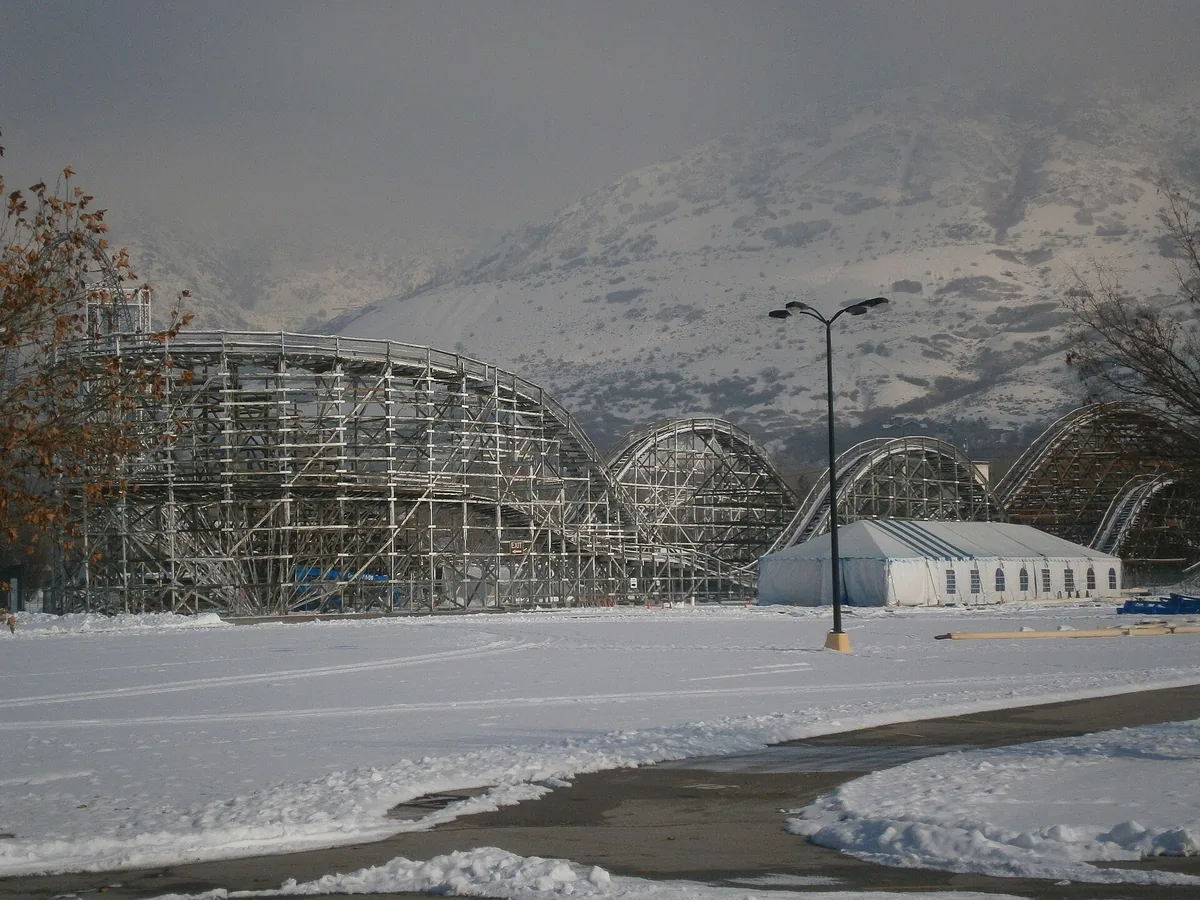
The race produced machines like X2. When it opened in 2002 as X at California’s Magic Mountain, it was the world’s first fourth-dimension coaster: 60 meters high, 122 kilometers per hour, with seats that rotated independently on their own tracks. In the 24 years since, only about 20 other fourth-dimension coasters have been built, and several have closed. X2 is now among them. In September 2026, three lawsuits were filed against Six Flags and ride manufacturer S&S Global alleging “catastrophic” brain injuries on the ride, following a CNN investigation that documented dozens of injuries leading to hospitalization, disability and death. On September 29, Six Flags announced X2 would shut down permanently, even while saying the ride “consistently passed a multitude of safety tests.” Weeks later the company said it would temporarily close nine more coasters across the United States and Canada after a man fell from his seat on Goliath and died at Six Flags Over Georgia. On October 24 it announced seat belts would be added to Goliath and other coasters, and a spokesperson said the company is “committed to rigorous ride inspection, maintenance and safety procedures.”
Set the headlines against the base rate and a strange arithmetic appears. Out of 1.7 billion annual amusement park rides across North America, 652 roller coaster injuries were reported in 2024 by parks that chose to share data. Riding a coaster is, by that measure, very unlikely to cause a brain injury. The studies that bear on the question are thin and aging. A 2002 paper by D. H. Smith and D. F. Meaney used reported g forces from three coasters in a mathematical model and found acceleration levels below those predicted to cause head injury. A 2017 study by C. Kuo and colleagues measured brain effects on three coasters that were low on average but, at their peak, “comparable with mild sports impacts,” like heading a soccer ball. The authors of that study wrote that “the limiting of g forces alone might be an insufficient design criterion for roller coaster rides.” That sentence, published nine years ago, is the hinge on which the current argument turns.
The Contradiction the Standards Cannot Settle
The unresolved contradiction is not whether coasters are dangerous. It is whether the rulebook is asking the right question. Schilder’s own answer splits the industry in two. For modern rides, he says, the standards are likely sufficient: modern manufacturing makes today’s coasters much smoother than their predecessors, and an ASTM rule that filters out brief, intense forces is probably fine for a ride that does not vibrate or jerk very much. But at many parks, the ambitious machines born of the arms race are still standing. The same rule that is adequate for a smooth new coaster is the rule applied to a 24-year-old one with a track full of tiny imperfections. “It makes you wonder: Are the current safety standards sufficient?” Schilder asks. [1] His answer — yes for new, uncertain for old — is a contradiction the standards themselves cannot express, because they do not distinguish between the two.
Evidence from outside the amusement park suggests the discarded forces deserve a second look. The U.S. Occupational Safety and Health Administration recommends limiting the duration and intensity of whole-body vibration for workers. In April 2026, the Virginia Tech Helmet Lab, which studies the science of brain injuries, published an article suggesting some concussions in baseball players may result from just milliseconds of vibration. And in July 2026, the New York Times reported on Kayleigh Bonner, a North Carolina high school student whose father, a retired U.S. Coast Guard surfman who captained boats through rough waves for 21 years, experienced symptoms of a brain injury and died by suicide. For a senior capstone project, she surveyed 77 other elite surfmen and found that 89 percent reported some symptoms of brain injury likely caused by the intense, rapidly changing forces traveling through their bodies as their boats were tossed by waves. The Coast Guard soon acknowledged the risk from its high-speed craft. Professional ballplayers and surfmen absorb far more of these forces than an occasional coaster rider. But the mechanism — brief, repeated, rapidly changing motion — is the one the 200-millisecond cutoff ignores.
The regulatory question has been open almost as long as the engineering one. Since 1999, Democratic U.S. Sen. Ed Markey of Massachusetts has repeatedly introduced legislation to regulate fixed rides; the bills have consistently stalled. U.S. Rep. André Carson, a Democrat from Indiana, has called for passage of a bill he first introduced in 2025 that would create federal oversight of amusement rides. The industry has long opposed that oversight. In 2010, Avery coauthored a paper asserting that “the industry needs to find a collective voice and establish consistent self-regulating policies in order to curb the incidents rates and avoid federal regulation.” Sixteen years later, the incidents are still generating headlines, and the self-regulating body still filters out the forces that researchers say are overlooked.
What remains is a gap between two kinds of safety. The first is well documented: the steady g load a coaster pulls, the injury counts parks report, the standards that have governed design since 1982. The second is mechanistic: a rider’s head moving out of phase with a torso, a track seam delivering a jolt too brief for the standard to see, a seat rotating on its own rail while the train shakes beneath it. That second kind is sketched in models and inferred from boat crews and ballplayers. Eager’s conclusion is modest and, for that reason, hard to dismiss: minimizing jerk and snap is “an important consideration.” Whether the standards will ever consider it is a question no simulation can answer.
Sources
Mentioned organisations (context, not sources)
- Physics Education — Organisation (homepage)
- NASA — Organisation (homepage)
- ASTM — Organisation (homepage)
- University of Twente — Organisation (homepage)
- U.S. Consumer Product Safety Commission — Organisation (homepage)
- University of Florida — Organisation (homepage)
- CNN — Organisation (homepage)
- U.S. Occupational Safety and Health Administration — Organisation (homepage)
- Virginia Tech Helmet Lab — Organisation (homepage)
- The New York Times — Organisation (homepage)