
Quantum KPZ Growth Law Confirmed in Two Dimensions
Watching Growth Happen in Real Time
For four decades, a single equation has promised that wildly different growing surfaces obey the same hidden mathematics. Until now, no experiment could watch that promise play out across a full two-dimensional surface. A team at the University of Würzburg has changed that, capturing the process directly rather than inferring it from theory. [1]
The equation in question is the Kardar-Parisi-Zhang (KPZ) equation, introduced in 1986. It describes how a surface grows when the process is both nonlinear and random. Nonlinear means the growth rate depends on the surface’s own shape, not just on external conditions. Random means chance events — a molecule landing here rather than there — shape the outcome. Physicists call such systems “out of equilibrium,” a state where energy flows through the system and it never settles into a static balance.
Siddhartha Dam, a postdoctoral researcher in the Würzburg-Dresden Cluster of Excellence ctd.qmat at the University of Würzburg’s Chair of Technical Physics, explains why this is so hard to measure. [1] A system that grows out of equilibrium changes in space and in time simultaneously, and it does so on ultrashort timescales. Building an apparatus that captures both dimensions of change at once — and fast enough to see it — has only recently become technically feasible. That is the gap the Würzburg team closed.
Their instrument of choice was not a crystal or a bacterial colony but a quantum system of fleeting light-matter particles. The team cooled a semiconductor made of gallium arsenide (GaAs) to about minus 269 degrees Celsius — just above absolute zero — and stimulated it continuously with a laser. Under those conditions, hybrid particles called polaritons formed inside the material. A polariton combines a photon — a particle of light — with an exciton, which is a bound pairing of an electron and a hole in the semiconductor. Polaritons exist only briefly and only while the laser pumps energy in. They vanish again within a few picoseconds — trillionths of a second — which makes them ideal for tracking fast growth as it happens.
Where the Data Pushed Back Against the Model
Tracking polaritons means knowing where they are inside the material at any moment. When the laser pumps the system, polaritons are created — the population grows. Dam and his colleagues quantified both the spatial spread and the temporal evolution of this growing quantum system. What they found matched the KPZ model. The confirmation did not come easily, and the route to it reveals why the two-dimensional case resisted proof for so long.
The theoretical foundation for testing KPZ behavior in exactly this kind of system was laid in 2015 by Sebastian Diehl, a professor at the Institute for Theoretical Physics at the University of Cologne and a co-author of the new study His group proposed that a driven quantum system of this type could display KPZ scaling. In 2022, researchers in Paris confirmed KPZ predictions experimentally — but only in one dimension, a single line of growth. Moving from one dimension to two is not a simple extension. In two dimensions, a surface can roughen in many directions at once, and the mathematics that governs the competition between smoothing and random kicks becomes far more demanding.
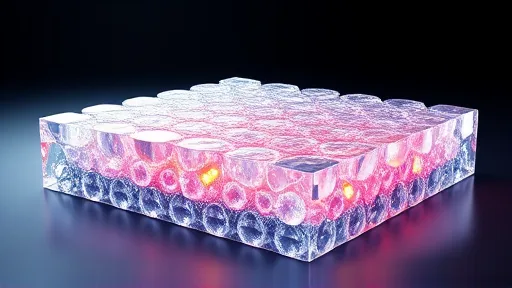
The experimental difficulty lay in the material itself. The team built a complex structure in which mirror layers trap photons inside a central “quantum film.” Within that layer, photons interact with excitons in the gallium arsenide, forming the polaritons that the researchers then observed as they evolved. Simon Widmann, a doctoral researcher at the Chair of Engineering Physics who conducted the experiments together with Dam, describes the level of control required. By precisely managing the thickness of individual material layers using molecular beam epitaxy — a method that grows crystals one atomic layer at a time under ultra-high vacuum — the team tuned the layers’ optical properties and fabricated the highly reflective mirrors the experiment demanded. Every parameter had to be fine-tuned, down to the laser, which had to excite the sample with micrometer precision. Without that control, the KPZ signature would have been lost in the noise.
“The experimental demonstration of KPZ universality in two-dimensional material systems highlights just how fundamental this equation is for real non-equilibrium systems,” Diehl said of the achievement. [3] The result extends a prediction first made on paper into a measurable, two-dimensional reality.
From One
Line to a Whole Surface

The jump from one dimension to two matters because most real growing surfaces are two-dimensional. A crystal face, a bacterial colony spreading across a dish, a flame front advancing through dry grass — each is a surface, not a line. The 2022 Paris experiment demonstrated the same universal scaling along a single line of growth. The Würzburg experiment now shows the same universal scaling holds when growth is free to spread in every direction across a plane.
The KPZ framework has been applied far beyond physics, to population dynamics, flame propagation, and even machine learning. That breadth is exactly what “universality” means: systems with completely different microscopic details can share the same macroscopic growth statistics. The Würzburg team’s result strengthens that claim by supplying the experimental evidence in the dimension where most natural surfaces actually exist.
The work appears in the journal Science, in a paper led by Simon Widmann and Siddhartha Dam with Johannes Düreth, Christian G. Mayer, Romain Daviet, Carl Philipp Zelle, David Laibacher, Monika Emmerling, Martin Kamp, Sebastian Diehl, Simon Betzold, Sebastian Klembt, and Sven Höfling. The finding does not close the book on KPZ. It confirms that the equation’s reach extends into two-dimensional quantum systems that exist only under non-equilibrium conditions — systems that live for picoseconds and disappear. What began as a theoretical prediction, then became a one-dimensional measurement, is now a two-dimensional fact.
Sources
1. University of Würzburg — Organisation (homepage)