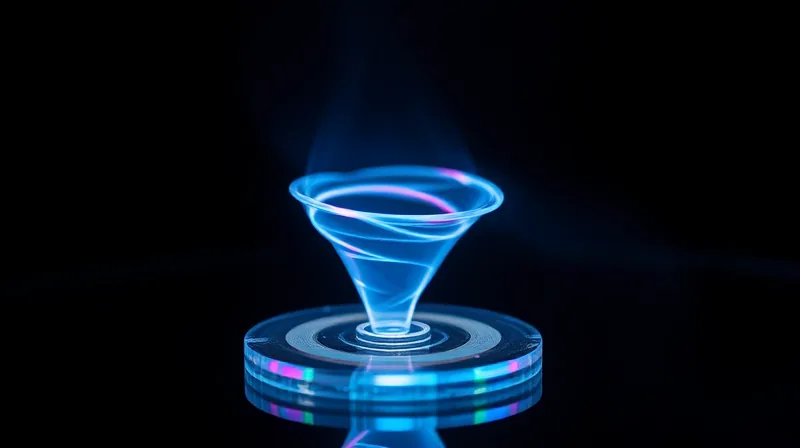
Optical Tornadoes Created with Liquid Crystals
For years, scientists seeking to make light twist like a whirlwind relied on increasingly complicated machinery. They carved intricate patterns into surfaces at the nanoscale and assembled bulky optical tables with lasers and lenses spread across entire rooms. The goal was always the same: to create structured light, beams that carry information not just in brightness or color, but in the very shape of their spin. Every method demanded painstaking precision, and the results remained fragile.
Now, a team from the Faculty of Physics at the University of Warsaw, together with colleagues from the Military University of Technology and the Institut Pascal CNRS at Universite Clermont Auvergne, has found a radically simpler path. They created tiny “optical tornadoes” — swirling beams of light that twist like miniature whirlwinds — using liquid crystals, the same kind of material found in everyday display screens. Instead of engineering complex structures from scratch, they let the material organize itself. The result is a breakthrough that becomes clear when set against the complexity of earlier approaches and the reasons they proved difficult to scale.
The old approach relied on nanofabrication. Researchers etched precise patterns onto surfaces, creating structures smaller than the wavelength of light itself. These metasurfaces could bend and twist light in remarkable ways, but they were expensive to make and difficult to scale. Other methods used large experimental systems with multiple optical elements, each needing careful alignment. The new work sidesteps all of that. It uses self-organizing structures called torons — tiny twisted spirals of liquid crystal molecules that form naturally under the right conditions. No nanofabrication required.
The Hidden Order Inside Liquid Crystals
Liquid crystals occupy a strange middle ground in physics. They flow like liquids, yet their molecules maintain an ordered arrangement, much like a solid crystal. This duality makes them incredibly useful. In a display screen, an electric field reorients the molecules, changing how light passes through. But the University of Warsaw team realized something deeper: these materials could do more than switch pixels on and off. They could trap light itself.
The key lies in defects. Within a liquid crystal, under specific conditions, the molecules can form tightly twisted spirals, similar to the double helix of DNA. When such a spiral closes on itself, joining its ends into a ring, it forms a structure called a toron. ‘They can be imagined as tightly twisted spirals, similar to DNA, along which the liquid crystal molecules are arranged. If such a spiral is closed by joining its ends into a ring resembling a doughnut, we obtain a toron,’ explains Joanna Medrzycka, a nanotechnology student at the Faculty of Physics, University of Warsaw, who prepared the liquid crystal samples together with Dr. Eva Oton from the Military University of Technology. [1]
These torons are not just curiosities. They act as microscopic traps for light, confining photons in a tiny volume. But trapping light is only half the story. To make it spin, the researchers needed something more: a way to make light bend its path, as if it were a charged particle in a magnetic field. Photons do not respond to magnetic fields the way electrons do. So the team had to create an illusion.

They achieved this through spatially variable birefringence, a property of certain materials where different polarizations of light travel at different speeds. ‘Spatially variable birefringence, that is, the difference in the propagation of different polarizations of light, acts like a synthetic magnetic field,’ explains Dr. Piotr Kapuscinski of the Faculty of Physics at the University of Warsaw. [1] ‘We call it “synthetic” because its mathematical description resembles the behavior of a magnetic field, even though physically it isn’t there. As a result, light begins to “bend,” much like electrons moving in cyclotron orbits.”
The concept of a synthetic magnetic field for light is not entirely new. Physicists have long known that carefully engineered materials can mimic the effects of magnetic fields on neutral particles. But applying this idea to liquid crystals, using their natural self-organization, represents a significant shift. The material does the heavy lifting. The researchers just need to set the right conditions and let physics take over.
Lasing From the Ground Up
To strengthen the effect, the researchers placed the toron inside an optical microcavity, a structure made of mirrors that reflects light back and forth, keeping it confined for longer periods. This amplifies the interaction between light and the liquid crystal. ‘This makes the field much stronger,’ says Dr. Marcin Muszynski from the Faculty of Physics at the University of Warsaw and Department of Physics City College of New York, the first author of the study. ‘Additionally, we can control the size of the trap, and thus the properties of the light, using an external electric voltage.”
The most striking result came when the team examined the energy state of the light. In typical systems, light carrying orbital angular momentum appears in excited states, meaning it occupies higher energy levels. These states are less stable and harder to maintain. The Warsaw team achieved something different. ‘For the first time, we managed to obtain this effect in the ground state, i.e., the lowest-energy state,’ explains Prof. Guillaume Malpuech from Universite Clermont Auvergne and CNRS, who developed the theoretical model together with Prof. Dmitry Solnyshkov and post-doc Daniil Bobylev. [3] ‘This is significant because the ground state is the most stable and the easiest for energy to accumulate in.”
This distinction matters enormously for practical applications. Excited states are transient; they decay quickly and require constant energy input to sustain. The ground state, by contrast, is where energy naturally accumulates. It is the most stable configuration. For light to carry orbital angular momentum in this state is remarkable. It means the spinning behavior is not a fragile, temporary phenomenon but a robust, persistent property.
To confirm the significance of their discovery, the researchers introduced a laser dye into the system. The result was unambiguous. ‘We obtained light that not only rotates but also behaves like laser light: it is coherent and has a well-defined energy and emission direction,’ says Dr. Marcin Muszynski. This was ground-state orbital angular momentum lasing, a feat that had not been achieved before. The light naturally ‘chooses’ this state, explains Prof. Jacek Szczytko from the Faculty of Physics at the University of Warsaw, the leader of the research group, because it is associated with the lowest losses.
The Road to Simpler Photonic Devices
The implications extend beyond fundamental physics. The ability to generate structured light in a stable, low-energy state using self-organizing materials could transform how we build photonic devices. ‘It shows that instead of relying on complex nanotechnology, we can use self-organizing materials,’ concludes Prof. Wiktor Piecek from the Military University of Technology. ‘In the future, this may enable simpler and more scalable photonic devices, for example for optical communication or quantum technologies.”
The connection to quantum technologies is particularly intriguing. Structured light beams with orbital angular momentum can carry information in ways that ordinary light cannot. Each twist of the beam represents a different state, potentially allowing for higher-bandwidth communication or new forms of quantum encoding. The fact that these beams can now be generated in a stable ground state, using a relatively simple setup, makes them far more practical for real-world applications.
The theoretical framework behind the work draws on deep physics. ‘It’s interesting that our approach draws inspiration from very advanced theories involving a so-called vectorial charge,’ adds Prof. Dmitry Solnyshkov. ‘So, in a way, we’ve managed to make photons behave not even like electrons, but like quarks, the charged particles which make up protons.’ This is a bold claim, but it reflects the sophistication of the mathematical description underlying the phenomenon.
Prof. Jacek Szczytko, the leader of the research group, emphasizes the interdisciplinary nature of the work. ‘Our solution combines several fields of physics, from quantum mechanics, through materials engineering, to optics and solid-state physics,’ he explains. ‘The inspiration came from systems known from atomic physics, where electrons can occupy different energy states. In photonics, a similar role is played by optical traps, which confine light instead of electrons.’ This cross-pollination of ideas from different subfields is what made the breakthrough possible.
The research team is now focused on understanding the limits of their approach. The theoretical model, developed by Malpuech, Solnyshkov, and Bobylev, provides a framework for predicting how the system behaves under different conditions. The experimental setup, refined by Muszynski, Kapuscinski, and their colleagues, allows for precise control over the toron and the resulting light. The next steps involve testing whether the effect can be replicated across different liquid crystal formulations and cavity geometries.
Sources
2. Universite Clermont Auvergne
3. CNRS