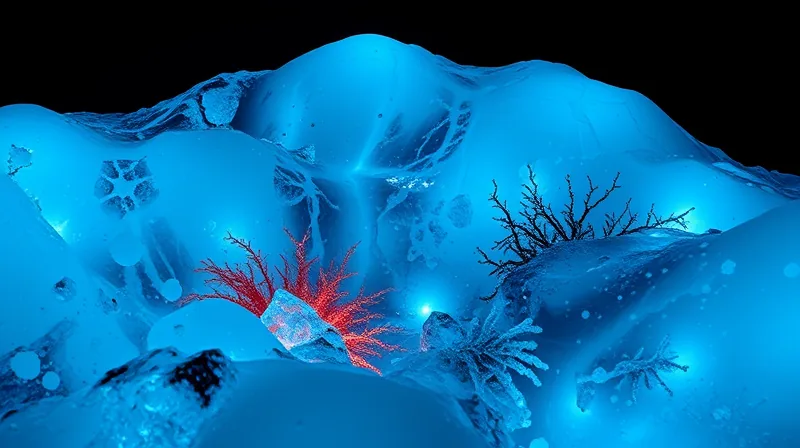
Dear reader, you may have heard of Ötzi the Iceman. He is a man who died in the Alps over 5,300 years ago. Hikers found his body in 1991. He became a frozen messenger from the Copper Age. But now, scientists have discovered something strange. His body is not just a relic. It is a living world. Inside him, ancient microbes are still alive. Some are growing. Some are moving. They have survived thousands of years in the ice. This is the story of a body that never truly died.
First, we must understand what happened to Ötzi after his death. He died high in the Ötztal Alps. The cold air froze his body quickly. Ice and snow covered him. For 5,300 years, he lay alone. The glacier preserved him like a time capsule. But nature is not static. The glacier moved. It thawed and refroze many times. Each thaw brought water into his body. Each freeze locked him back in ice. This cycle created a unique environment. It was cold, wet, and dark. Most life would die here. But some microbes adapted. They learned to live in the cold. They became part of Ötzi’s one-man ecosystem.
Now, scientists have looked inside him. They did not just look at his bones or tools. They looked at the microbes. A team led by microbiologist Mohamed S. Sarhan of the Institute for Mummy Studies in Bolzano, Italy, conducted the analysis. They took samples from his stomach. They collected meltwater from inside his body. They swabbed his skin. They even sampled the air in his storage room. They also took soil from the glacier where he was found. This soil was frozen in 1991. It held clues to the past.
The team wanted to know which microbes were ancient. They wanted to know which were modern. This is a big problem in mummy studies. Modern germs can contaminate ancient bodies. Scientists must separate the old from the new. The team used two methods. First, they grew microbes in a lab. They put samples on special plates. They added nutrients. They waited to see what grew. Second, they used shotgun metagenomics. This means they sequenced all the DNA in the samples. They looked at every bit of genetic code. They compared it to known species. They also measured DNA damage. Ancient DNA breaks down over time. Modern DNA is intact. This let them tell the difference.
Inside Ötzi’s gut, they found ancient bacteria. These bacteria match what we expect from an ancient human. They are similar to gut bacteria from non-Westernized people. These bacteria lived in Ötzi when he was alive. They helped him digest food. They were part of his body. But on his skin and in his tissues, they found something else. They found yeasts. These yeasts are not from his body. They came from the environment. They colonized him after he died. And some of them are still alive.
The team found four species of yeast. Their names are Phenoliferia, Glaciozyma, Goffeauzyma, and Mrakia. These are cold-loving yeasts. They are called psychrophilic. They thrive at low temperatures. They can live in glaciers. They can live in snow. They can live on frozen bodies. The team grew these yeasts in the lab. The yeasts formed colonies. They were viable. This means they were alive. They could reproduce. They could grow. This is surprising. Ötzi is kept at -6 degrees Celsius. That is 21 degrees Fahrenheit. It is very cold. But these yeasts are still active.
One yeast, Glaciozyma, is especially interesting. Its abundance increased between 2010 and 2019. It became the dominant strain. Its DNA damage decreased. This suggests it is metabolically active. It is growing under the conservation conditions. It is not just surviving. It is thriving. This is a living time capsule. It has been with Ötzi for thousands of years. It probably colonized him soon after he died. It adapted to the cold. It stayed with him through the thawing and refreezing. It is still with him today.
But these yeasts are not just passive passengers. They could affect Ötzi’s body. Some of them have enzymes that break down protein and collagen. These are the building blocks of skin and muscle. If the yeasts grow too much, they could damage the mummy. They could cause decomposition. This is a danger for museums. They must keep Ötzi frozen. They must control the humidity. They must monitor the microbes. If the yeasts become active, they could eat the mummy from the inside.
The team also found Pseudomonas bacteria. These are common in soil and water. They were on Ötzi’s skin and in his tissues. Their DNA damage suggests they are ancient. They probably came from the glacier. They were part of the environment when Ötzi died. They are not dangerous to the mummy. But they show how the environment interacts with the body.
This study changes how we think about mummies. We often see them as static objects. They are frozen in time. But they are not. They are dynamic. They are biological interfaces. They interact with the environment. They host life. Even after death, a body is not truly dead. It becomes a new ecosystem. Microbes move in. They adapt. They survive. They grow. This is true for all bodies. But it is especially true for frozen bodies. The cold slows decay. It preserves tissues. But it also preserves microbes. It creates a unique world.
This is not the first study of Ötzi’s microbes. In 2019, scientists sequenced his gut bacteria. They found a diverse community. It was different from modern Western guts. It was more like the guts of non-industrialized people. This makes sense. Ötzi ate a varied diet. He ate meat, grains, and plants. He did not eat processed food. His gut bacteria reflected his diet. But the 2019 study focused on his gut. The new study looks at the whole body. It looks at the skin. It looks at the tissues. It looks at the water inside him. It gives a complete picture.
Other scientists have studied ancient microbes. They have looked at other mummies. They have looked at frozen remains from the Andes. They have looked at bog bodies from Europe. Each body has its own microbial story. But Ötzi is special. He is the oldest frozen mummy. He is the most studied. He is a window into the past. His microbes are a window into ancient environments. They show us what the Alps were like 5,300 years ago. They show us how life adapts to extreme cold. They show us the resilience of microbes.
The study also has practical importance. Museums must preserve Ötzi for future generations. They must stop decay. They must stop microbial growth. But they must also understand the microbes. If the yeasts are active, they might need to change the storage conditions. They might need to lower the temperature. They might need to dry the air. They might need to use antimicrobial treatments. But they must be careful. They do not want to damage the mummy. They do not want to kill the ancient microbes. These microbes are part of the history. They are part of the story.
The team also found genes for degrading phenol. Phenol is a toxic compound. It is used as a disinfectant. It is used to kill fungi. In the 1990s, researchers treated Ötzi with phenol. They used it to stop mold growth. The phenol might have affected the microbes. It might have killed some. It might have selected for others. The yeasts might have genes that help them survive phenol. This is a side effect of human intervention. It shows how our actions affect the mummy.
This study is a collaboration. It includes scientists from Italy, Germany, and other countries. It is part of a larger effort to understand mummies. The Institute for Mummy Studies is a leader in this field. They study mummies from around the world. They use advanced techniques. They sequence DNA. They analyze proteins. They study microbes. They are building a picture of ancient life.
Other scientists are also working on this. Albert Zink, an anthropologist at Ludwig Maximilian University of Munich and a co-author of the study, described the yeasts as ‘living time capsules. They have been with Ötzi for thousands of years. They are a direct link to the past. Patrick Hunt, an alpine archaeologist at Stanford University who was not involved in the study, called Ötzi ‘the most important archaeological science finding of the 20th century’ and endorsed the preservation implications. He says the study is vital for preservation.
Nikolay Oskolkov, a researcher in ancient DNA at Lund University, noted that while the evidence for active yeasts is compelling, additional replication studies are needed. He wants to see if the results are consistent. Damla Kaptan, a researcher in ancient microbes at the University of Stavanger, suggested that detecting RNA would confirm the yeasts are metabolically active. RNA shows that genes are active. If the yeasts are making RNA, they are truly alive. But she says they could be dormant. They could become active during thawing. This is a question for future research.
The study was published in the journal Microbiome on June 3, 2026. The title is about the microbiome of Ötzi. It is a scientific paper. But it is also a story. It is a story of life in the cold. It is a story of survival. It is a story of a body that became a world.
Now, let us think about what this means. We often think of death as an end. But for microbes, death is a beginning. A dead body is a source of nutrients. It is a home. It is a habitat. Microbes move in. They break down tissues. They release gases. They create new compounds. This is decomposition. It is a natural process. But in cold environments, it is slow. It is paused. It is frozen. The microbes do not die. They wait. They wait for warmth. They wait for water. They wait for a chance to grow.
Ötzi’s body is a perfect example. He died in a cold place. He was frozen quickly. The cold stopped most decay. But it did not stop all life. Some microbes were already there. They were on his skin. They were in his gut. They were in the soil. They adapted to the cold. They became part of his ecosystem. They survived for thousands of years. They are still there. They are still alive.
This is not just about Ötzi. It is about all frozen bodies. It is about permafrost. It is about glaciers. It is about ice. These environments preserve life. They preserve microbes. They preserve viruses. They preserve DNA. As the climate warms, these bodies thaw. They release ancient microbes. They could affect modern ecosystems. They could affect human health. This is a new frontier in science.
But for now, we focus on Ötzi. He is a treasure. He is a teacher. He teaches us about the past. He teaches us about the present. He teaches us about the future. His microbes are a part of him. They are a part of history. They are a part of science.
The study also shows the importance of careful sampling. The team took samples over many years. They compared the samples. They saw changes. They saw growth. They saw evolution. This is only possible with long-term studies. It is only possible with good records. It is only possible with collaboration.
The yeasts are not the only microbes. There are also bacteria. There are also fungi. There are also viruses. Each has its own story. Each has its own role. The team found many species. They are building a catalog. They are mapping the ecosystem. This is a huge task. But it is worth it.
The yeasts are especially interesting because they are alive. They can be grown. They can be studied. They can be sequenced. They can be compared to modern yeasts. They can show us how life adapts. They can show us how evolution works. They are a living laboratory.
The team also looked at the soil from the glacier. This soil is from 1991. It is a control. It shows what the environment was like. It shows what microbes were present. It helps the team distinguish between ancient and modern. It is a key part of the study.
The storage room is also important. The team sampled the air. They sampled the water. They sampled the surfaces. They wanted to know what modern microbes are present. This helps them identify contaminants. It helps them know what is real.
The study is a model for future research. It shows how to study ancient microbes. It shows how to separate old from new. It shows how to preserve mummies. It shows how to learn from the past.
Now, let us think about the bigger picture. Ötzi is not alone. There are many frozen bodies. There are mummies in the Andes. There are mummies in Siberia. There are mummies in Greenland. Each has its own microbial community. Each has its own story. Scientists are studying them all. They are building a global picture. They are learning about ancient life. They are learning about ancient environments.
The study also has implications for astrobiology. If life can survive in frozen bodies on Earth, it might survive on other planets. It might survive on Mars. It might survive on icy moons. The yeasts on Ötzi are a model. They show that life can adapt to extreme cold. They show that life can survive for thousands of years. This is exciting for scientists who search for life in space.
But we must also be careful. We must not contaminate these frozen bodies. We must not introduce modern microbes. We must not disturb the ancient ecosystems. This is a challenge for scientists. They must use clean techniques. They must work in sterile conditions. They must respect the bodies.
The study also raises ethical questions. Should we keep Ötzi frozen? Should we let him thaw? Should we study him more? Should we leave him alone? These are difficult questions. Scientists and museums must decide. They must balance science and respect. They must balance knowledge and preservation.
For now, Ötzi remains in his high-tech chamber. He is at the South Tyrol Museum of Archaeology in Italy. [4] The chamber is kept at -6 degrees Celsius. The humidity is 99 percent. It mimics the glacier. It keeps him safe. But it also keeps his microbes safe. They are growing. They are living. They are part of him.
The yeasts are not the only living things. There are also bacteria. There are also fungi. There are also viruses. Each is a part of the ecosystem. Each is a part of the story.
The team will continue to study Ötzi. They will take more samples. They will sequence more DNA. They will grow more cultures. They will learn more about the microbes. They will learn more about the past.
This is a new chapter in the story of Ötzi. He is not just a mummy. He is a living world. He is a time capsule. He is a teacher. He teaches us about life. He teaches us about death. He teaches us about survival.
The study also shows the power of science. It shows how we can learn from the past. It shows how we can use modern tools. It shows how we can collaborate. It shows how we can discover.
The yeasts are a reminder. Life is resilient. It can survive in the harshest conditions. It can adapt. It can grow. It can thrive. This is true for microbes. It is true for humans. It is true for all life.
Ötzi’s body is a testament to this. He died. But his microbes lived. They are still living. They are still growing. They are still part of the world.
The study also has a practical side. It helps museums preserve mummies. It helps scientists understand decay. It helps us protect ancient remains. This is important for history. It is important for culture. It is important for science.
The team used many techniques. They used culturing. They used metagenomics. They used DNA damage analysis. They used comparative genomics. Each technique gave a piece of the puzzle. Together, they gave a complete picture.
The study is a model for future work. It shows how to study ancient microbes. It shows how to separate old from new. It shows how to preserve mummies. It shows how to learn from the past.
Now, let us think about the future. What will happen to Ötzi? Will his microbes continue to grow? Will they damage him? Will we find new species? Will we learn more? The answers are unknown. But the study gives us a starting point.
The yeasts are a bridge. They connect the past to the present. They connect the dead to the living. They connect the ice to the lab. They are a link.
The study also has implications for medicine. It shows how microbes can survive in cold environments. It shows how they can adapt. This could help us understand infections. It could help us develop new treatments. It could help us preserve organs. It could help us in space travel.
The yeasts are not dangerous. They are cold-loving. They cannot survive in warm bodies. They cannot infect humans. They are safe. But they are fascinating.
The team also found genes for breaking down toxic compounds. This could have applications in bioremediation. It could help us clean up pollution. It could help us treat waste. It is a potential resource.
The study is a reminder. The world is full of life. Even in the coldest places. Even in the deadest bodies. Life finds a way.
Ötzi is a symbol. He is a symbol of the past. He is a symbol of the present. He is a symbol of the future. His microbes are a part of him. They are a part of us. They are a part of the world.
The study also shows the importance of patience. Science takes time. It takes years. It takes decades. But it is worth it. The team worked for years. They collected samples. They analyzed data. They published results. They advanced knowledge.
The yeasts are a gift. They are a gift from the past. They are a gift to the future. They are a gift to science.
The study is a collaboration. It includes many scientists. It includes many institutions. It includes many countries. It is a global effort. It is a human effort.
Ötzi is not just an Italian mummy. He is a world mummy. He belongs to everyone. His story is our story. His microbes are our microbes. His past is our past.
The study is a step forward. It is a step toward understanding. It is a step toward preservation. It is a step toward knowledge.
The yeasts are a mystery. They are a puzzle. They are a challenge. They are an opportunity.
The team will continue to study them. They will sequence their genomes. They will study their proteins. They will study their metabolism. They will learn how they survive. They will learn how they grow.
The study is a beginning. It is not an end. There is more to learn. There is more to discover. There is more to understand.
Ötzi’s body is a library. It is a library of life. It is a library of death. It is a library of time.
The yeasts are a chapter. They are a chapter in the story of life. They are a chapter in the story of Ötzi. They are a chapter in the story of science.
The study is a testament. It is a testament to curiosity. It is a testament to perseverance. It is a testament to collaboration.
Ötzi is a teacher. He teaches us about the past. He teaches us about the present. He teaches us about the future. He teaches us about life. He teaches us about death. He teaches us about survival.
The yeasts are a lesson. They are a lesson in resilience. They are a lesson in adaptation. They are a lesson in life.
Now, we close with a single sentence that redefines a word the reader thought they understood.
Mummy is not a dead body preserved in time, but a living world frozen in a moment.