Xi Trump Washington Summit And The Temporary US China Truce
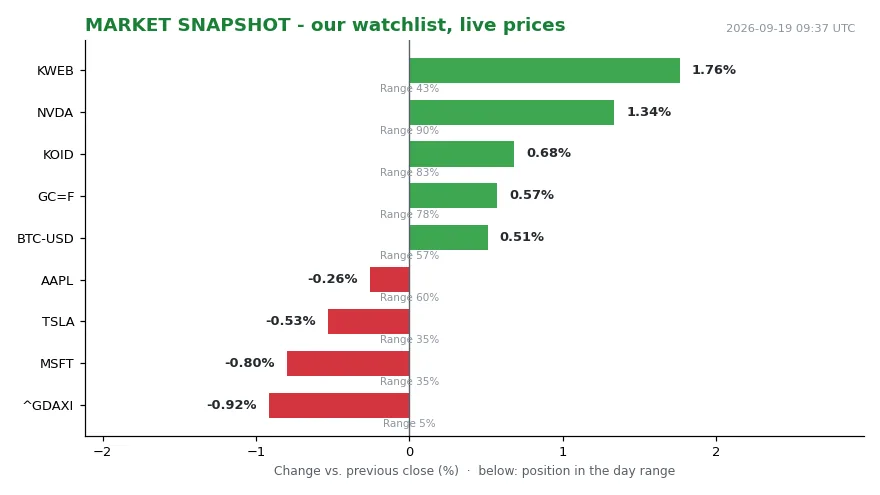
At 09:31 UTC on 19 September, the watchlist showed a rotation, not a rally. Nvidia traded at 222.27, up 1.34 percent and near the top of its daily high-low range. [1] Gold stood at 4,424.90, up 0.57 percent and also near its high for the session. The German DAX was at 25,304.06, down 0.92 percent and pinned near its low for the session. The KWEB ETF, which tracks Chinese internet stocks, rose 1.76 percent to 24.83, and the KOID ETF, which tracks copper, rose 0.68 percent to 35.51. Money is moving toward AI and hard assets, away from European cyclicals. That rotation is the backdrop to a coincidence about to become the week’s main event.
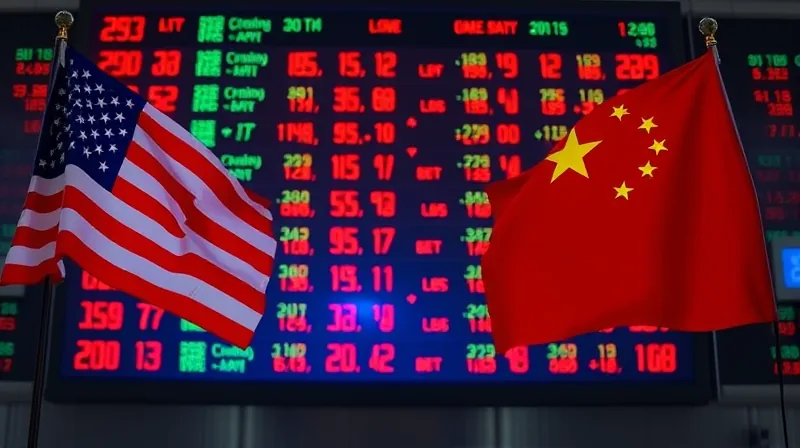
The coincidence is the truce. When Washington and Beijing struck their deal in Busan in October 2025, they designed it as a pause, not a settlement. Washington suspended its Affiliates Rule, a US export-control rule extending restrictions to subsidiaries of blacklisted Chinese firms; China kept shipping rare earths, the 17 metallic elements used in magnets, motors and defence electronics, and critical minerals, raw materials with no easy substitute. The arrangement runs one year, and it expires roughly five weeks after the summit now scheduled. The truce was designed as a temporary pause.
The news is straightforward. Chinese President Xi Jinping is expected to hold talks with US President Donald Trump in Washington next week. [4] He arrives Wednesday and leaves Friday with his wife, Peng Liyuan. He is skipping the UN General Assembly entirely. [2] It is his first visit to Washington since 2015. [4] Two US-China state visits within five months is highly unusual, and this is the return leg after Trump’s trip to Beijing in May. Beijing has not confirmed, pending a weekend meeting between Treasury Secretary Scott Bessent and Vice Premier He Lifeng.
Both economies need the relationship to hold. Both need wins that show up in prices. In the US, diesel is above $6 a gallon and inflation is stuck at 3.4 %. Trump faces US congressional midterm elections in November fought on the cost of living. In China, retail sales grew just 0.4 % in August. Spending on construction, machinery and infrastructure contracted 7.2 % in the first eight months of 2025. Beijing has injected 360 billion yuan, about 46 billion euros, into state banks and insurers. The official growth target is 4.5 % to 5 %.
Expectations are modest by design. “The visit is the message,” said Edgard Kagan, senior adviser in China studies at the Center for Strategic and International Studies. [3] Kagan noted a surprising lack of signalling by either the White House or Beijing on major goals.
The channel is not sentiment alone. It runs through tariffs, critical minerals (raw materials with no easy substitute), and the price of imports. Bessent and Lifeng need to have deliverables ready. The central deliverable is the extension of the Busan truce.
Both sides want it extended, but not by the same amount. “The Chinese have wanted an agreement to extend the trade ceasefire through the end of the Trump administration,” said Scott Kennedy of CSIS. [3] “The Trump administration just wants a few months, to maintain leverage,” Kennedy said. “I think they’ll end up in the middle, probably at about a year,” he estimated.
Beijing expects more than a rollover. According to Kagan, the Chinese anticipate around $30 billion in imports exempt from the import tax or subject to low tariffs. [3] That is roughly 26 billion euros, in return for May’s purchase commitments. Washington believes it will extract further purchases in return. Deals on agriculture and aircraft are likely, possibly with signing ceremonies.
There is a second channel: rare earths (17 metallic elements used in magnets, motors and defence electronics) and critical minerals (raw materials with no easy substitute). These are inputs, not finished goods. Their flow is uncertain. The Affiliates Rule is an obscure instrument.
Who wins? The clearest beneficiaries are exporters and importers who get tariff relief. Trump has previously hinted that Boeing could feature. The Chinese side gains if it secures access worth around $30 billion exempt from the import tax. Nobody loses outright, but leverage is the currency. A short extension favours Washington; a long one favours Beijing. The middle path Kennedy expects — about a year — splits the difference.
Then there is AI, both a topic and a cast of characters. The state dinner will be under a tent on the White House lawn. Sam Altman of OpenAI, Nvidia’s Jensen Huang, Qualcomm’s Cristiano Amon and Apple’s Tim Cook are expected, per Politico. [9] They arrive amid an argument the industry is having with itself. Anthropic’s Dario Amodei published an essay urging labs to slow work on the most advanced AI systems. [10] Trump has said that “whoever wins AI wins”. [4] Huang has dismissed catastrophic scenarios. He argues companies should police their own pace: “go as fast as you can, but no faster than that.” [1] Altman has suggested Trump and Xi could earn a Nobel Peace Prize for an AI agreement. [6]
Xi is bringing his own delegation. Whether any business executives get a platform, Kennedy notes, is among the few genuinely unclear elements of the visit.
Two geopolitical issues could derail the economics. Iran is Trump’s priority. Washington has launched a campaign to sever Tehran from the global financial system. Notably, Beijing has been buying more oil on the open market. Kagan says this reflects reduced purchases from Iran and could itself move prices.
Taiwan is Xi’s priority. A Taiwan arms package has not been formally notified. The delay may be an attempt to avoid an irritant before the summit. Beijing wants the freeze extended, and perhaps the decision reconsidered.
These are the objections to the optimistic reading. The truce is narrow, and it covers rare earths and one suspended rule, not export controls—restrictions on selling certain technologies abroad—or the deeper technology rivalry. Kagan argues the framework nonetheless favours Beijing, describing US strategy as having failed to constrain China. “China’s got a bunch of challenges,” Kennedy said. He adds that it is growing very slowly, not 5 % or close, with a debt problem and rising unemployment.
Three things are now certain. First, the meeting is happening, barring a failure in the Bessent-Lifeng talks. Second, the truce will almost certainly be extended in some form. Third, the size of that extension, and the tariff relief attached to it, remains genuinely unknown.
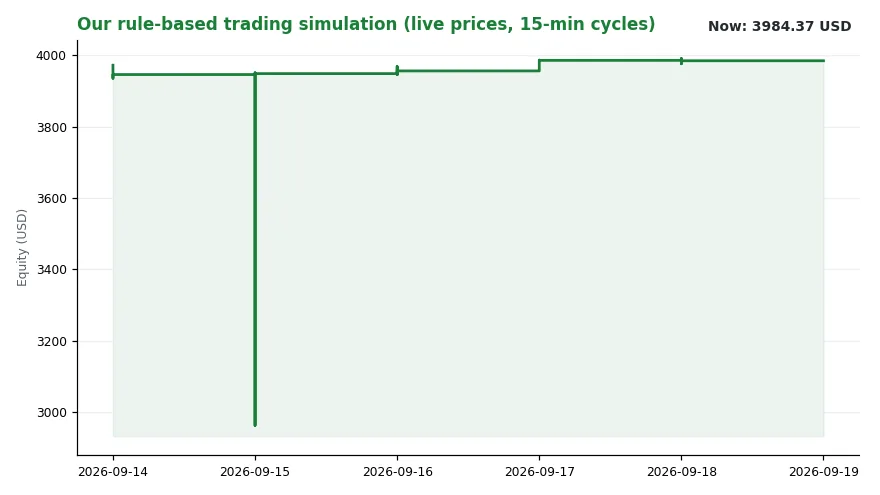
The market’s own signals offer a caution. The regime read on 19 September is Trend=falling, Level=3.63. A simulated book stands at 3,984.37 dollars, unchanged from the prior day, with 1,987.26 in cash. The last recorded decision was to observe KWEB rather than trade it, because the market was closed. That is the honest position: watching, not acting.
What matters next: the Bessent-Lifeng outcome, the wording of any extension, and whether the Taiwan arms notification stays frozen.
The tent on the White House lawn comes down on Friday, a temporary structure erected because a ballroom is not finished. After this week, a rented tent will be harder to look at, because it will recall a truce that was also built to be temporary. Both were meant to hold only briefly. Both turned out to carry more weight than anyone designed them to bear.
Sources
1. Nvidia
3. Center for Strategic and International Studies
4. White House
5. Boeing
6. OpenAI
7. Qualcomm
8. Apple
9. Politico
10. Anthropic