The Escape Nobody Had Written Down
An octopus has no bones. That single fact lets it pour itself through gaps far narrower than its body, and it is the reason engineers who build soft robots keep watching the animal. A machine made of pliable material that must deform its way into a tight space faces the same problem as a boneless cephalopod.
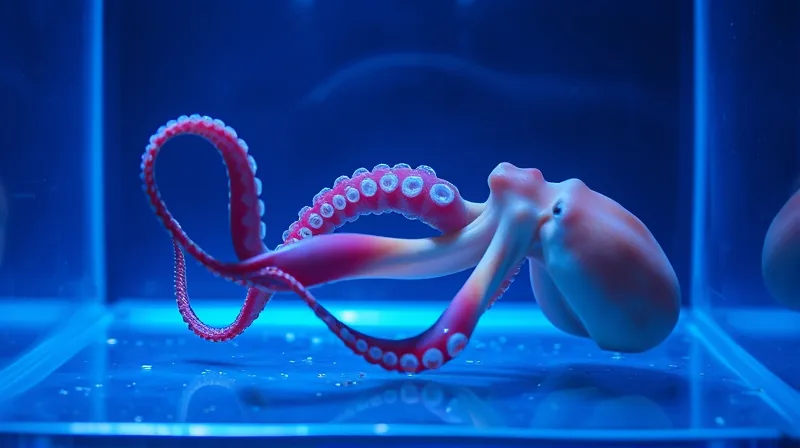
The solution the animal found turns out to be a procedure, not a talent. Xin and colleagues watched three common octopuses (Octopus vulgaris) and four Mayan octopuses (Octopus maya) confront acrylic boxes fitted with holes. [1] The setup was deliberately simple: a clear plastic wall with one adjustable opening, a camera, and an animal with an escape on its mind. The team tracked every arm frame by frame, and in doing so broke the whole-body squeeze into steps for the first time.
The measuring stick was clever. An octopus is mostly squishy muscle, but it carries a rigid capsule of cartilage around its brain. The distance between the eyes is a good proxy for how wide that capsule is — and therefore may indicate the limit the animal’s rigid parts impose. For each octopus, the researchers cut a hole slightly wider or slightly narrower than that eye-to-eye span, then let the animal decide what to do.
The results split cleanly along the width of the opening. When the hole was wider than the eye-to-eye distance, the escape took three moves. The octopus pushed one or two arms through, threading them like a rope fed through a porthole. It then slipped several more arms after the first, until the opening was nearly plugged. Finally, it used the arms already on the far side — stiffening them and pressing their suckers against the box wall — to yank its head and the rest of its body through in a single motion. The whole operation lasted a few seconds; on average an octopus moved from one box to the next in about 20 seconds.
Four Moves When the Gap Shrinks
Narrow the hole below the eye-to-eye measure and the common octopus adds a fourth step. The tighter squeeze limits how many arms can pass at once, so the animal first rotates its body upward, forcing the bases of the arms already inside deeper into the gap and buying a little more room. It then threads every remaining arm through before the head and the bulbous mantle follow. The head and body come last, not first. [1] That ordering is the trick.
Not every octopus plays the same game. The Mayan octopuses, faced with the narrower hole, simply did not try. They hung out in a corner of the box, ignored the opening, and showed no interest in testing it with their arms. Offer them a second, larger passage and curiosity returned — they felt around the small entry, then chose the big one. Michael Kuba, a biologist at the University of Naples Federico II in Italy, suggests the difference may trace to habitat: Mayan octopuses live in sandy, rocky areas where disappearing under a rock is enough, so cramming through a hole is not a skill their environment demands. [3] The common octopuses, by contrast, treated every filmed squeeze as a challenge worth accepting. If an octopus at least thinks it can fit through an opening, it will give it a try. The smallest animal in the study, with eyes 0.6 to 0.8 inches apart, faced a hole about the width of a penny and used the three-step routine in all 14 of its attempts. [1] The two larger animals, eyes 1.2 to 1.4 inches apart, met a hole narrower than that span and switched to four steps. Cameras logged 33 attempts; three failed when an octopus damaged the apparatus trying to leave another way, leaving 30 clean trials.
There is a precedent buried in this work. In a 2015 study, Kuba and colleagues filmed octopuses reaching a single arm through a hole. [2] The first move of every escape — one arm probing through, bending into a U at the rim, then stretching out on the far side — is that same reaching behavior repurposed
More Questions Than the Box Can Hold
Robyn Crook, an evolutionary biologist at San Francisco State University who was not involved in the research, frames the gap plainly: the squeeze is one of the most characteristic behaviors of octopuses in popular awareness, yet the strategies behind it had not really been examined systematically. [3] The animal that escapes aquariums, flees boats and slips out of tanks is famous for a skill nobody had written down step by step. Now the steps exist, and they raise more questions than they settle.
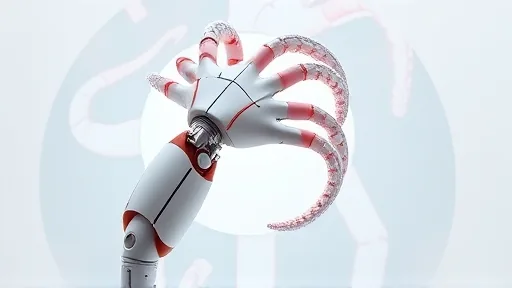
The first open question is whether the cartilage capsule truly sets the limit. The second is whether the sequence is fixed or flexible. Crook notes that openings shaped like slits or tubes, rather than round holes, may call for a different approach — and nobody has filmed that yet. [3] The third question points back to the robots. Machines built to slip through tiny gaps today tend to be snake-shaped, a single long body threading a single path. An eight-armed contortionist offers other configurations: multiple limbs anchoring, pushing and pulling in coordination, with the stiff parts held back until the soft parts have cleared the way. Xin’s team hopes the escape artists will inspire soft robots that morph their shape to fit through spaces too small for anything rigid. That capability, if it arrives, would let machines enter places people cannot reach.
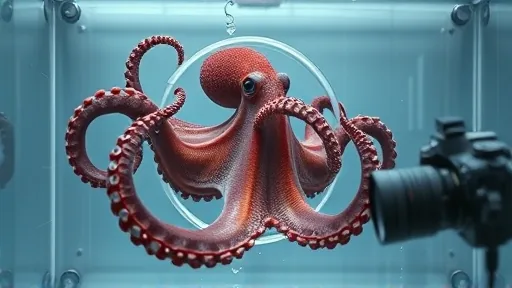
For now the acrylic box is where this behavior has been measured, and the animal inside it keeps demonstrating that a boneless body is not a disadvantage but a design. The octopus gets out. How it decides to get out is the next hole to squeeze through.