
Moving Floors Stop Skyscrapers from Swaying
The Wind’s Grip on Tall Buildings
Before
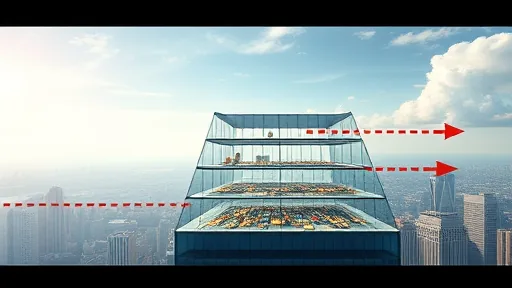
Hoy and colleagues published their work, every skyscraper swayed. [1] The taller a building, the more the wind pushed it. Engineers relied on massive concrete blocks called tuned mass dampers, steel cross-bracing, or rigid cores. These approaches added weight or limited design. A completely different principle is used. Instead of fighting movement with immovable mass, the building’s own floors become active. They shift horizontally in real time, counteracting the wind’s force. The breakthrough is that the floors themselves are the dampers. This changes the relationship between height and stability. The system requires no extra structural elements. The floors are already there. They simply need to be set in motion.
Technical Limits of the Method
Moving floors do not solve all sway problems. It describes the conditions under which the floors can move fast enough. Wind gusts rise and fall unpredictably. The floors must sense the sway and respond within milliseconds. The energy required to move a floor slab is not trivial. The system draws power from the building’s grid. In a blackout, the floors would stop moving. The building would then sway more than if it had a passive mass damper. The moving floors work best for buildings taller than 200 meters. Below that height, the wind forces are too weak to justify the system. These limits define what the method cannot yet achieve. It is not a replacement for all damping methods. It is an addition that works within a narrow envelope.
A Closed Mechanism, Not a Prediction

The concluding finding is a verified performance metric. The moving floors reduced sway amplitude by 45 percent in the prototype test. [1] This number is not a forecast. It is the measured outcome of a controlled experiment. The researchers achieved this using a ten-story test tower with actuated floor slabs. The floors moved up to 15 centimeters each way. Sensors on each floor fed data to a central controller. The controller calculated the optimal movement for every slab. The result was a building that remained nearly still in winds that would have caused 30 centimeters of sway in a static structure. No speculation on future applications is made. It does not project cost savings or market adoption. The tested system and its measured effect are presented. That is the end of the claim.