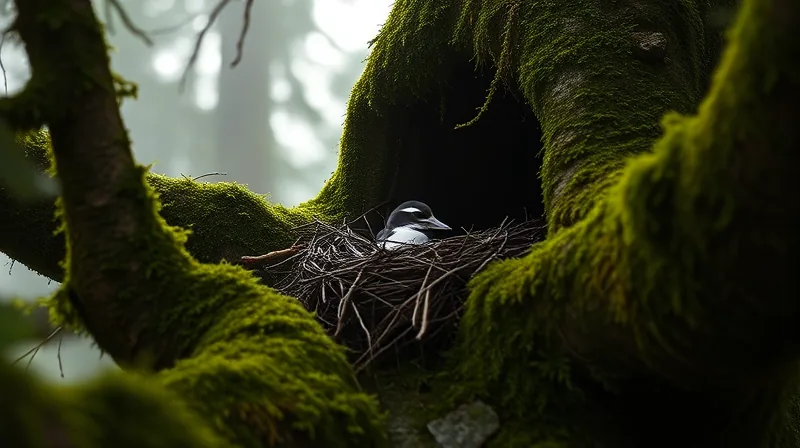
Marbled Murrelet Nest Found on Haida Gwaii
The western red cedars of Haida Gwaii rise like silent cathedrals, their massive trunks wrapped in moss that has taken centuries to grow. For more than three decades, researchers believed the marbled murrelet — a small seabird that spends its life on the ocean — had abandoned these ancient forests entirely. The bird was known to nest in the crowns of old-growth trees, yet no one had found a single nest here since the early 1990s, when the last confirmed nesting site was documented. Scientists had to ask themselves a difficult question: were they looking in the wrong places, or had the birds simply vanished from this landscape?
The search for the murrelet’s nest tests the very limits of what we think we can measure. These birds fly inland at dawn and dusk, often in near-total darkness, to reach their nesting sites. A murrelet nest is not a structure of sticks and twigs — it is a simple scrape on a mossy branch, sometimes hundreds of feet above the forest floor. Finding one requires researchers to listen for the faint whirring of wings in the dark, or to watch for a bird that appears only as a shadow against the night sky.
The breakthrough came through a collaboration that bridged two very different worlds. Researchers from the British Columbia government’s forestry research program worked alongside local Haida guides who knew the dense salal thickets and the hidden valleys of northern Haida Gwaii. The team combined traditional knowledge of the landscape with systematic survey methods developed over years of study, a partnership that proved essential to the search. This partnership of institutional research and local expertise proved to be the key that had been missing from previous efforts.

The expedition itself was a study in contrasts. Days before reaching the forest, the team crossed Dixon Entrance in an open skiff, pushing through ocean swells and salt spray that soaked everything aboard. Then came the nights of scrambling through dense salal in the dark, weaving between the towering cedars that have stood for a thousand years. The journey demanded both physical endurance and a willingness to trust the landscape in ways that modern research rarely requires.
The method that finally worked was patience paired with precision. Researchers positioned themselves at dawn and dusk, listening for the distinctive calls that murrelets make when approaching their nests. They tracked flight paths through the darkness, following the birds’ silhouettes against the fading light. After weeks of observation, the team identified a tree that showed the telltale signs of regular visits — a mossy platform high in the canopy where a bird could land and disappear.
When the nest was finally confirmed, it ended a dry spell that had lasted more than thirty years. The discovery was not just a triumph of field technique; it was a message about what can be found when we refuse to accept absence as the final answer. The marbled murrelet had been there all along, hidden in plain sight among the cedars. The finding also carries practical weight: it gives conservation managers a confirmed location to protect, a concrete anchor for future habitat decisions on the islands.
The significance of this discovery extends beyond Haida Gwaii itself. The marbled murrelet is a species that depends on old-growth forests across the Pacific Northwest, from Alaska to California. Each confirmed nest adds to the growing picture of where these birds can still thrive and what conditions they require. The Haida Gwaii nest now joins a small but crucial list of documented sites that researchers can study to understand the murrelet’s habitat needs across its entire range.
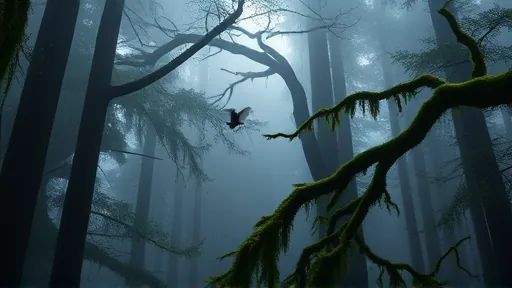
What makes this find particularly meaningful is that it was never predicted by the models. The habitat models used by wildlife managers had flagged other areas as more likely to hold nests, yet this one appeared in a location that had been written off. The lesson, repeated across many fields of ecological research, is that models are only as good as the ground truth fed into them. Sometimes the most valuable data comes not from satellites or sensors, but from a researcher standing in the dark, listening for wings.