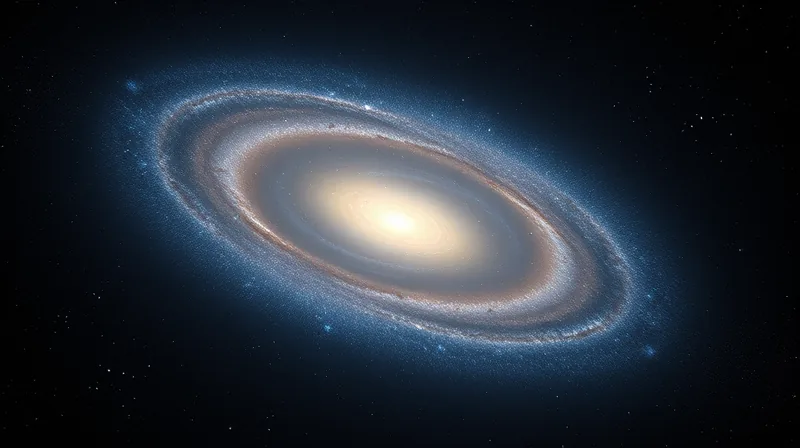
Giant Galaxy IC 1101 Reveals True Size After Deep Imaging
That is the challenge astronomers faced with IC 1101, a galaxy so enormous that 17 Milky Ways lined up end to end would barely match its width. The galaxy’s vast scale has made it a subject of intense study for decades. The difficulty is not just size — it is knowing where the galaxy actually ends and where the surrounding cluster’s faint glow begins. For decades, researchers knew IC 1101 was big. They just could not say exactly how big.
The breakthrough came from the deepest images ever taken of this object, captured in 2022 by the Isaac Newton Telescope at the Roque de los Muchachos Observatory on La Palma in the Canary Islands. Longer exposure times mean fainter details become visible, and those details finally revealed the galaxy’s true edge. The results, submitted to arXiv.org on July 16, show a diameter of roughly 520 kiloparsecs — nearly 1.7 million light-years. Within that enormous span, the galaxy holds approximately 3.4 trillion solar masses of stellar material That is 3.4 trillion times the mass of our Sun, all packed into stars.
What makes this measurement so remarkable is what it says about how galaxies evolve. IC 1101 is not a finished object. It is still growing, still consuming, still changing. The galaxy sits over a billion light-years away at the heart of the Abell 2029 galaxy cluster, and it belongs to a special category known as brightest cluster galaxies. These systems are the largest in the universe, and they grow by repeatedly merging with smaller galaxies that wander too close — a process astronomers call galactic cannibalism.
A Boundary That Blurs With Every Merger
The tail-like features extending from IC 1101’s edges tell the story of its diet. These structures are the remnants of galaxies that have been pulled apart and absorbed, their material stretched into streams by gravity. Astrophysicist Carlos Marrero de la Rosa, of the Instituto de Astrofisica de Canarias in Tenerife, Spain, describes the process plainly: “It’s still accreting things… It has not finished.” [1] The galaxy is, in a very real sense, still at the table.
Earlier studies had already suggested that IC 1101 must be massive, but they could not pinpoint where the galaxy’s edge transitions into the diffuse material of the cluster beyond. That boundary is not a clean line — it is a gradual fade, a slow blending of one object into another. The 2022 observations changed that, giving researchers the precision they needed to draw a line between what belongs to the galaxy and what belongs to the space around it.
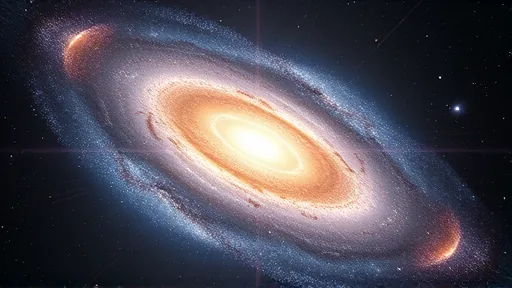
This distinction matters because it changes how we understand galactic growth. A galaxy that appears smaller might simply be one whose outer regions have not been detected yet. IC 1101 is not exceptional because it is unique — it is exceptional because we finally have the tools to see it clearly.
The measurement also reveals something about the limits of observation itself. Every time astronomers build a more sensitive instrument or take a longer exposure, the universe gets bigger. Objects that seemed well-defined become diffuse. Edges that seemed sharp become gradual. The question of where a galaxy ends is not just a matter of pointing a telescope — it is a matter of deciding what counts as part of the galaxy in the first place.
Lessons for Understanding How Galaxies Assemble
The techniques used to measure IC 1101 have implications that extend beyond this single object. Brightest cluster galaxies are the extreme cases of a process that happens everywhere in the universe — the gradual assembly of large structures from smaller ones. By studying the most extreme example, researchers can test their models of how galaxies grow and merge over cosmic time.
Galactic cannibalism is not a rare event. It is the standard way that large galaxies form. The Milky Way itself is currently absorbing smaller satellite galaxies, and it will eventually merge with the Andromeda galaxy in several billion years. But IC 1101 shows what happens when this process continues for an exceptionally long time, in an exceptionally dense environment.
Marrero de la Rosa calls IC 1101 “a kind of galaxy of the future.” That phrase captures something important about how astronomers think about cosmic evolution. The galaxy is not a relic of the past — it is a preview of what other galaxies might become. Dense clusters like Abell 2029 provide the conditions for repeated mergers, and those mergers produce objects that keep growing without an obvious endpoint.
The same observational techniques that revealed IC 1101’s true size can be applied to other brightest cluster galaxies. Each new measurement adds a data point to our understanding of how these systems form and evolve. The question is no longer whether such galaxies are enormous — it is how enormous they can become, and what limits their growth.
Pinning down the extents of such vast galaxies is no simple task, Marrero de la Rosa says. The difficulty lies in the nature of the objects themselves. A galaxy like IC 1101 does not have a hard boundary — its outer regions fade gradually into the cluster’s diffuse material, making the edge a matter of interpretation as much as measurement.
The 2022 observations represent a significant step forward, but they are not the final word. The data came from a single telescope, and the analysis required careful subtraction of background light to isolate the galaxy’s true signal. Other instruments, with different strengths and capabilities, could refine the measurement further. The galaxy’s edge might shift again as techniques improve.
IC 1101’s continued growth means that any measurement is, in a sense, a snapshot of a moving target. The galaxy is still accreting material, still merging with neighbors, still changing shape. The tail-like features visible in the deepest images are evidence of recent meals, and future observations could reveal new streams of material being pulled into the galaxy’s grip.
The study submitted to arXiv.org on July 16 provides the most precise measurement to date, but it also raises questions about what comes next. If IC 1101 is still growing, how large will it become? What happens when it exhausts the available material in its cluster? And what does its future tell us about the fate of other galaxies in dense environments? For now, the answer is that the galaxy has not finished — and neither has our understanding of it. Future observations with more powerful instruments will likely refine this picture further, offering new insights into the life cycle of the universe’s largest structures.