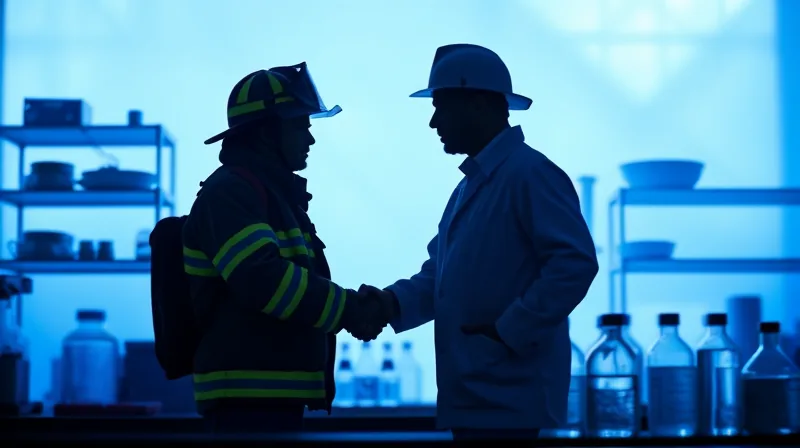
Firefighters Ask Science Answers Faster
When the Clock Is Running
A fire crew and a physics laboratory have almost nothing in common — until both are told to act within the hour, and neither can wait for the other’s paperwork. Two British investigations have asked how research gets done when the clock is running. Scientists in academia can struggle when asked for research to support those decisions, often because their institutions are not set up to provide authoritative knowledge for rapid decision-making. [1] The pandemic showed the exception: researchers in academia and industry, working with policymakers, solved the protein structures of the SARS-CoV-2 virus in record time, conducted fast randomized controlled trials to test drugs, and quickly developed vaccines that subsequently gained rapid approval. [1] That sprint is the blueprint. The question the two new initiatives ask is whether the blueprint can be made routine rather than miraculous.
The first of the two is the Agile Initiative at the University of Oxford, which began in early 2022 when environmental scientists there asked whether academic research teams could deliver the timely science needed by decision makers while working in partnership with stakeholders in government, industry, non-profit organizations and local communities. [1]? They tested the idea with a series of experimental grants lasting between 6 and 12 months, funded by the Natural Environment Research Council, part of the country’s main public funder, UK Research and Innovation. [1]. Three funding models were tried against each other. The first was business as usual, with research topics proposed by scientists. The second flipped the model, with decision makers posing the questions for researchers to answer. The third combined the two through what is called co-creation or co-production, an iterative process in which decision makers and researchers design and carry out the study together. The first two approaches resulted in relatively few effective ideas. The third generated strong interest from both groups and produced many good ideas. [1].
One of the funded projects shows what co-production looks like when the stakes are literal fire. After the severe Amazon fire season of 2023-24, in which a drought fuelled some of the worst fires in two decades, researchers joined government officials, fire brigades and Indigenous organizations to write a handbook on how to fire-proof the forest. [1] The handbook was then distributed by boat along major rivers to hundreds of local fire-fighting teams before the next fire season, which is expected to be fierce because of the current El Niño. [1]. A single handbook is not a transformed research system, but it suggests that the system can move when the question arrives from outside the seminar room. The lesson is not that scientists lack ideas. It is that the direction of the question matters as much as the quality of the answer.
The Invoice Nobody Knew How to Pay
A university finance office and a village elder share one problem: neither fits neatly into the other’s forms. The second finding comes from a separate, two-year investigation called the Co-Production Futures Inquiry, led by researchers at the universities of Liverpool, Manchester and Sheffield and funded by Research England, part of UK Research and Innovation. [1]. In response to a call for evidence on the scale of the problem and possible solutions, the team reviewed around 100 submissions from more than 90 organizations. [1]. The inquiry has released its findings in a report and discussed them in a podcast. [1]. Its central complaint is money. Partners outside academia need to be paid, but a common complaint among the respondents was the difficulty of making this happen. [1]. Many universities are not set up to fund individuals who are not in an academic post or employed in an established organization. [1]. Often, project teams find workarounds to pay research partners — such as temporarily putting recipients on payroll systems or searching for organizations to employ them while working with a university. [1].
The Agile Initiative also highlighted institutional barriers to research with partners outside academia — the very barriers the Co-Production Futures Inquiry was set up to map. [1].

A different problem — common to both initiatives — was how to align co-created science with existing academic career structures. [1]. Early-career researchers working on agile projects were typically on short-term contracts, including those leading project teams. But a 6- or 12-month grant is precarious, even by the standards of early-career research. [1].
The Publication That Arrives Too Late
A smoke alarm and a peer-reviewed journal have the same failure mode: both can be perfectly reliable and still arrive after the house has burned. Most funders require results to be published as peer-reviewed studies as a condition of awarding grants. Both initiatives found that this is not always possible, especially on a fast timescale. [1]. Publication of a peer-reviewed study can take longer than 12 months, and researchers who don’t work in universities don’t typically publish their findings in journals. [1]. For them, an effective output looks different — a handbook, a briefing, a boat-delivered manual — and the funding rules rarely recognize it as one.
Here is where the two investigations converge into a single line of argument. The Agile Initiative found that co-created grants, in which decision makers and researchers build the study together, produced many good ideas where both scientist-led and decision-maker-led models produced relatively few. The Co-Production Futures Inquiry, working independently from a different set of universities and a different evidence base of around 100 submissions from more than 90 organizations, documented the institutional obstacles that keep such partnerships from becoming standard practice. [1] Different houses, same research question, and the answers point the same way. The parallel is not a coincidence of taste: it is two separate measurements of the same gap between what universities can produce in a crisis and what their rules allow them to produce.
At a time of public mistrust of institutions, these findings show how universities could become more agile and responsive to the needs of wider society. [1] The changes needed are not about brilliance or goodwill, which the pandemic already showed to be abundant. They are about contracts long enough to matter, payment routes that reach people outside the academy, and definitions of success wide enough to include a handbook that reaches firefighters by boat before the season turns.
Sources
Mentioned organisations (context, not sources)
- University of Oxford — Organisation (homepage)
- Natural Environment Research Council — Organisation (homepage)
- UK Research and Innovation — Organisation (homepage)
- University of Liverpool — Organisation (homepage)
- University of Manchester — Organisation (homepage)
- University of Sheffield — Organisation (homepage)
- Research England — Organisation (homepage)