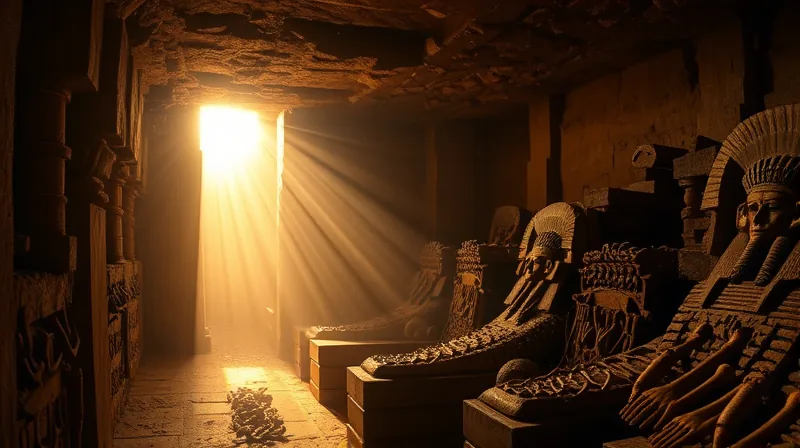
Egyptian Tomb Reveals Order Within Ancient Burial Reuse
For decades, archaeologists studying Egypt’s Theban necropolis have faced a puzzle. The site holds more than 400 tombs, yet the burial practices that shaped them over centuries remained frustratingly unclear. How did a culture so meticulous about death shift its rituals across generations? The answer, it turns out, was hiding in the bones themselves.
The traditional view assumed that Egyptian burials followed a predictable pattern: individual interments in elaborate coffins, each body given its own sacred space. But a new study published in the journal Frontiers in Environmental Archaeology challenges that assumption with evidence of something far more dynamic
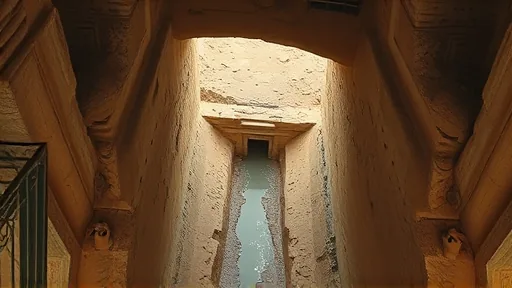
The research focuses on Tomb 209 in the western necropolis, a site spanning the early 25th Dynasty (754-656 BCE) through the Ptolemaic period (305-30 BCE) Its original owner was likely a high official of Nubian origin named Nisemro. The tomb’s location within an active drainage channel of the Wadi Hatasun made it prone to repeated flash flooding — a complicating factor that turned out to be an archaeological gift
Bodies Speak Through Layered Time
The study employed what researchers call an “integrated archaeothanatological approach,” combining data on body position, coffin use, superposition of remains, and stratigraphic relationships with osteological analysis. The goal was to reconstruct the chronological sequence of burials in a site known as Side Chamber 3, one of the tomb’s main secondary areas that remained largely undisturbed.
Excavation yielded 16 mummified people, represented by 1,444 bones, plus one mummified dog. A separate chamber contained the disarticulated remains of at least four additional individuals, totaling 1,775 bone fragments. The sheer volume of material offered an unprecedented window into how burial practices evolved over time.
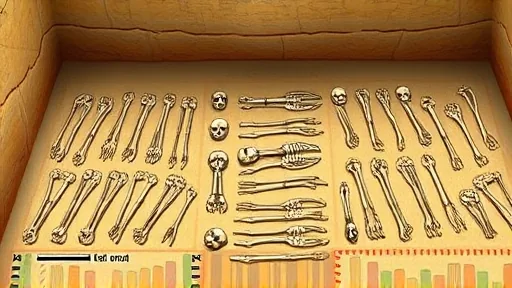
The evidence shows a clear shift from individual burials in elaborate coffins toward the reuse of earlier burial sites. Later interments were placed with greater density, sometimes directly atop earlier bodies. This was not careless dumping but a deliberate process of layering that respected what came before.
Order Within Apparent Chaos
The established assumption held that tomb reuse meant ritual decay — that later generations simply abandoned the careful practices of their ancestors. The Theban evidence appeared to support this view, with crowded chambers and superimposed bodies suggesting neglect. But the new analysis tells a different story.
Co-author Jared Carballo-Perez of the University of La Laguna in Spain describes what the detailed study revealed “The detailed study of the bodies indicates neither chaotic accumulation nor a loss of the original ritual over time,” he said. “Rather, there was a spatial logic in which each new deposition was adapted to the presence of previous bodies — a kind of funerary memory in the processes of reuse.” [1]
This “funerary memory” is the key insight. Each new burial was placed with awareness of the bodies already present, adapting to their positions rather than ignoring them. The result was a complex stratigraphy that preserved ritual meaning even as burial patterns changed.
The flash flooding that plagued the tomb actually helped preserve this record. Sediment deposits from repeated floods sealed layers of burials, creating natural stratigraphic markers. What seemed like a disadvantage became a preservation mechanism, allowing researchers to trace the sequence of interments with unusual precision. .
Memory Carved in Bone
The broader significance extends beyond this single tomb. The Theban necropolis contains over 400 tombs, and this study provides a framework for understanding how reuse functioned across the entire region. The pattern revealed here — adaptive, memory-driven reuse rather than chaotic accumulation — likely applies to other sites facing similar questions.
The research also demonstrates the power of combining multiple analytical methods. Traditional approaches might have treated the jumbled remains as evidence of disturbance or neglect. The integrated approach reveals intentionality and continuity where others saw disorder. This methodological shift could reshape how archaeologists interpret complex burial sites throughout Egypt and beyond.
The bodies in Side Chamber 3 tell a story of cultural persistence through change. Generations of Egyptians returned to the same space, honoring their dead while adapting to practical constraints. The flash floods came and went, dynasties rose and fell, but the funerary memory endured — layer upon layer, bone upon bone, each deposition a continuation of the last.