A Cell That Should Have Vanished in Days
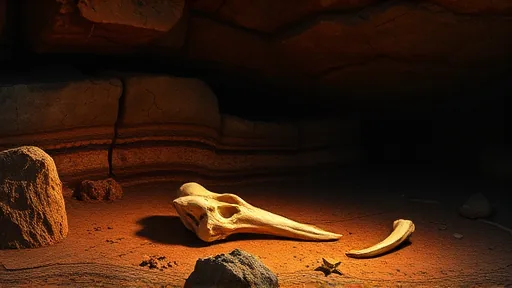
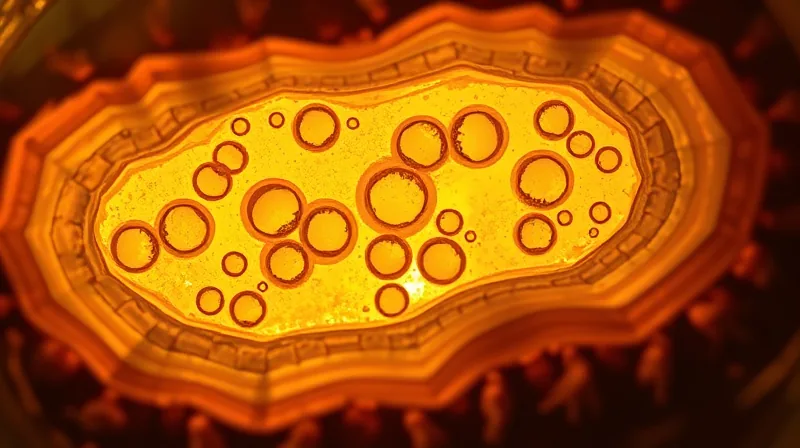
Red blood cells are among the most perishable things a body owns. Once an animal dies, its blood cells break down within days — not centuries, not millennia, days. Yet a 115-million-year-old limb bone from a theropod dinosaur called Aratasaurus museunacionali, unearthed at a fossil-rich site in northeastern Brazil known as Mina Pedra Branca, appears to hold oval microstructures sitting exactly where blood vessels once ran. Each one measures about 20 micrometers across. Under a scanning electron microscope, they look like cells. Looking like a cell has never been enough.
The chemistry is what changes the argument. A team led by organic geochemist Kliti Grice of Curtin University in Bentley, Australia, used high-performance liquid chromatography coupled with mass spectrometry to read the molecular contents of a bone extract. [2] The dominant tetrapyrroles — ring-shaped pigment molecules — turned out to be heme B and its diagenetically altered forms. Heme is the iron-bearing, ring-shaped molecule inside hemoglobin, the protein that ferries oxygen through the body. The surrounding rock matrix, by contrast, carried the signature of chlorophyll and bacteriochlorophyll. That contrast is the hinge on which the whole case swings: the bone’s molecules do not look like they leaked in from the sediment around it.
Spatially resolved Raman spectroscopy then placed the porphyrin signals on the ellipsoid structures themselves. Transmission electron microscopy confirmed the same structures held iron, nitrogen and carbon — the elemental triad of heme — alongside crystals of hausmannite, a manganese oxide mineral with the formula Mn3O4. The team’s claim is precise: blood-derived biomolecules, preserved inside mineralized red blood cells of a dinosaur.
What a Fossil Can Tell Us About How an Animal Lived
If the interpretation holds, the payoff reaches past a single spectacular specimen. Grice points out that bones already reveal anatomy, growth patterns, locomotion and evolutionary relationships. Molecular preservation opens a different door entirely — one onto physiology, metabolism, even activity levels of animals no one can observe alive. Every museum label about dinosaur behavior rests on inference from shape; chemistry would let researchers infer from substance.
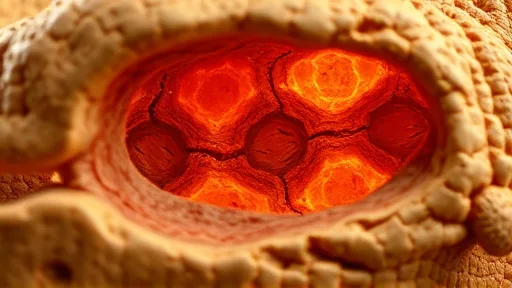
The preservation mechanism the team proposes is equally consequential. Blood decomposes fast, so only unusual and fast-acting conditions could freeze those tissues in place long enough for fossilization to take over. Within the bone, hausmannite appears to have acted as a time capsule — Grice’s word is “entomb” — stabilizing the cell-like structures and shielding the molecules inside, collagen amino acids among them. The mineral did not replace biological material after it had disappeared, the team argues; it arrived in time to protect what was still there.
That distinction matters because fossilization normally works the other way. Mineral-rich fluids seep through bone after death, and the minerals that precipitate can mimic bodily structures with convincing cruelty. In 1997, two paleontologists examined tiny spheres inside a fossil limb, possibly from a pterosaur, once thought to be fossilized blood cells. [2] They concluded the spheres were pyrite — an iron mineral deposited after death, a counterfeit cell. That study, by D.M. Martill and D.M. Unwin, laid down criteria for any future claim: compare the structures’ shape with red blood cells of living relatives, and identify specific biomarkers in the structures, heme compounds among them.
The Verdict That Still Awaits Its Test
Not everyone accepts that the criteria have been met. Mary Schweitzer, a paleontologist at North Carolina State University in Raleigh who was not involved in the new work, raises two objections. [2] The heme biomarkers do not appear confined to the round structures alone, as fossilized blood cells would demand, but emerge from analysis of the whole bone. And the proposed cells differ in size and shape from the red blood cells of living birds and reptiles. “I am not convinced,” she says of the heme identification. She does credit the breadth of methods: “Extraordinary claims require extraordinary evidence, and that does require state-of-the-art technology.” Schweitzer knows the terrain. In 2005, she and colleagues reported the first recovery of flexible soft-tissue blood vessels from the 68-million-year-old leg bone of a Tyrannosaurus rex — a landmark that ignited debate over whether such tissue could survive deep time at all, and over how to detect it reliably. Nearly three decades after the pyrite spheres, the same question echoes: is this blood, or is it a mineral wearing blood’s outline?
Grice answers with convergence rather than any single measurement. No one really knows what a dinosaur’s red blood cell looked like, she concedes, nor how fossilization might have distorted the original shape or let heme-related molecules escape their cellular confines over time. Her team’s reading, she says, “rests on the convergence of anatomy, morphology, mineralogy, elemental analysis and molecular chemistry.” That combination is critical, in her view. On whether other fossils carry traces preserved by hausmannite, she is candid: “We simply don’t know yet. But this type of preservation may not be quite as rare as we currently think.”