Dark matter flash detected in xenon tank experiment
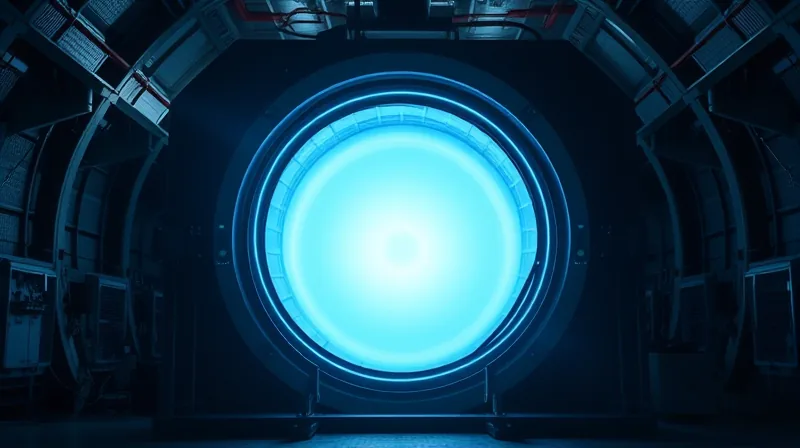
Deep beneath the Black Hills of South Dakota, a tank holding 10 tonnes of ultra-pure liquid xenon sits in silence, waiting. It waits for something that has never been seen: a dark matter particle, invisible and massive, colliding with the nucleus of an atom. In 2023 or 2024, that waiting may have ended with a single, unusual energetic flash.
The signal could have come from a massive dark matter particle passing through the Galaxy and striking an atom’s nucleus. If confirmed, it would mean that dark matter - the invisible substance thought to hold galaxies together - has finally been caught. It would also reveal that dark matter is made of particles far heavier than protons — the long-theorized but never-detected weakly interacting massive particles, or WIMPs.
The finding comes from the LUX-ZEPLIN experiment, known as LZ, at the Sanford Underground Research Facility in Lead, South Dakota. [1] Researchers announced the result on 1 September at the TeV Particle Astrophysics conference in Tendo, Japan. The team also posted a preprint on the experiment’s website describing what they found.
Samuel Eriksen, the LZ researcher who presented the result, and his collaborators analyzed 220 days of observational data. [2] Those days ran from March 2023 to April 2024. Within that stretch of time, they found exactly one event that stands out from the background noise.
The Long
Hunt for the Invisible
For decades, theoreticians have argued that dark matter’s main ingredient is a WIMP. The idea is elegant: a particle that interacts through gravity and the weak nuclear force, but nothing else. It would be heavy, slow, and nearly impossible to see - except when it bumps into something.

The search has not been easy. Experiments have tried to detect dark matter as it streams through the Earth. Other facilities, like the Large Hadron Collider near Geneva, Switzerland, have tried to create it by smashing atoms together at tremendous speeds. [4] So far, every attempt has come up empty.
LZ is the latest and largest step in a lineage of direct-detection experiments using xenon. It started up in late 2021, a scaled-up version of earlier efforts that used the same approach. The idea is to fill a tank with liquid xenon and watch for the tiny flash of light produced when a particle strikes a xenon nucleus.
The single outlier event is intriguing, says Jianglai Liu, a physicist at Shanghai Jiao Tong University in China. [3] It will undoubtedly excite the field, he added. But caution is warranted, because previous experiments have seen hopeful signs of dark matter that turned out to be spurious.
One Event, Many Questions
The LZ result is, at this moment, a single data point. One flash in a tank of liquid xenon, recorded over 220 days of observation. It is not yet a discovery - it is a candidate, a maybe, a thread worth pulling.
Researchers warn that the history of dark matter searches is littered with false alarms. Signals that looked promising at first later faded away under closer scrutiny or more data. The LZ team knows this, which is why they present the event as intriguing rather than conclusive.
The next step is more data. If the signal repeats, if more flashes appear in the xenon tank, then the case for WIMPs grows stronger. If it does not, the event will join the list of hopeful signs that never materialized into anything real.
For now, the field waits. The detector in South Dakota keeps running, watching for another flash. The single event from 2023 or 2024 is a question mark in the data — one that could either open the door to a new understanding of the Universe, or close it quietly, leaving physicists to look elsewhere for the dark matter that shapes our Galaxy.
Sources
1. Sanford Underground Research Facility