Curiosity Rover Finds New Bedrock Pits on Mars
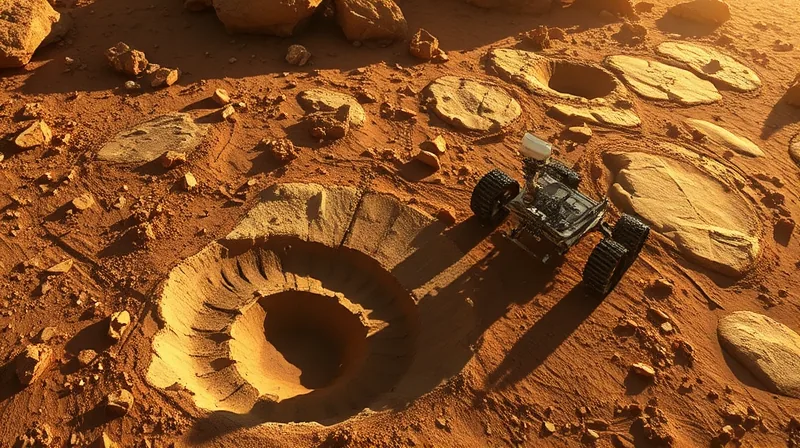
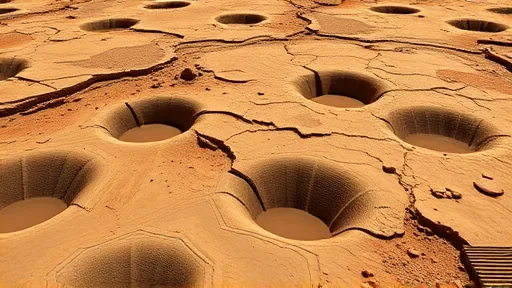
After fourteen years of exploring the Martian surface, the rover Curiosity has encountered a mystery unlike anything in its prior experience. The bedrock in its current workspace is dotted with broad, shallow pits — a feature that challenges the established understanding of how such formations occur. These voids are not entirely new to the mission, but their shape and context defy easy explanation
Typically, pits form when resistant nodules or pebbles weather out of their host rock, leaving behind a void. The pits observed this week, however, are much broader and shallower than those past features. More puzzling still, they are not accompanied by the obvious objects that would have once occupied the space, leaving scientists without a clear culprit for their creation. .
Instruments Uncover a New Puzzle
The Mars Hand Lens Imager (MAHLI) and the Mast Camera (Mastcam) have become the primary instruments for investigating this new enigma. They have acquired stereo mosaics of the pits and tightly overlapping image sets that can be transformed into a digital elevation model. This detailed structural data provides a new puzzle for scientists studying the processes that have affected this particular section of rocks in the stratigraphy of Mount Sharp. .
While the pits presented a novel mystery, the “typical” bedrock in the area proved to be anything but boring. Mastcam imaged and ChemCam rastered across complex packages of layers, revealing changes in texture and structure over short vertical differences. These variations might be evidence of changes in depositional conditions that are captured in close proximity to one another, offering a glimpse into the dynamic history of the region.
The rover’s suite of instruments, including ChemCam, MAHLI, and the Alpha Particle X-Ray Spectrometer (APXS), also analyzed gray, rough, resistant layers that differed from the host bedrock. The distinct appearance of these layers likely indicates a different chemistry, hinting at a unique origin or alteration process. . ChemCam also studied one of the gray float rocks, small, loose pebbles scattered across the workspace, to try to understand the origins of these stones.
Surveying the Surrounding Terrain
The investigation extended far beyond the immediate workspace. The “Cordillera” butte continued to draw significant attention. A comprehensive Mastcam mosaic was created to cover its entire visible face, while more focused ChemCam Remote Micro-Imager (RMI) mosaics were aimed at specific horizons. This detailed imaging helps scientists piece together the geological story written in the butte’s layers.
Further south down “Valle Grande,” the “Tolhuaca” and “Potosí” buttes were also targeted for observation. ChemCam was used to look for potential crossbedding, a sedimentary structure that can reveal information about past wind or water currents. . The instrument also assessed the mineralogy of dark material capping Potosí, a feature that could hold clues to volcanic or other geological activity.
Amid the geological investigations, the environmental science team remained busy. They planned activities for the Rover Environmental Monitoring Station (REMS), Mastcam, and Navigation Camera (Navcam) at a higher-than-usual cadence. This increased activity was in response to a potential regional dust storm, which they monitored closely, finding by the end of the week that the storm appeared to be dissipating.
All of this was accomplished despite the loss of a planning day due to a lost downlink. The findings from this week, detailed by Michelle Minitti, the MAHLI Deputy Principal Investigator, underscore that even after 14 years, Mars continues to surprise and challenge our understanding. The question of what other new tricks this old rover might uncover remains open
Sources
3. Mast Camera
4. ChemCam
5. Alpha Particle X-Ray Spectrometer
6. Rover Environmental Monitoring Station
8. NASA