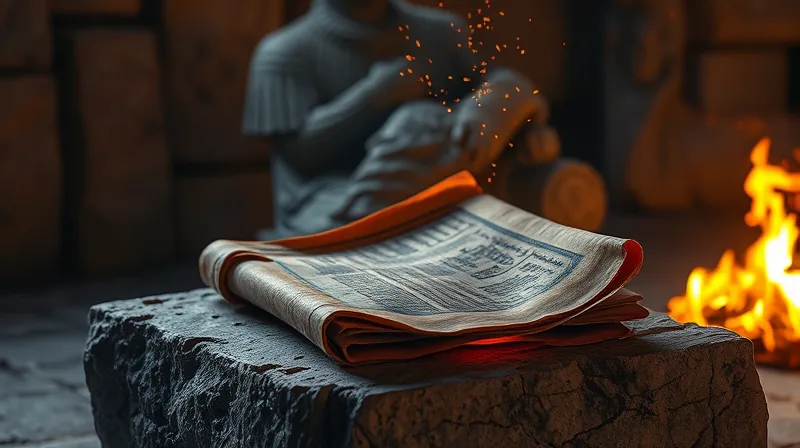
Burning Scrolls to Read Burnt Scrolls
A Bonfire Built to Order
The team behind the Vesuvius scroll project built its own reference library on purpose. [2] Researchers at the University of California, Berkeley, made their own papyrus scrolls, wrote on them with leaded ink, and then burned them. [2] The burning was calibration, not vandalism. A known text inside a known object lets every signal the X-ray instrument picks up be traced back to a cause the team controlled. Without that control group, every bright pixel in a scan of a genuinely ancient scroll would be an unverified guess.
The logic runs against intuition: to read a two-thousand-year-old document, the team first needed a document it was willing to destroy.
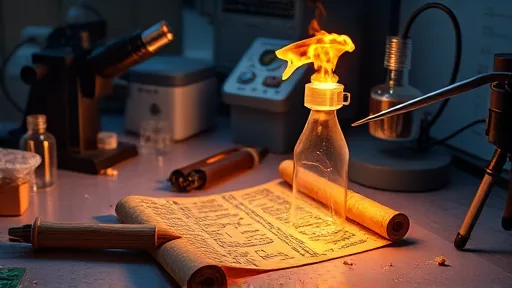
What made the test decisive was the choice of ink. [2] Lead in the ink absorbs X-rays differently from the carbon-based ink used in antiquity, and that single material difference is the hinge on which the whole method turns. The letters do not need to be seen directly; they need to be distinguished from the surrounding papyrus.
The Model That Has to Change
The older model of reading a damaged text assumed physical access to the writing surface. That assumption is now under revision. A rolled, carbonized scroll is not a document waiting to be opened; it is a three-dimensional object whose internal structure can be scanned without moving a single fiber. The scroll stays closed, and the information comes out anyway.
This shifts what counts as a readable source. Under the old frame, a burned scroll was a casualty: physically present, intellectually gone. Under the revised frame, burning may have preserved structure that ordinary decay would have consumed. The very damage that seemed to end the document’s life may be what kept its internal pattern intact for two millennia.
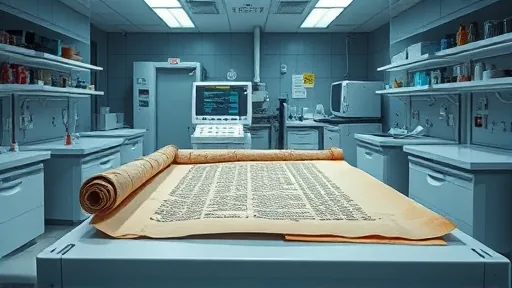
The revision also changes who can do the reading. If the method depends on a controlled reference — a scroll the team burned itself, with ink the team chose — then the technique becomes teachable and checkable rather than a one-off miracle. Other laboratories can build their own reference objects, burn them, and test whether their instruments recover the known text. That is the difference between an anecdote and a method.