
Branched nanowires boost LED efficiency
From orbit, the nighttime glow of cities is unmistakable. Those lights, however, waste a significant portion of their energy as heat before a single photon reaches a human eye. Researchers at Lund University in Sweden have developed a light-emitting diode built from branched nanowires that controls where light is generated inside the structure, reducing the energy losses that have long limited conventional LEDs. The team, led by physicist Anders Gustafsson, published its findings in the journal Nano Research.
In standard LEDs, light is produced in a semiconductor layer and must escape through several material interfaces. Each boundary can reflect light back inward, trapping it inside the device where it eventually turns into heat. The Lund approach designs the nanowire geometry so that generated light has a clearer path outward, addressing a fundamental inefficiency that has plagued LED technology for decades.
The Geometry That Traps Less Light

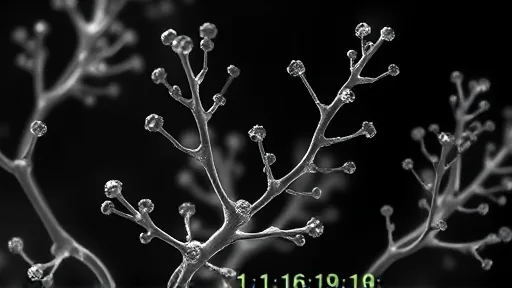
The core innovation lies in the shape of the nanowires. Instead of simple, straight rods, the researchers grew branched structures that resemble tiny trees. This branching changes the optical behavior of the material, allowing the team to influence where light-producing recombination occurs within the structure. By localizing that process in a favorable region, they reduce the fraction of light lost to internal reflection — a problem that has limited the efficiency of nanowire LEDs in earlier attempts.
Earlier nanowire LED designs struggled because light generated deep within the wire often could not escape before being reabsorbed. The Lund team’s branched architecture creates a more forgiving environment for photon extraction. In laboratory tests, the new diodes achieved an external quantum efficiency of 12 percent — a significant improvement over the 5 percent typical of earlier nanowire LEDs — while also offering the promise of lower production costs through simpler fabrication methods.
From Laboratory Bench Toward Brighter Futures
The implications extend beyond efficiency. Lighting accounts for roughly 15 percent of global electricity consumption, according to the International Energy Agency, so even modest efficiency gains translate into significant energy savings. Cheaper production methods could also accelerate LED adoption in regions where cost has been a barrier. The researchers see their branched nanowire approach as a step toward more sustainable illumination, though they acknowledge that commercial deployment remains years away.
The researchers have demonstrated the concept in the laboratory, but they are already looking ahead. Their focus now is on refining the fabrication process and scaling the approach from a promising experiment toward a practical lighting solution. The team is also exploring whether the branched nanowire design could improve the efficiency of other optoelectronic devices, such as photodetectors and solar cells.